

Dubai Airport Confirmation Warning Widens to Both Hubs
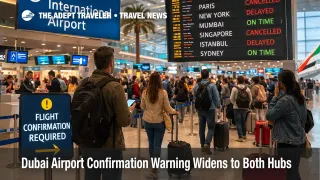
Dubai's airport recovery is still running as a gated restart, not a normal reopening. Dubai Airports says some flights continue to operate from Dubai International Airport (DXB) and Dubai World Central, Al Maktoum International Airport (DWC), but travelers should not go to either airport unless their airline has directly confirmed a departure time, and even confirmed flights can still move again as schedules rebalance. For passengers in the UAE, that means the real decision is no longer whether Dubai is open in a general sense. It is whether your exact flight, and any onward connection, is still real enough to justify the trip to the airport.
This is an update story because the operational rule has widened since Adept's earlier March 7 carrier focused coverage. The question is no longer just what Emirates is doing. It is that Dubai Airports is now applying an airport system level instruction across both Dubai hubs, while the U.K. Foreign, Commonwealth & Development Office, or FCDO, still says travelers should not go to the airport unless the airline has confirmed the reservation and should limit movements to essential journeys only if shelter conditions remain part of the risk picture.
Dubai Airport Confirmation Warning: What Changed
The confirmed change is scope. Dubai Airports now says partial operations continue at both DXB and DWC, but the airport's public advisory is explicit that passengers should not travel to either airport unless they have been contacted directly by their airline and told the flight is confirmed. That moves the guidance beyond one carrier's selective restart and turns it into a system wide airport rule. In practice, that is a much stricter threshold than many travelers use on a normal disruption day, when people often gamble on getting help at the terminal.
The airport's own FAQ makes the rule even tighter. Dubai Airports says schedules may continue to adjust as airlines reposition aircraft and rebalance their global networks, which means an earlier confirmation is not the same thing as a stable departure. A traveler who checked once and then got in the car is still exposed if the flight moves again. That is why this Dubai airport confirmation warning matters now. The airport is not telling people to head in early and sort it out on site. It is telling them to stay away unless the airline has already cleared them to move.
For readers who followed earlier Adept coverage, this is the next stage after Emirates Dubai Restart: Confirmed Flyers Only March 7 and Dubai Airport Flights Halted After March 7 Blast. The story has moved from selective airline restart logic to a broader airport access rule that now governs both Dubai airports, regardless of carrier.
Which Travelers at DXB and DWC Are Actually Cleared to Move
The best fit for airport movement is narrow. It is the traveler with a directly confirmed departure, a reservation that still shows as live in the airline system, and, if connecting, an onward itinerary that also remains protected. That traveler has a credible reason to move, especially if the airline has sent a fresh message rather than relying on an older app status or a booking that has not been revalidated since the latest schedule changes.
Everyone else faces a weaker case for going. That includes passengers on split tickets, travelers waiting on reissue requests, people holding canceled segments while hoping airport staff can fix the trip, and anyone treating a partially operating departures board as proof that their own booking will work. The FCDO's current UAE advice hardens that logic, because it says travel by air should happen only when the airline has confirmed the reservation and says movement should be limited to essential journeys. A speculative airport run is not just inefficient in this environment. It can turn a booking problem into a ground movement problem.
There is also a practical difference in how the two airports are presenting the risk. DXB's main passenger advisory emphasizes direct airline confirmation and the reality that operations are being progressively scaled. DWC's advisory is blunter about the operating condition itself, saying some flights are canceled or delayed because of the temporary partial closure of UAE airspace and telling passengers to check with their airline and not travel to the airport. The operational message is functionally the same, but the framing helps. DXB is being presented as a controlled restart. DWC is being presented as an airport where the cancellation and delay environment remains front and center.
What Travelers Should Do Before Heading to Either Dubai Airport
Start with proof, not optimism. Open the airline app, check the carrier website, look for a direct email, text, or call from the airline, and confirm the exact flight number and departure time again just before leaving. If you are connecting, confirm the whole chain, not just the first sector out of Dubai. A flight that leaves DXB or DWC is not enough if the onward segment has not recovered. On a constrained operating corridor, the wrong partial confirmation can strand you deeper in the trip.
The rebook versus wait decision should also be stricter than normal. Move now only if the airline has directly confirmed your departure and the rest of the itinerary still works. Wait if you are still depending on airport improvisation, same day standby, or a manual fix after arrival. This is one of those cases where going to the airport early does not create optionality. It can remove it, especially if road time, hotel checkout timing, or a renewed local alert leaves you caught landside with no protected solution.
Over the next 24 to 72 hours, the useful signals are simple. Watch whether Dubai Airports softens the no show language, whether your airline expands from reduced to more regular scheduling, and whether official travel advice changes the movement threshold inside the UAE. Until that happens, the smart rule is harsh but clear, if your trip has not been directly validated by the airline, staying put is usually smarter than trying the airport.
Why the Disruption Still Spreads Through Dubai Travel
The mechanism here is straightforward. When a global hub resumes only partially, the airport stops behaving like an open marketplace and starts behaving like a gated recovery point. Aircraft can move, but only in a rationed way, and airlines use that scarce operating space first for passengers whose bookings are already confirmed and reconstructable. That is why Dubai Airports is pushing responsibility back to the airline confirmation stage instead of letting the terminal become a holding pen for uncertain demand.
First order, travelers without direct confirmation risk wasted airport runs, long curbside delays, denied entry to the departure process, or extended time landside while flights continue to move around. Second order, those failed runs spill into hotel extension demand, transfer breakdowns, rebooking pressure, and road congestion around both airports as too many people try to solve the same problem in person. In a city built around smooth hub transfers, a partial restart does not stay contained inside the terminal. It spreads quickly into lodging, ground transport, and onward connection planning.
That is why the Dubai airport confirmation warning is more than a line on an advisory page. It is the operating rule for how Dubai is rationing movement while schedules remain unstable. Until that language changes, the right assumption is not that the airport can fix your trip. It is that the airport wants only travelers whose trip is already fixed enough to move.