

Dubai Airport Warning Now Covers DXB and DWC
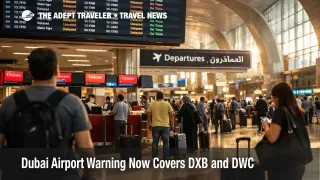
Dubai's operating rule has widened from one airline's restart message to an airport system warning. Dubai Airports says partial operations resumed from March 7 at Dubai International Airport (DXB) and Dubai World Central, Al Maktoum International Airport (DWC), but some flights remain delayed or canceled, and travelers should not go to either airport unless their airline has directly confirmed the flight. That matters now because it shifts the decision point from "Is my carrier flying again?" to "Has the airport operator and my airline actually cleared my specific trip to move?" For many stranded passengers, the safest default is still to stay put until the whole chain is confirmed.
The practical change from earlier coverage is that this is no longer only an Emirates logic problem. Dubai Airports is now applying the same core rule across both Dubai airports, while Emirates is separately running a reduced schedule, accepting transit passengers only when their onward flight is operating, and offering rebooking or refunds for affected bookings in its waiver window. Together, those signals say Dubai is partially functioning, but still tightly rationed by airspace, aircraft positioning, crew flow, and real time airline decisions.
Dubai Airport Warning: What Changed
What changed on March 7 is that the airport system itself, not just Emirates, told travelers to avoid both DXB and DWC unless the airline has contacted them to confirm the flight. Dubai Airports says some flights are operating from both airports, but schedules continue to change. It also says travelers can be turned away if they arrive without airline confirmation, which makes an unverified airport run a real operational failure, not just a wasted gamble.
That is a sharper traveler threshold than a generic "check flight status" message. Dubai Airports also says even previously confirmed flights can keep shifting as airlines reposition aircraft and rebalance global networks. In practice, "confirmed" means more than seeing the flight number still listed online. It means your airline has directly confirmed that your specific booking is active and operating, and for transfer passengers it should also mean the onward segment is still live. Emirates is saying the same thing in carrier specific language, telling customers not to go to the airport unless they hold a confirmed booking, and saying Dubai transit passengers will only be accepted if the connecting flight is operating.
For readers catching up, this moves the story beyond Emirates Dubai Restart: Confirmed Flyers Only March 7. The operating gate is now airport wide, and it covers both DXB and DWC, not only one carrier's afternoon restart logic.
Which Dubai Travelers Face the Most Risk
The most exposed group is passengers who have a booking number, but no direct airline contact confirming that the flight is operating. They are the people most likely to lose time and money on a failed airport trip, especially if they are relying on hotel checkout timing, prepaid transfers, or onward flights from another city. The same risk applies to travelers who see a flight showing as scheduled but have not been cleared by the carrier, because Dubai Airports is explicit that schedules remain fluid.
Transit passengers are also exposed, because partial resumptions do not restore a hub evenly. A first leg can restart before an onward sector does, or the onward sector can operate with different timing than originally ticketed. Emirates is already treating this as a chain problem, not a single segment problem, by accepting Dubai transit passengers only if their connection is also operating. That matters well beyond Emirates because the same hub math affects interline travelers, hotel stopovers, and anyone trying to use Dubai as a bridge between Europe, Asia, and Africa while the regional system is still constrained.
The ground side risk is still real, too. The U.K. government's current United Arab Emirates advice tells travelers to limit movements to essential journeys, prefer daylight movement when travel is unavoidable, and shelter if warnings are issued. That means an unnecessary airport attempt is not just inefficient, it may cut against the broader operating logic now in place inside the UAE. Travelers already using UAE Shelter In Place Rules Reshape Exit Planning should now read that advice together with the airport warning, not as separate issues.
What Travelers Should Do Before Heading to DXB or DWC
The immediate move is simple. Do not leave for DXB or DWC unless your airline has directly confirmed the flight, and if you are connecting through Dubai, do not move unless the onward segment is also confirmed. For many travelers, staying in the hotel one more cycle beats burning transport money and hours on an airport run that ends at the curb or check in desk.
The main decision threshold is whether you have a full operating chain or only partial hope. Go to the airport if the airline has contacted you, the booking is live, the flight is operating, and your transfer or onward plan still works. Wait if you are still relying on a general schedule display, a stale booking email, or a partially restored route map. Emirates is also offering rebooking on alternate flights for affected travelers through April 30, 2026, or refunds for eligible bookings, which may be better than forcing a same day airport attempt in a constrained system.
Over the next 24 to 72 hours, watch for three things. First, whether Dubai Airports starts publishing more stable operating language for DXB and DWC. Second, whether your airline shifts from case by case confirmation to normal check in instructions. Third, whether the UAE movement environment loosens enough that airport trips become routine again instead of exception based. Until those signals change, the Dubai airport warning should be treated as an active traveler filter, not as boilerplate.
Why Dubai Is Open, but Still Not Normal
The system is partially open because airspace has reopened enough for limited movements, but the hub is not normal because restoration is being managed flight by flight. Dubai Airports says priority is being given to departures, and flight movements are being gradually increased based on capacity and airspace availability. It also says airlines decide which flights operate based on aircraft positioning, crew availability, and available airspace. That is why two passengers heading to the same airport on the same day can face completely different outcomes.
This is also why DXB and DWC should be separated in traveler thinking, even though the advisory currently applies to both. Dubai Airports has confirmed partial operations at each airport, but it has not published a clean, airport by airport operating split that would let travelers assume one is broadly more reliable than the other. Until it does, the safer reading is that both airports are live in a limited way, and both remain governed by airline confirmation rather than normal airport routine.
The first order effect is obvious, some passengers can fly again. The second order effects are what break trips: road congestion from speculative airport runs, hotel extensions when travelers miss the real operating window, tighter seat pressure as carriers ration scarce slots, and more transfer failures across a hub that is functioning below normal depth. That is the real meaning of the current Dubai airport warning. Dubai is no longer shut in the simple sense, but it is not safely usable on assumption.
Sources
- Passenger Advisory, Dubai Airports
- Dubai Airports issues operational updates following temporary airspace measure, Dubai Airports
- Travel updates, Emirates
- United Arab Emirates travel advice, UK Government
- Emirates Dubai Restart: Confirmed Flyers Only March 7, Adept Traveler
- UAE Shelter In Place Rules Reshape Exit Planning, Adept Traveler