

Saudi Travel Advice: Riyadh, Eastern Province Risk
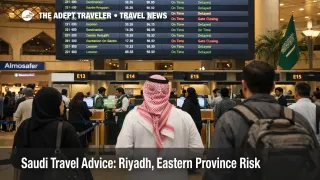
Saudi travel advice now creates a split decision for travelers, because Saudi Arabia remains commercially reachable and exit options are still broadly available, but the U.K. Foreign, Commonwealth & Development Office says Riyadh Province and the Eastern Province are under an all but essential travel warning and tells British nationals to stay inside and be ready to shelter due to continued missile and drone risk, including falling shrapnel from interceptions. The practical change since Adept's March 7 coverage is not a new closure headline. It is that Saudi now sits in the middle tier of the regional map, still usable by air, but less predictably usable on the ground for meetings, transfers, and same day airport runs. Travelers considering Riyadh or Dammam as a reroute, staging point, or onward departure market should treat shelter risk, airport access timing, and hotel readiness as part of the booking decision, not as background noise.
Saudi travel advice matters here because the official message now pulls in two directions at once. FCDO says commercial travel options remain widely available despite limited disruption and temporary airspace closures, but it also says travel within or out of Saudi Arabia is at the traveler's own risk and warns people to keep a personal emergency plan that does not depend on U.K. government support.
Saudi Travel Advice: What Changed for Travelers
What changed is operational emphasis, not simple availability. As of March 8, 2026, FCDO says its Saudi Arabia page was updated on March 6 to add information about continued missile and drone attacks in Riyadh Province and the Eastern Province, plus the risk of shrapnel from intercepted strikes. The same page tells British nationals in Saudi Arabia to stay inside, exercise increased caution, and take hard cover in an interior stairwell or room with as few outside walls or windows as possible if advised to shelter.
That means Saudi is no longer just a market where travelers ask, "Are flights operating?" It is now a market where they also need to ask whether the trip requires dependable surface movement between airport, hotel, office, and any secondary stop. King Khalid International Airport in Riyadh has told passengers bound for destinations affected by current regional developments to check directly with airlines before heading to the airport, which reinforces the point that a bookable seat is not the same thing as a friction free airport run.
The commercial side is still materially better than in several neighboring markets. FCDO says commercial travel options remain widely available, and U.S. Mission guidance from March 4 said Saudi airspace remained open and Riyadh, Jeddah, and Dammam airports continued operating international flights, even as wider regional aviation risk remained elevated. Even so, Reuters reported on March 6 that a Lufthansa flight to Riyadh had to divert to Cairo because of a temporary closure of the airspace above Riyadh, which shows how quickly the operating picture can still shift.
Which Travelers Should Still Use Saudi, and Who Should Not
Saudi still fits some travelers, but not all of them. It makes the most sense for people who already have a confirmed, near term flight plan, a hotel with strong security procedures, flexible corporate approval, and a simple airport to hotel to airport pattern. It is also more defensible for travelers using Jeddah as a less exposed western gateway than for those whose plans depend on Riyadh or the Eastern Province, where the FCDO warning is more direct.
The weakest fit is anyone trying to use Riyadh or Dammam as a "figure it out after landing" fallback. That includes travelers chasing speculative rebooking options, people with tight same day onward connections, families carrying medication or children who would struggle with extended shelter periods, and business travelers whose trip depends on multiple in city meetings. First order, they may still get in or out by air. Second order, they can lose the trip on the ground through delayed airport access, hotel lockdown behavior, corporate duty of care limits, or last minute flight timing changes. That is the real distinction between commercially possible and operationally dependable.
Saudi also works differently as a transit versus staging market. As a pure transit market, the case is stronger if you already hold a confirmed ticket and can keep dwell time short. As a staging market, where you may need one or more nights, local transport, or flexible departure timing, the risk profile gets worse because you are relying on stable ground movement and consistent operating conditions, not just on whether the airport is technically open.
What Travelers Should Do Before Using Saudi as Transit
Travelers should treat Saudi as a controlled option, not an easy one. Before departure, confirm the flight directly with the airline, not just through an online agency or app, and verify whether your hotel has internal shelter procedures, food backup, and transport support. If the trip touches Riyadh Province or the Eastern Province, assume that shelter guidance may interrupt your movement window and build that into transfer timing.
The main decision threshold is simple. Use Saudi as transit if your route is confirmed, your ground chain is short, your purpose is essential, and you can absorb a sudden overnight or missed meeting. Avoid using Saudi as a staging base if your plan depends on multiple road movements, uncertain airport access, or an onward itinerary that collapses if one leg slips by a few hours. Travelers who mainly need a safe holding point while they hunt for a later exit should be skeptical of Saudi for that role right now, especially in Riyadh or the Eastern Province.
Over the next 24 to 72 hours, watch for three things. First, any fresh official advisory change from FCDO or your own government. Second, airport and airline instructions that narrow when you should head to the terminal. Third, signs that carriers are still having to reroute, divert, or suspend individual Saudi services even while the broader market stays open. If those signals worsen, the correct move shifts from "transit only" toward "avoid unless essential."
Why Saudi Is Open by Air but Less Predictable on the Ground
The mechanism is regional, but the traveler consequence is local. Saudi airspace and airports are not shut in the way some nearby markets have been, which is why commercial options remain available. But the same regional escalation that leaves the airport system partially functioning also creates on the ground uncertainty through missile alerts, intercepted drones, falling debris risk, and short notice operating changes. That is why Saudi now behaves like a live but conditional market, not a normal one.
This is also why "airport open" is the wrong shortcut. A traveler can lose the itinerary before check in by getting trapped in hotel sheltering, delayed on airport access roads, or caught in airline timing changes that only become clear close to departure. Riyadh airport's own advice to check directly with airlines before heading out is a practical sign of that fragility. The first order effect is a less predictable airport run. The second order effect is more overnight hotel demand, more cautious corporate approvals, and a shift in reroute demand toward gateways that feel less exposed on the ground.
For the broader Middle East stack, Saudi therefore sits between full disruption and usable normality. It is more commercially available than several neighbors, but its value as a reroute or staging market is constrained by province level risk and by the fact that air access can remain open while local operating confidence falls. Travelers who need certainty should not confuse those two things.
Sources
- Saudi Arabia Travel Advice, GOV.UK
- Riyadh Airport Urges Passengers to Check Flight Status, Saudi Gazette
- Lufthansa Flight to Riyadh Diverted to Cairo for Safety Reasons, CEO Says, Reuters
- Travel Advisory: Saudi Arabia, U.S. Embassy and Consulates in Saudi Arabia
- Saudi Travel Advice Adds Shrapnel, Shelter Rules
- Middle East Airspace Reopens, Closures Stay Fluid
- Arabia, Travel News and Guides from The Adept Traveler