

Saudi Travel Advice Adds Shrapnel, Shelter Rules
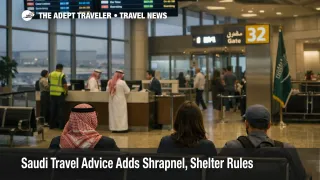
Saudi travel advice changed on March 6, 2026, when the U.K. Foreign, Commonwealth & Development Office, or FCDO, added explicit warnings about continued missile and drone attacks in Eastern Province and Riyadh Province, including the risk of falling shrapnel from interceptions. The same page now tells British nationals in Saudi Arabia to stay inside, exercise increased caution, and be ready to shelter if advised. That matters because Saudi Arabia is no longer just a nearby reroute idea in Gulf disruption planning. It is now a market where commercial departures may still exist, but where the ground risk and movement decision have become part of the travel equation.
The practical shift is that Saudi travel advice now combines two messages that pull in different directions. FCDO says commercial travel options remain widely available despite limited disruption and temporary airspace closures, but it also says travel within or out of Saudi Arabia is at the traveler's own risk, warns that insurance could be invalidated if you travel against advice, and tells people to keep a personal emergency plan that does not depend on U.K. government support.
Saudi Travel Advice: What Changed
The new element is not simply that Saudi Arabia is in a tense region. It is that the March 6 update makes sheltering, shrapnel risk, and movement restraint part of the formal traveler guidance for two important provinces, Eastern Province and Riyadh Province, both now under an "all but essential travel" warning from FCDO. The page also says regional escalation has already led to travel disruption and tells travelers to stay away from areas around security or military facilities.
That is a meaningful change from treating Saudi Arabia as a passive fallback. Riyadh and the Eastern Province include major business demand, onward connections, and practical entry points for travelers trying to rebook, reroute, or keep meetings alive. Once the advisory tells people to stay inside and prepare to shelter, the question is no longer just whether a seat exists. The question becomes whether the full journey from hotel to airport, border post, or meeting site is still worth attempting under that risk profile.
The Saudi page is also unusually clear about the contradiction travelers now have to manage. Commercial options remain available, but the same guidance says to check airline updates, local authority instructions, and border status before moving, keep emergency supplies and medication accessible, and be prepared to change plans quickly. That is not a normal travel disruption advisory. It is a limited usability advisory.
Which Travelers Should Rethink Saudi Plans
The clearest group that should reassess fast is optional travel into Riyadh Province or the Eastern Province. If a meeting can move online, if a connection can be rebuilt through a lower risk hub, or if a short Gulf stop was mainly about convenience, the advisory has changed the burden of proof. Travelers are now being told that no travel can be guaranteed safe, and that insurance may not respond normally if they proceed against official advice.
Business travelers and corporate travel managers face a more mixed decision. A trip can still be technically possible while becoming harder to approve internally. In practice, an "all but essential travel" label often triggers legal, duty of care, and insurer reviews even before an airline cancels anything. That is similar to the logic already showing up elsewhere in the region, including Kuwait Advisory Raised, FCDO Says Essential Only and Bahrain Road Exit Planning Gets Real for Travelers, where the formal advisory level changed the decision tree before the transport network fully shut down.
Travelers already inside Saudi Arabia face a different problem. Their decision is not whether to start the trip, but whether staying put is safer than moving. FCDO's own wording leans toward caution. It says to stay inside, to take hard cover if advised to shelter, and to follow local authority guidance because risks may vary across the country. That makes Saudi Arabia usable in narrow cases, but it does not make it predictably workable on the ground.
What Travelers Should Do Before Moving
Start with the purpose of the trip, not the flight search. If your travel into Riyadh or the Eastern Province is discretionary, postponing is usually the cleaner decision because the advisory has already crossed from generic caution into specific shelter guidance. If you are already in Saudi Arabia and considering departure, confirm the entire chain before checkout, airline status, airport access, border conditions if relevant, onward entry permission, and whether your insurer still covers the plan you are about to attempt.
For travelers who still need to move, the threshold should be high. Keep the trip only when the flight is confirmed, the reason for travel is genuinely hard to defer, and you can tolerate an extra hotel night, a shelter period, or a last minute interruption without breaking the trip. Drop same day improvisation. The advisory itself says to keep departure plans under review, maintain access to essential medication and emergency supplies, and stay ready to change plans quickly.
Travelers looking at Saudi Arabia as a workaround for wider Gulf disruption should also compare it against cleaner alternatives rather than assuming "open" means "better." In some cases, Amman Exit Flights Make Jordan a Cleaner Exit Point may offer a simpler commercial exit logic. In others, Saudi may still beat a more unstable Gulf hub, but only when the ground move, airport access, and onward booking are all already solved.
Why Saudi Still Works, and Why It Can Still Fail
The mechanism here is straightforward. Saudi Arabia can still function commercially while becoming less dependable operationally. FCDO explicitly says commercial travel remains widely available, but it also says regional escalation has caused travel disruption and that local risks vary. That means the first order problem is not necessarily a canceled flight. It may be the inability to move comfortably between hotel, workplace, airport, or border when alerts, shelter instructions, or security avoidance rules intervene.
The second order effects are where travelers get caught. Once movement becomes conditional, airport runs need more buffer, hotel stays become harder to time, and corporate approvals become easier to pull at the last minute. FCDO's regional risks page adds that attacks have targeted aviation and oil infrastructure, that authorities can temporarily close airports near the Saudi Arabia, Yemen border, and that attacks have also been made on other locations in the country, including Riyadh and Jeddah. That does not mean Saudi Arabia is closed. It means the usable parts of the system can narrow faster than a timetable suggests.
That is the right way to read the Saudi update. This is not a full stop market, but it is no longer a low friction neighboring option either. Saudi travel advice now describes a country where some trips can still work, but only if the traveler treats sheltering, shrapnel risk, airport access, and backup planning as core parts of the itinerary rather than edge cases.