

UAE Government Flight Registration Reshapes Exits
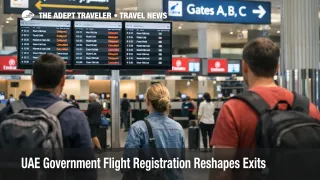
The United Kingdom has turned the UAE advisory into more than a shelter and movement management warning, because the Foreign, Commonwealth & Development Office, or FCDO, now tells disrupted British travelers they can register interest in UK government flights from the United Arab Emirates. That is the real change from Adept's March 7 coverage. The UAE is still under an FCDO warning against all but essential travel, and the same live advisory still tells people to shelter if local authorities direct them to do so, limit exposure around sensitive sites, and treat regional escalation as a live security risk. For stranded travelers, the immediate decision is no longer only whether commercial flights are real enough to chase, but whether to enter a government managed queue while staying put unless a confirmed departure chain justifies movement. The nut of this update is simple: UAE government flight registration adds a second exit path for eligible British nationals, but it does not turn a fragile commercial recovery into a normal travel environment.
UAE Government Flight Registration: What Changed
What changed on March 7 is not the security backdrop, it is the exit logic. The FCDO's UAE advice now includes a dedicated section telling travelers with disrupted plans that they can register interest in UK government flights from the UAE. The linked registration page says the service is for British nationals, requires a valid UK passport, and will be used to send important updates about booking for flights. That matters because it creates a state backed channel for people who no longer want to rely entirely on unstable airline inventory out of Dubai or Abu Dhabi.
Just as important, the new option sits on top of the older restrictions, it does not replace them. The same FCDO page remains current as of March 8, 2026, keeps the UAE under an all but essential travel warning, warns that insurance could be invalidated by travel against advice, and still tells travelers to follow local authority instructions and shelter indoors if told to do so. In practice, the advisory is no longer only about personal safety behavior. It is now also about sequencing an exit plan under state guidance rather than improvising around every rumored seat release.
Which Travelers Should Register, and Which Should Still Lean Commercial
The strongest fit for registration is the stranded British national whose trip has already broken in a meaningful way. That includes travelers without a usable confirmed departure, travelers on split tickets whose onward chain no longer works, and travelers whose hotel, visa, or transfer clock is running down while commercial schedules remain unstable. For that group, joining the registration system makes sense because it creates a second line of communication beyond carrier email, app alerts, or airport rumor. The FCDO and the Prime Minister's March 5 remarks both frame this as part of a wider regional support effort tied to direct updates for British nationals.
The weaker fit is the traveler who already holds a clean, confirmed departure from Dubai International Airport (DXB) or Zayed International Airport (AUH) on one protected booking and can reach the airport only when the airline says to move. That traveler should not assume registration is a faster substitute for a real ticket already in hand. The registration page promises updates about booking, but it does not say that signing up guarantees a seat, a departure date, or priority over other passengers. That means the commercial track still wins when the entire itinerary is confirmed and operational. The registration track becomes more valuable as soon as the commercial chain turns speculative.
This is the main difference from UAE Shelter In Place Rules Reshape Exit Planning. Yesterday's problem was whether movement itself was justified. Today's problem is whether eligible travelers should add themselves to a government assisted queue while that movement threshold remains high. Emirates Dubai Restart: Confirmed Flyers Only March 7 is still relevant because it shows the commercial side of the same rule set, only move when the booking is real.
What Travelers Should Do Now
British nationals in the UAE whose travel is materially disrupted should register promptly, then treat that as a communication and booking readiness step, not as a green light to head for the airport. The registration page asks for a valid UK passport, a reachable email address, and a reachable mobile number. If you cannot use the online form, it provides a U.K. government phone number. The practical point is to make yourself visible to the system while remaining physically conservative on the ground.
Travelers with a confirmed airline departure should keep working the commercial path first, but they should do it with a harder threshold than under normal irregular operations. Recheck the exact flight, confirm onward segments if you are connecting, and move only when the carrier has actually confirmed the departure window. Registration may still be sensible as a backup if the rest of the itinerary is weak, but it should not lure someone into abandoning a protected seat for a process that, at least publicly, is framed as interest registration and flight booking updates, not a guaranteed extraction.
Over the next 24 to 72 hours, watch for three things. First, whether the FCDO changes the wording again, either toward firmer departure guidance or a more explicit government flight rollout. Second, whether carriers in Dubai and Abu Dhabi publish wider confirmed schedules that reduce the value of the government channel for some travelers. Third, whether hotel extension pressure and airport transfer scarcity worsen as more stranded passengers stop chasing speculative inventory and wait for either a confirmed commercial slot or a government booking update.
Why the UAE Exit Decision Tree Just Changed
The mechanism is straightforward. Before this update, the traveler decision inside the UAE was mostly binary: shelter in place, or move only for a clearly justified commercial exit. The new registration option adds a middle state. A stranded British traveler can now stay physically conservative while still taking an active step toward departure. That matters because it reduces the pressure to convert every partial airline restart into an airport run.
First order, some travelers now have a second exit track beyond commercial airline inventory. Second order, that changes the economics of waiting. People who know they are in a government contact and update system may be more willing to keep a hotel room one more night, skip a risky cross city transfer, or stop burning money on speculative reissues that still do not solve the whole itinerary. It also means airport congestion pressure can shift, because fewer people may self deploy to terminals without a confirmed path, while demand for hotel extensions and controlled ground transport can remain elevated.
The important limit is that this is still not a normal evacuation notice and not a normal flight market. The government is asking British nationals to register, and the UAE advice now offers a dedicated interest form for flights, but the same live advisory still treats the country as a place where only essential travel is advised and shelter instructions may still matter. For travelers, the best reading is disciplined, not optimistic: register if eligible and disrupted, hold onto any real commercial booking you already have, and do not let a new exit channel trick you into unnecessary movement before the departure path is actually confirmed.
Sources
- United Arab Emirates Travel Advice, GOV.UK
- Register Your Interest in UK Government Flights from United Arab Emirates, Register Your Presence Abroad
- PM Remarks on the Situation in the Middle East, March 5, 2026, GOV.UK
- Prime Minister's Oral Statement on Iran, March 2, 2026, GOV.UK
- UAE Shelter In Place Rules Reshape Exit Planning
- Emirates Dubai Restart: Confirmed Flyers Only March 7