

Bahrain Visa Extension Update Reshapes Exit Timing
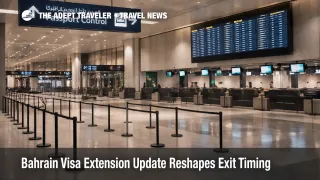
Bahrain's March 8 advisory update matters because it adds something travelers can actually use, not just another warning headline. The U.K. Foreign, Commonwealth & Development Office, or FCDO, says Bahrain remains under an "all but essential travel" warning, but it also added new information on extending visas, public gatherings, and security sites and incidents. That changes the decision for people who expected to transit out quickly and now may need extra hotel nights, a visa extension, or a faster exit plan instead.
The practical shift since earlier Bahrain coverage is this. Travelers are no longer only judging whether Bahrain is safer than the next Gulf option, they also need to judge whether they can remain legally, move carefully, and avoid creating a new problem while waiting. FCDO now says travelers should keep departure plans under review, ensure onward visas are valid, and consider departing if their presence is not essential and they can do so safely.
Bahrain Visa Extension: What Changed
The new traveler facing detail sits in Bahrain's entry rules. FCDO now says visitors can apply to renew a visa through the Nationality, Passports and Residence Affairs department, while warning that overstaying can bring penalties, legal problems, or later visa complications. Bahrain's official eVisa system also points users to formal visa extension services, and Bahrain's service directory shows extensions for several visit eVisa types with listed processing times of one working day for some categories.
That does not mean every stranded traveler should immediately extend and stay put. It means Bahrain has become a more structured waiting room than a few days ago, but only if your visa type is extendable, your onward documents still work, and your hotel and airport chain remain credible. The legal risk now starts earlier than many travelers assume. Once a short stay slips toward overstay territory, the problem is no longer only regional instability, it is immigration compliance inside Bahrain itself.
Which Travelers Face the Hardest Bahrain Choice
The people who need to think hardest about visa timing are not ordinary short break visitors. They are stranded regional travelers, business travelers using Manama, Bahrain as a temporary base, and anyone whose onward trip depends on a later commercial seat, a road move into Saudi Arabia, or a separate ticket out of another Gulf hub. FCDO explicitly says that if travelers plan to leave Bahrain by road, they must also satisfy Saudi Arabia's entry rules, and if they drive, the vehicle must be wholly owned and registered in their name.
Public gathering guidance also matters more in practice than it sounds on paper. FCDO says demonstrations and protests can cause traffic disruption, roadblocks, and localized clashes, and that public gatherings on roads or in public squares are temporarily banned to protect public safety. It specifically says travelers should leave the area if they see a large public gathering or demonstration, stay alert for diversions, and expect checkpoints on major roads. For travelers, that means a hotel near a nightlife or protest sensitive area is now less useful than one with a clean airport run and flexible checkout.
The security sites language is even more operational. FCDO says travelers should stay away from security or military facilities, and Bahrain's safety guidance now says filming, photographing, publishing, or redistributing images of security and military sites, operations, or incidents is prohibited, with arrest and prosecution risk for violations. In plain language, that means this is not a place to document alerts, fragments, police activity, or military movements for social media while you are waiting for a flight.
What Travelers Should Do Now
Start with visa status, not flight search. If your current stay could run longer than planned, check whether your visa category can be extended and do it before overstay risk becomes part of the problem. Then confirm whether your onward destination also needs a visa or fresh entry clearance, because FCDO now explicitly ties Bahrain departure planning to having valid documents for the next stop.
The next threshold is whether Bahrain is still serving as a useful waiting room. Bahrain still has one practical advantage over some nearby Gulf options this week, it now offers clearer visa extension logic than the more purely security focused FCDO updates for Qatar and Saudi Arabia. But it looks weaker than an exit platform if your plan depends on road travel into Saudi Arabia, because Saudi remains under tougher geographic warnings, including all but essential travel advice for Eastern Province and Riyadh Province, plus shelter and shrapnel guidance. Bahrain also looks less robust than a simple stay put plan in the UAE if you already have a government managed or confirmed departure channel there.
So the decision rule is straightforward. Stay in Bahrain only if you can remain legally, avoid protest and security sensitive areas, and hold a realistic onward chain. Leave sooner if your visa is short, your hotel location creates movement risk, your departure depends on a road crossing into Saudi Arabia, or your next ticket is still speculative. Travelers wanting the earlier overland logic can review Bahrain Road Exit Planning Gets Real for Travelers, while those comparing alternate Gulf fallback channels should also read UAE Oman Border Crossings Offer Overland Exit.
Why Bahrain's Role Changed This Week
The mechanism here is simple. Earlier in the Gulf disruption cycle, Bahrain's value came mainly from geography, close to Saudi Arabia, connected to regional airspace, and small enough to use as a temporary hold point. The March 8 update changes that by moving Bahrain from a generic caution story into a rules and compliance story. Once official guidance starts spelling out visa renewal, protest avoidance, and security site restrictions, the traveler calculation becomes less about whether a seat appears tomorrow and more about whether the full waiting strategy still holds together.
That is why Bahrain now sits in an awkward middle position among Gulf fallback options. It is not as operationally weak as a market where no lawful or documented waiting path is obvious, because Bahrain now does give stranded visitors a clearer extension route. But it is not a clean normal hub either, because the advisory still says travel within or out of Bahrain is at your own risk, regional escalation has caused disruption, some embassy staff and dependents were temporarily withdrawn, and travelers should limit movement to essential journeys only if they remain in country. Bahrain still works for some people this week, but only as a controlled pause, not as a casual place to wait and see.
Sources
- Bahrain Travel Advice, GOV.UK
- Bahrain Entry Requirements, GOV.UK
- Bahrain Safety and Security, GOV.UK
- Bahrain Electronic Visa Service
- Visa Services, Kingdom of Bahrain
- Extension of a Visit eVisa for Two Weeks (Single Entry), Kingdom of Bahrain
- Requests and Visa Management, Kingdom of Bahrain
- United Arab Emirates Travel Advice, GOV.UK
- Saudi Arabia Travel Advice, GOV.UK
- Qatar Travel Advice, GOV.UK
- Bahrain Road Exit Planning Gets Real for Travelers
- UAE Oman Border Crossings Offer Overland Exit