

Israel Exit Options Update Adds Taba Bus Route
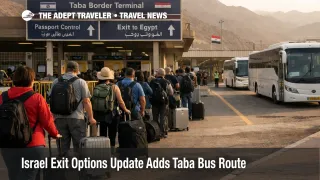
Israel exit options update became more actionable on Monday, March 9, after the U.S. Embassy in Jerusalem sharpened its guidance for Americans stranded in the country. The practical shift is not that Israel suddenly became easy to leave, it did not. The shift is that the embassy is now steering travelers toward a clearer decision tree: register through the State Department crisis intake form, check limited commercial flights from Ben Gurion Airport (TLV), or use the Taba land crossing into Egypt, where the embassy is offering bus service for eligible U.S. citizens.
The broader advisory backdrop has not improved. The U.S. travel advisory dated February 27, 2026 says Americans should reconsider travel to Israel and the West Bank, while Gaza and several border areas remain under do not travel warnings. That same advisory says the Department of State authorized the departure of non emergency U.S. government personnel and family members from Mission Israel on February 27, and it tells U.S. citizens to complete the crisis intake form if they are seeking assistance.
Israel Exit Options Update: What Changed
What changed on March 9 is precision. The embassy's latest update says Ben Gurion Airport is open for limited commercial flights, with approved operations by El Al, Israir, Arkia, and Air Haifa, and it also says the Department of State is organizing limited assistance flights for travelers who have registered through the crisis intake form. Separately, the embassy says the Taba land crossing into Egypt is operating and scheduled to be open 24 hours a day.
The other meaningful change is that the overland option is no longer just a vague fallback. The embassy says it is offering bus service to Taba for U.S. citizens in need of assistance departing Israel, with travelers told to contact the embassy and complete an online form to receive reservation details, departure time, and a rally point. That matters because it turns a difficult self arranged border run into a more structured path, even if onward travel still depends on seat availability and border processing.
This also builds on an earlier pattern rather than replacing it. Reuters reported that Israeli airlines had already begun gradually increasing service at Ben Gurion, though under tight operating constraints, while Israir and Arkia were also running repatriation style services via Taba and Aqaba. In other words, March 9 is less a reopening story than a managed, limited exit story.
Which Travelers Have the Best Chance of Leaving
Travelers already registered with the State Department and those who can move quickly with cash in hand are in the strongest position. The embassy says travelers heading through Taba should carry at least $85.00 (USD) in cash per person, because ATMs at the crossing are often not reliable. It also says travelers going beyond South Sinai need a 30 day Egyptian visa on arrival for $30.00 (USD) in cash, plus $20.00 (USD) for a required letter of guarantee and $35.00 (USD) for the Taba border exit fee.
The Taba route fits some travelers better than others. It works best for people who can tolerate a multi step exit chain, border crossing, ground transfer, then onward flight from Sharm el Sheikh or another Egyptian gateway. The embassy and OSAC guidance both point travelers to Arkia and TUS for flight information tied to this route, and note that travelers may obtain a free entry stamp at Taba for South Sinai only, but that stamp does not authorize onward travel to Cairo or other Egyptian governorates.
By contrast, travelers who need the simplest possible itinerary, older passengers, families with heavy baggage, or anyone uncomfortable with border formalities may still prefer to wait for a workable Ben Gurion departure if one is available. The tradeoff is straightforward, the airport option is cleaner when it works, but the land exit may be faster to secure when flight inventory remains thin.
What Travelers Should Do Now
The first move is administrative, not physical. Americans who want U.S. help should complete the crisis intake form once, and not submit duplicates, because that is how the State Department is prioritizing updates on assistance flights and ground transportation. The advisory also says Americans should remain vigilant, know where the nearest hardened shelter is, and use the Home Front Command alert app or similar official tools for real time warnings.
The next decision threshold is whether you have a credible same day or next day exit chain. Rebook through Ben Gurion if you can secure an actual seat on one of the limited carriers and can reach the airport safely. Use the Taba option if you can meet the embassy's cash and document requirements, can tolerate a land crossing, and have a realistic onward plan from Egypt. Wait in place only if neither option is workable, or if local security conditions make movement riskier than sheltering.
Travelers should also be careful with numbers circulating about the wider evacuation picture. The best supported public figure is that the State Department said about 27,000 Americans had safely returned to the United States from the Middle East by Friday, March 6, with most making their own way out. I could not verify a reliable official estimate for how many travelers remain stranded in Israel specifically, so broad regional stranded totals should be treated cautiously unless governments publish them directly.
Why the Disruption Still Spreads Beyond One Border Crossing
The mechanism here is simple. Even when one airport reopens partially and one land border stays open, travelers still need the whole chain to function. A seat out of Tel Aviv is useless if inventory is rationed or airport throughput remains restricted. A bus to Taba helps, but only if the border is processing, the cash rules are met, and onward flights from Egypt remain available. That is why limited reopening can still feel like a bottleneck, not a recovery.
The second order effects are what make this update travel relevant beyond Israel itself. As travelers shift to Egypt, Jordan, and other fallback exits, pressure rises on hotels, transfers, and short notice air seats outside the original disruption zone. Adept Traveler has already tracked similar spillover in related Middle East coverage, including Jordan River Crossing Hours Tighten Through March 18, Saudi Travel Advice Adds Shrapnel, Shelter Rules, and the guide Egypt Tourist Entry Requirements For 2026, which becomes more useful when Egypt turns from destination to escape route.
For now, the March 9 message is clear. Israel exit options update is no longer just about waiting for normal flights to return. It is about choosing the least fragile path out, then making sure every step after that first move is actually in place.
Sources
- Security Alert: U.S. Embassy Jerusalem, March 9, 2026, Update 1
- Security Alert: U.S. Embassy Jerusalem, March 9, 2026, Update 2
- Israel, the West Bank and Gaza Travel Advisory, U.S. Department of State
- Travel Advisory Update, February 27, 2026, U.S. Embassy Jerusalem
- Israeli airlines to increase flights to Tel Aviv this week, Reuters
- More than 20,000 Israelis return since start of Iran war, ministry says, Reuters
- Home Front Command App, Google Play
- Download the Home Front Command App