

Türkiye Adana Shutdown Raises Southeast Travel Risk
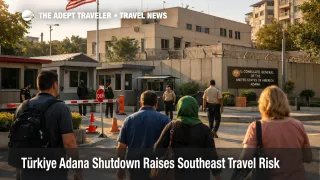
Southeast Türkiye travel risk is no longer just a regional warning story. On March 9, 2026, the U.S. State Department said it ordered non emergency personnel and family members to leave Consulate General Adana, suspended all consular services there, and strongly encouraged Americans in southeast Türkiye to depart now. That is the meaningful change from earlier Türkiye coverage, because the problem is no longer mainly flight spillover from the wider Middle East crisis. It is now a direct support downgrade on the ground in Adana, with practical consequences for travelers in the southeast who may need help, flexibility, or a fast exit. Travelers with optional plans in the region should reassess immediately, and travelers already there should shift from normal trip management to departure planning.
The advisory itself did not raise Türkiye's nationwide level beyond Level 2, Exercise Increased Caution, but the southeast remains a Level 4, Do Not Travel zone within that broader framework. The updated advisory says southeast Türkiye includes Adana, Adiyaman, Batman, Bingol, Bitlis, Diyarbakir, Elazig, Gaziantep, Hakkari, Hatay, Icel, Kilis, Kahramanmaras, Malatya, Mardin, Mus, Osmaniye, Siirt, Sanliurfa, Sirnak, Tunceli, and Van. That matters because many travelers will hear "Adana" and assume the issue is only the consular district or the city itself. It is wider than that, and the State Department is explicitly tying the consular drawdown to safety risks across the southeast.
Southeast Türkiye Travel Risk: What Changed
What changed on March 9 is operational, not cosmetic. The State Department says Americans in southeast Türkiye are now strongly encouraged to depart, and the U.S. Consulate in Adana is no longer providing consular services. In practice, that strips away the nearest U.S. mission point for routine and emergency help in the southeast, and pushes travelers toward U.S. Embassy Ankara or U.S. Consulate General Istanbul instead. For someone in Adana, Gaziantep, or Hatay, that means longer distance to help, weaker local support, and less margin if road conditions, domestic flights, or communications worsen.
This also changes the decision logic versus Adept's earlier March 6 Türkiye flight story. Earlier, the main question was whether regional aviation disruption would spill into Türkiye itineraries. Now the harder question is whether a southeast trip is worth keeping once consular capacity has been pulled back and the U.S. is actively urging departure from the region. That is a different threshold, because it is not just about delays. It is about whether the support environment is shrinking faster than your ability to improvise around it.
Which Travelers Should Cancel, Not Buffer
The weakest position belongs to travelers with discretionary plans in the southeast, especially city breaks, hotel stays, family visits with flexible timing, or business trips that can move elsewhere in Türkiye. If your trip centers on Adana, Gaziantep, Hatay, Sanliurfa, Diyarbakir, or nearby provinces, the case for simple buffering has become much weaker. When the nearest U.S. post suspends services and tells Americans to leave, the practical posture should shift from "build extra time" to "ask whether this trip should happen at all."
Travelers already in the region face a different problem. They may still be able to move commercially, but the second order effects matter. More people choosing to reposition north or west can put fresh pressure on domestic air seats, intercity buses, private transfers, and short notice hotel inventory in Istanbul, Ankara, and other safer staging points. A departure plan that works on paper can still fail if too many people try to make the same move at once, or if onward plans depend on a tight domestic connection.
This is also a poor environment for travelers who rely on official help as a fallback. Families with children, solo travelers with medical or document complications, and anyone whose trip crosses multiple transport modes should treat the consular suspension as a serious downgrade in resilience. The U.S. guidance specifically says travelers should have a plan to leave that does not depend on U.S. government help, which is the opposite of a normal consular safety cushion.
What Travelers Should Do Now
If you are already in southeast Türkiye and can move safely, the best immediate play is to simplify the trip and reposition toward Istanbul or Ankara rather than waiting for more clarity in place. Keep travel documents accessible, confirm transport before checking out, and avoid building a same day chain with a domestic flight, an airport transfer, and a long haul departure all riding on one timing assumption. In the current environment, one broken link can turn a controlled exit into an overnight problem.
If your trip has not started yet, the decision threshold is fairly clean. Cancel or reroute southeast itineraries that are optional, tourism led, or dependent on fixed dates. Hold only if the travel is essential, your route in and out is confirmed, your contacts on the ground are solid, and you can operate without expecting nearby U.S. consular support. Even then, that is a risk management choice, not a normal travel booking decision.
Over the next 24 to 72 hours, watch for any further mission guidance, changes in domestic transport reliability, and whether allied governments harden their own southeast Türkiye advice. For readers tracking broader regional exits, Jordan Amman Exit Plans Need More Buffer Now and Middle East Airspace Closures Keep Global Reroutes remain useful context, because the same regional stress can still affect onward options even after you leave the southeast. The main point now is simple, southeast Türkiye travel risk has crossed the line where cancellation often makes more sense than padding the schedule.
Why the Support Environment Got Worse
Consular suspension does not mean borders close or flights stop. It means the nearest U.S. mission can no longer handle the local workload that travelers often ignore until something goes wrong, emergency documents, welfare checks, arrest or detention support, local coordination, and crisis communication. When those functions move to Ankara or Istanbul, distance becomes a real operational handicap. That does not automatically trap travelers, but it reduces recovery speed when a bad day gets worse.
The broader advisory helps explain why this matters now. The State Department says southeast Türkiye faces terrorism and armed conflict risk, notes heightened anti Western and specifically anti U.S. or anti Israel sentiment, and says U.S. government employees have faced travel restrictions in the region since hostilities between the United States and Iran began on February 28, 2026. It also notes that NATO air defenses destroyed an Iranian ballistic missile headed into Turkish airspace on March 4. Those details do not prove every traveler will face an incident. They do explain why the mission drawdown is more than bureaucratic housekeeping. It reflects a judgment that the operating environment has become harder to support safely from Adana.
That is why the second order effects matter as much as the headline. Once a nearby consulate suspends services, travelers do not just lose convenience. They lose local problem solving capacity, and that pushes more of the burden onto self funded transport changes, hotel nights, remote communication, and faster personal decisions. In a region already under a Do Not Travel warning, that is the point where many southeast itineraries stop being travel plans and start being exposure.