

U.S. Shutdown Hits TSA Lines at Spring Break Airports
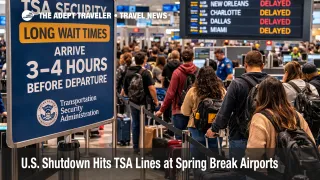
The U.S. shutdown airport story has moved from warning to visible checkpoint failure at some airports. On Sunday, March 8, Reuters reported security waits of up to 3.5 hours at William P. Hobby Airport (HOU) in Houston, Texas, while Louis Armstrong New Orleans International Airport (MSY) and Houston Airports issued public warnings telling travelers to arrive much earlier than usual because of TSA staffing shortages tied to the partial Department of Homeland Security shutdown. For travelers, that means the checkpoint itself is now a real delay risk, not just a background political story.
This is the material change since earlier Adept Traveler shutdown coverage, including U.S. Shutdown Risk Raises Spring Break Airport Strain and Global Entry Pause, TSA Pay Fight Hit U.S. Travel. Earlier coverage focused on staffing risk and line volatility. The March 8 and March 9 update is that some airports are now publishing concrete early arrival guidance after long lines formed and passengers started missing flights.
Shutdown TSA Lines: What Changed at Airports
The clearest confirmed pressure point is Houston Hobby. Reuters reported waits of up to 3.5 hours there on Sunday, March 8, and Houston Airports says HOU passengers should arrive four hours before departure because TSA wait times can exceed two hours during the shutdown. Houston Airports also said fewer TSA lanes are open because of the funding lapse.
New Orleans is also a live traveler problem now. The airport said the TSA was experiencing a shortage of workers that was causing longer than average checkpoint lines, and AP reported waits of up to about two hours, with the airport urging passengers to arrive at least three hours early and warning delays could continue through the week. That is weaker than the worst Houston Hobby case, but it is still enough to break normal airport timing for domestic trips.
Other hubs matter because of their network role, not just their local wait times. Reuters said George Bush Intercontinental Airport (IAH), Charlotte Douglas International Airport (CLT), and Hartsfield, Jackson Atlanta International Airport (ATL) were also seeing longer than normal lines. Even when those airports are not hitting Hobby style extremes, they handle large connection flows, which means a slower checkpoint at the start of a trip can spill into missed onward flights later in the day.
Which Travelers Face the Most Missed Flight Risk
The most exposed travelers are not simply the ones using the biggest airports. They are the ones whose trip only works if timing holds. That includes families with checked bags, passengers booked on the last practical flight of the day, travelers with short domestic connections, and anyone trying to make a cruise embarkation, event, or same day business commitment. When screening becomes less predictable, those thin margin itineraries fail first.
Houston origin passengers face the clearest immediate risk because the airport system itself is telling Hobby travelers to use a four hour buffer. New Orleans origin passengers should also assume the next few days remain unstable unless airport guidance improves. For passengers connecting through Atlanta or Charlotte, the risk is more indirect but still serious, because packed spring schedules leave fewer same day recovery options once a first segment is missed.
There is also a false comfort problem here. Some travelers will clear security normally and assume the broader warning is overblown. That is the wrong read. The issue is variability, not uniform collapse. A trip can still unravel if one airport or one peak departure bank suddenly loses enough throughput to create a queue spike.
What Travelers Should Do Now
For Houston Hobby, the practical answer is simple, use the airport's four hour recommendation unless conditions clearly improve before you leave for the airport. For New Orleans, use at least three hours. At other large hubs, especially during morning peaks and late afternoon banks, add more screening buffer than you normally would even if your airport has not yet issued an aggressive warning.
Rebook rather than wait if your itinerary includes a short connection, separate tickets, a cruise departure, or the last useful flight of the day. Waiting can still make sense for a flexible nonstop with multiple backup options, but it is a bad gamble when one checkpoint miss could force an overnight stay. The tradeoff is straightforward, leaving early costs time, but leaving late can now collapse the entire itinerary before you even reach the gate.
Over the next 24 to 72 hours, watch airport specific advisories more closely than national shutdown rhetoric. Houston and New Orleans have already shown that conditions can diverge sharply from airport to airport. Also watch for signs that more checkpoints are reducing lane availability or that arrival guidance starts moving from two or three hours to four or more at other hubs.
Why This Disruption Spreads Faster During Spring Break
The mechanism is simple. TSA officers are continuing to work without pay during the partial Department of Homeland Security shutdown, and Reuters reported higher than normal absences as spring break demand builds. When even a modest number of officers are unavailable, fewer screening lanes stay open, throughput drops, and lines grow quickly around the day's busiest departure banks.
Spring break makes that weakness more dangerous because demand is already elevated. Airlines for America says U.S. airlines expect 171 million passengers from March 1 through April 30, 2026, about 4 percent more than last year. In a system that busy, a checkpoint delay does not stay isolated. It spills into missed first legs, crowded airline service desks, tighter reaccommodation, and more expensive same day recovery.
That is why this story matters beyond a few ugly queue photos. The first order effect is obvious, longer waits at security. The second order effect is what hits travelers harder, missed flights, fewer open seats later in the day, and hotel or ground transport costs that were not part of the original trip budget. Until the shutdown ends or staffing stabilizes, shutdown TSA lines should be treated as a real operating condition in U.S. air travel, especially at spring break airports.
Sources
- Security lines hit three hours at some US airports as TSA absences rise
- Travelers encounter long waits at some airports as DHS shutdown affects security checkpoints
- Government shutdown impacting TSA
- Louis Armstrong New Orleans International Airport
- A4A Statement on Extraordinarily Long TSA Lines at Some U.S. Airports
- U.S. Airlines Prepare for Record Number of Passengers this Spring Amid Government Shutdown
- U.S. Shutdown Risk Raises Spring Break Airport Strain
- Global Entry Pause, TSA Pay Fight Hit U.S. Travel