

Qatar Race Postponement Raises April Gulf F1 Risk
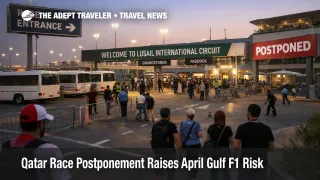
Qatar race postponement has pushed the Gulf travel story into a new phase, because the World Endurance Championship has now moved its March 26 to 28 opener at Lusail International Circuit out of its original slot after airport closures and wider regional disruption, while Formula One says any decision on Bahrain and Saudi Arabia next month will be guided by safety. For travelers, that shifts the risk from same week flight chaos into advance planning for race weekends, hotel blocks, sponsor trips, and back to back Gulf itineraries that were supposed to run on a fixed April calendar.
The practical change from earlier Qatar coverage is that a major motorsport event has already broken first. FIA WEC says the Qatar 1812km will instead be staged later in the second half of the 2026 season, and Formula One's official 2026 calendar still lists Bahrain for April 10 to 12 and Saudi Arabia for April 17 to 19, with no postponement announced as of March 10. That means travelers should stop treating April Gulf race plans as routine, fully locked trips, even though the Bahrain and Jeddah rounds remain on the calendar for now.
For readers following this broader Gulf disruption, this is the point where transport instability starts changing event booking behavior, not just airport behavior. Adept Traveler has already reported that Qatar remains a constrained exit platform rather than a normal hub, and that wider Gulf airspace conditions have stayed fluid even when some corridors reopen. Now that event timing has slipped in Qatar, the next traveler decision point is whether April race travel into Bahrain and Saudi Arabia still offers enough certainty to justify nonrefundable bookings.
Qatar Race Postponement: What Changed for Event Travelers
The confirmed part is straightforward. FIA WEC, Lusail International Circuit, and the Qatar Motor and Motorcycle Federation backed a postponement of the Qatar 1812km, which had been scheduled for March 26 to 28, and the series says it is targeting a replacement date in the second half of 2026. The WEC season will now start at Imola instead.
That matters beyond endurance racing because it gives travelers a real proof point. Gulf disruption is no longer only about whether an airport can restart a limited bank of flights. It is now affecting whether a major spectator event can keep its original date at all. Reuters also reported that Formula One and the FIA are closely watching the situation, with any decision on the Bahrain and Saudi Arabian Grands Prix next month to be guided by safety.
For travelers who were building multi stop Gulf trips around race weekends, the risk has widened. A Qatar fan trip can no longer rely on the old March arrival window, and an April itinerary built around Bahrain, then Jeddah, now carries a higher chance that flight options, hotel timing, or the event itself could change after booking. For recent background on the transport side, see Qatar Evacuation Flights Stay Limited on March 8 and Middle East Airspace Reopens, Closures Stay Fluid.
Which April Gulf Race Trips Face the Most Risk
The most exposed travelers are the ones locking in expensive, time sensitive packages. That includes fans buying premium grandstand or hospitality tickets, teams and suppliers moving staff and equipment, sponsors hosting clients, and travelers pairing Bahrain and Saudi Arabia on back to back weekends because the official Formula One calendar still places those races on April 10 to 12 and April 17 to 19.
The risk is lower for travelers holding flexible hotel rates, refundable airfares, and points bookings that can be redeployed quickly. It is higher for anyone depending on scarce premium cabins, charter availability, or a tightly sequenced itinerary with prebooked transfers, nonrefundable rooms, and onward events in another country. Once uncertainty enters the event calendar, the pressure does not stay inside the circuit gates. It spills into airline inventory, room holds, and ground logistics across the whole trip.
There is also a difference between Bahrain and Saudi Arabia from a traveler planning standpoint. Bahrain comes first, so it has the shorter decision window. Saudi Arabia, one week later in Jeddah, benefits from slightly more time for conditions to stabilize, but it also inherits disruption if Bahrain planning breaks late, because many travelers and corporate guests treat the two weekends as one combined Gulf swing.
What Travelers Should Do Before Booking April Race Plans
If you have not booked yet, the cleanest move is to protect flexibility over access. Choose refundable or changeable air and hotel products, avoid back to back nonrefundable race packages, and be careful with separate ticket structures that force you to self protect if one leg fails. That matters more now that a real Qatar race postponement has already shown event dates are not immune from the transport and security picture.
If you are already booked for Bahrain or Saudi Arabia, your next decision threshold is simple. Keep the trip if your bookings are flexible and the race is the main purpose. Start reducing exposure now if your itinerary depends on fixed premium flights, prepaid hospitality, or a broader regional vacation that would become expensive to rebuild if one race weekend shifts. Travelers should also review refund rules on event tickets, hotels, and any third party package inclusions before the next payment deadline hits.
Over the next 24 to 72 hours, watch for only three things that materially change the decision. First, any statement from Formula One, the FIA, Bahrain organizers, or Saudi organizers that moves beyond monitoring. Second, any fresh airport or airspace disruption that reduces confidence in April access. Third, any changes to race weekend ticketing, hospitality communications, or travel advisories that imply organizers are preparing for altered operations. Until one of those shifts, Bahrain and Saudi remain scheduled, but Qatar race postponement is a warning that Gulf event travel can no longer be treated as business as usual.
Why the Disruption Now Reaches Beyond Airports
The mechanism is broader than a single airport closure. Major event travel depends on confidence in a whole chain, published air service, stable airspace, predictable hotel demand, sponsor logistics, freight timing, staffing movements, and the willingness of fans to book early. When one major race is postponed, that signals the chain is weak enough that organizers may not want to force travelers, teams, and partners into a shrinking decision window.
First order, Qatar travelers lose a fixed race week and may need refunds, credits, or complete rebooking. Second order, uncertainty pushes outward into April by changing how travelers price risk for Bahrain and Jeddah. Some people hold off on booking, others lock in flexible inventory early, and premium capacity can tighten even before any formal schedule change because buyers are competing for the smaller pool of options that remain easy to unwind.
That is why this matters to more than motorsport fans. Gulf event travel often drives high yielding air demand, premium hotel occupancy, and linked regional itineraries. Once the market sees one Lusail postponement, it stops assuming every later event will run normally just because it is still on the calendar. For now, the April Formula One rounds are still listed as scheduled, but Qatar race postponement has moved the burden of caution onto the traveler.
Sources
- Qatar 1812km postponed, season to start at Imola
- Decision on Middle Eastern F1 races to be guided by safety, says FIA head
- WEC postpones Qatar season-opener, F1 races in the spotlight
- F1 Schedule 2026, Official Calendar of Grand Prix Races
- Qatar Evacuation Flights Stay Limited on March 8
- Middle East Airspace Reopens, Closures Stay Fluid