

Qatar Evacuation Flights Stay Limited on March 8
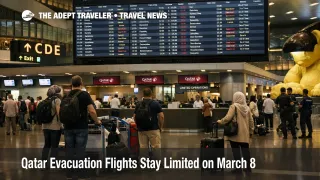
Qatar evacuation flights are still available on March 8, 2026, but only in a narrow, managed way, not as a return to normal travel. The biggest change since earlier Doha corridor coverage is that Qatar Airways has moved from tightly controlled relief flying into a limited published schedule to and from Hamad International Airport (DOH), Doha, Qatar, while major government advisories still warn against normal travel and tell some nationals to leave if they can do so safely. For most travelers, that means Qatar is usable as a constrained exit platform, not a routine Gulf stopover or confidence-building transit hub right now.
Qatar evacuation flights now sit in an awkward middle ground. There are real outbound seats on some days, but the country is still under an all but essential travel warning from the U.K., a Level 3 Reconsider Travel advisory from the United States, and a Do Not Travel warning from Australia because of the risk of armed conflict, ongoing regional escalation, and repeated flight disruption.
Qatar Evacuation Flights: What Changed
What changed most for travelers is that Qatar now has limited operating corridors instead of a total stop. Qatar Airways said on March 8 that scheduled operations remain temporarily suspended overall, but it is running a limited schedule to and from Doha in the coming days. On March 9, planned departures from Doha include Seoul, Moscow, London Heathrow, Delhi, Madrid, Islamabad, Beijing, Perth, Nairobi, and Istanbul. Planned arrivals into Doha the same day include Amsterdam, Berlin, Frankfurt, London Heathrow, Zurich, and Muscat, and those inbound flights are only for passengers whose final destination is Doha.
That is operationally important, but it is not a full reopening. Qatar Airways is still explicitly saying these flights do not confirm the resumption of scheduled commercial operations, and Hamad International Airport is still warning that flight operations remain temporarily suspended in the broader sense because of the closure of Qatari airspace, with only limited repatriation activity authorized. Qatar Airways also says it operated repatriation flights from Doha on March 8 to Amsterdam, Berlin, Frankfurt, London Heathrow, and Zurich.
For readers tracking this story day by day, this update moves beyond Qatar Relief Corridor Opens Doha in Slices and Doha March 9 Flights Open on Limited Qatar Schedule by clarifying that Qatar still has an exit channel, but it is a managed corridor with unstable capacity, not a normal hub recovery.
Who Should Still Avoid Qatar Right Now
Qatar is still a poor fit for discretionary travel, short stopovers, or any itinerary that depends on easy onward connections. The U.K. Foreign, Commonwealth & Development Office advises against all but essential travel to Qatar, updated its warning on March 3 to reflect regional escalation and leaving Qatar, and tells travelers to stay away from areas around security or military facilities, follow local instructions, and be ready to shelter in place.
The United States is more explicit about the evacuation side. The State Department says non emergency U.S. government personnel and family members were ordered to leave Qatar on March 2, routine consular services are suspended, Americans are strongly encouraged to depart now, and anyone staying should prepare contingency plans that do not depend on U.S. government evacuation help. It also says Americans can complete a crisis intake form to request assistance, while a broader March 8 Middle East notice says U.S. citizens in Qatar and several nearby countries may request information on government facilitated departure options as they become available.
Australia has gone further and now advises do not travel to Qatar, citing the volatile security situation, military strikes in Qatar, the airspace closure, and the risk of wider movement restrictions. That matters because it shows how far official confidence in normal travel conditions has deteriorated, even though limited flights have restarted in a controlled form.
What Travelers Should Do Now
If you are already in Qatar and trying to leave, the immediate move is to treat Doha as a seat-confirmation problem, not an airport-access gamble. Do not go to Hamad unless you hold a valid confirmed ticket, because both Qatar Airways and airport authorities are still warning against speculative airport runs. If you have a Qatar Airways booking dated between February 28 and March 15, 2026, the airline says you are eligible for a fee free date change of up to 14 days or a refund of the unused value of the ticket.
If you are a British national, register your presence with the U.K. government, but do not mistake that for a confirmed evacuation program from Qatar. The current U.K. advice for Qatar tells people to register and keep departure plans under review, but unlike the United Arab Emirates, where the FCDO has separately published information about registering interest in U.K. government flights, Qatar guidance is still centered on commercial departure options and local authority instructions.
If you are a U.S. citizen, complete the crisis intake form if you may need help, but plan as though your real exit will still come through commercial capacity unless Washington later announces something more concrete. The next decision window is the next 24 to 72 hours. Watch whether Qatar Civil Aviation Authority permissions widen, whether Qatar Airways adds more destinations or frequencies, and whether your home government shifts from registration and intake forms into named flight programs. Until that changes, Qatar evacuation flights remain limited enough that travelers should protect certainty over convenience.
Why Qatar Is Usable Only as a Managed Exit
The core mechanism is simple. Qatar is not dealing with a normal airline disruption or even a routine regional security advisory. Official warnings point to the risk of armed conflict, commercial flight disruptions, and the need to shelter if instructed, while Qatar's own foreign ministry says missile and drone activity affected areas near Hamad International Airport as well as other critical infrastructure zones.
That changes the role of Doha in the travel system. First order, the airport can no longer function as a high-volume, high-reliability global connecting hub. Second order, every traveler decision becomes more fragile, because a missed corridor flight can spill into extra hotel nights, tight document checks for onward travel, insurance problems under strengthened advisories, and scarce replacement inventory on the next permitted wave of flights. That is why Middle East Airspace Closures Snarl Gulf Hub Flights still matters as background. The wider Gulf network remains too unstable for normal connection logic.
The practical conclusion is blunt. Qatar is not closed in the absolute sense, but it is not normal, and it is not a comfortable discretionary destination right now. It works, at best, as a tightly controlled departure point for travelers who already have a confirmed reason to be there and a realistic path out. For everyone else, Qatar evacuation flights are still too limited, too conditional, and too dependent on rolling security and airspace decisions to treat the country as a standard March 2026 travel market.
Sources
- Qatar travel advice, GOV.UK
- Qatar International Travel Information, U.S. Department of State
- Consular Information for Americans in the Middle East, U.S. Department of State
- Qatar Airways Limited Operations Page
- Qatar Airways Travel Alerts
- Operations Update, Qatari Airspace Closure, Qatar Airways
- Alerts Page, Hamad International Airport
- Qatar Foreign Ministry Statement, March 4, 2026