

Taba Border Cash Rules Raise Egypt Exit Risk
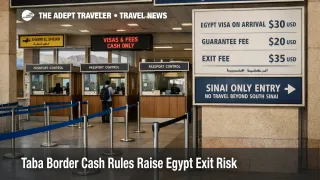
Taba border cash rules became more restrictive on March 9, 2026, because recent U.S. Embassy Jerusalem alerts now tell travelers to carry at least $85.00 (USD) in cash per person and warn that the free Taba entry stamp only permits travel within South Sinai. That sharpens the traveler problem from "can I get across?" to "can I legally and financially complete the next step after I get across?" Travelers using Taba as a fallback from Israel should not assume that crossing into Egypt automatically gives them freedom to continue to Cairo or elsewhere without extra paperwork and cash.
This is a real change from our earlier route focused coverage, including Israel Exit Options Update Adds Taba Bus Route and Israel Taba Exit Still Matters as Flights Resume, which explained how the crossing fit into the broader Israel exit picture. The new issue is narrower, but more dangerous to itineraries, because a traveler can now make the border crossing successfully and still fail the onward Egypt plan if they arrive short on cash or holding only the South Sinai stamp.
Taba Border Cash Rules: What Changed
What changed is precision. The U.S. Embassy Jerusalem alerts now say U.S. Embassy Cairo recommends carrying at least $85.00 (USD) in cash per person for Taba because ATMs at the crossing are unreliable and can run out of cash. The same alert stack says travelers may obtain a 30 day visa on arrival for $30.00 (USD) in cash, must also pay $20.00 (USD) in cash for a letter of guarantee, and $35.00 (USD) in cash for the Taba border exit fee. That total is why the $85 threshold matters operationally, not just as a rough suggestion.
The other change is legal scope. The free entry stamp available at Taba is not a general Egypt entry permission. The embassy alerts say it permits travel within South Sinai only and does not authorize onward travel to Cairo or other Egyptian governorates. The U.S. Department of State's Egypt advisory aligns with that narrower framework by saying travelers without a visa can get a free 14 day Sinai only visa on arrival at Taba, while travelers who need broader Egypt access need a different visa path.
Which Travelers Face the Most Risk at Taba
The travelers most exposed are not necessarily the people least able to cross the border. They are the people most likely to misunderstand what happens after the crossing. Anyone expecting to move directly from Taba to Cairo, Luxor, the Nile Valley, or another Egyptian governorate without securing the paid visa path is taking a real compliance risk. Travelers who arrive with only card access and no cash are exposed for a different reason, because the process can fail at the payment point before the itinerary even gets rebuilt.
This route still fits some travelers well. If the actual goal is South Sinai, for example Taba, Nuweiba, Dahab, or Sharm el Sheikh, Egypt, the free stamp may be enough. The embassy alerts also say the 30 day visa on arrival at Taba can support onward flying from Sharm el Sheikh International Airport (SSH), including itineraries that transit through Cairo. That makes Taba workable for travelers whose Egypt plan is really a Sinai plus airport bridge, not an overland move deep into the country.
The route is weaker for travelers with tight, multi leg onward plans, heavy baggage, older companions, or anyone trying to salvage a full Egypt itinerary on short notice. In those cases, Taba is no longer just a border decision. It becomes a sequence management problem involving cash, entry class, ground transfer, and a realistic onward air booking from Sinai. That is the tradeoff that now matters more than the mere existence of the crossing.
What Travelers Should Do Before Choosing Taba
The first decision threshold is simple. Use Taba only if you know whether your Egypt plan stops in South Sinai or continues beyond it. If the trip ends in South Sinai, the free stamp may be operationally enough. If the trip goes beyond South Sinai, travelers should line up the broader visa path, the required cash, and any support documents before leaving Israel, rather than assuming the crossing itself will sort that out.
The second threshold is money, not routing. Travelers should treat $85.00 (USD) in cash per person as the working floor, not the target to beat, because the embassy guidance is built around unreliable border ATMs and fixed cash fees. Anyone traveling as a family or group should scale that cash requirement per person, and anyone depending on cards or same day ATM withdrawals is building a fragile plan.
The third threshold is onward realism. Travelers who do not already have a credible South Sinai stay or an onward flight chain should slow down before committing to Taba. Egypt Tourist Entry Requirements For 2026 is the more useful background read once Egypt shifts from destination to escape route, because the border choice now depends on visa fit as much as transport fit. And for travelers still comparing Egypt versus Jordan exits, Jordan River Crossing Hours Tighten Through March 18 remains a relevant comparison point, because both routes now punish assumptions about last minute border flexibility.
Why the Taba Route Now Fails More Easily
The mechanism is straightforward. Taba can look open and functional while still failing travelers at the next layer. One traveler may cross legally but lack enough cash for the paid Egypt entry path. Another may enter with the free stamp and only discover later that the document does not authorize onward movement beyond South Sinai. A third may secure border entry but still lack a workable transfer and flight chain from Sinai. In all three cases, the route exists, but the itinerary still breaks.
That is why the story is more restrictive than it first sounds. The embassy guidance does not close Taba, but it narrows the set of travelers who can use it cleanly. First order, underfunded or misdocumented travelers can get stuck in the border workflow or limited to South Sinai when they meant to continue. Second order, that pushes more demand into hotels and transfers around Taba and Sharm el Sheikh, raises the value of pre arranged onward flights, and makes bad assumptions more expensive. Taba still works, but only when the cash plan, the stamp or visa class, and the onward route all match the same itinerary.