

Israel Taba Exit Still Matters as Flights Resume
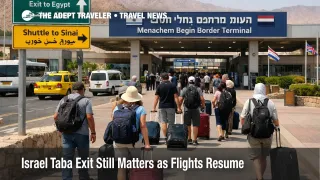
Israel Taba border exit remains one of the few structured non air ways out of the country on March 8, 2026, even after Israel began a gradual restart of outbound flying from Ben Gurion Airport. The U.K. Foreign, Commonwealth and Development Office, or FCDO, still points eligible travelers toward Taba, says transport continues from major cities to Eilat, and says a British Embassy team is on the Egyptian side to direct British nationals toward onward options to Sharm El Sheikh Airport. For travelers who do not yet hold a confirmed outbound seat, or who need a same day surface plan they can actually execute, Taba still matters because it is a real border workflow, not just a theoretical fallback.
The practical change since Adept's March 7 coverage is not that Taba disappeared. It is that the comparison set changed. The FCDO now says Ben Gurion started a gradual outbound restart on March 8 through a limited group of Israeli carriers, but it also warns that commercial options can change at short notice. That means the traveler decision is no longer only how to get out by land, it is whether a confirmed air booking is solid enough to beat a functioning border route into Egypt.
Israel Taba Border Exit: What Changed on March 8
What changed on March 8 is not the border route itself, but the fact that Israel now has a very limited outbound flight restart running alongside it. The FCDO says Ben Gurion is gradually operating outbound flights, initially through El Al, Israir, Arkia, and Air Haifa, with passenger numbers constrained by security rules. That narrows the cases where Taba is clearly superior, but it does not remove them. Taba still has an advantage when you do not have a confirmed seat, when your flight option could vanish again, or when you need to reach Sinai or Sharm el Sheikh, Egypt, directly rather than wait for a wider air recovery.
The route itself remains structured. The FCDO says transport services continue from major Israeli cities to Eilat, points travelers to Egged buses, and notes that Moovit can help with local public transport from Eilat to the crossing. The Israel Airports Authority, or IAA, says Menachem Begin Border Crossing, the Taba crossing, operates 24 hours a day, seven days a week for passengers, though it also advises travelers to verify density before arriving. That combination matters because it gives travelers a defined southbound chain instead of a speculative airport gamble.
Which Travelers Still Benefit Most From the Taba Route
Taba is still strongest for three groups. First are travelers who cannot secure a confirmed outbound flight from Israel and do not want to spend more time waiting on fragile airline inventory. Second are travelers whose onward plan works from South Sinai, especially Sharm El Sheikh, rather than from Tel Aviv. Third are travelers who want the cleanest non air route and can handle the Egyptian entry process in cash and in sequence. That is why Israel Taba Shuttle Buses Reshape Tourist Exits still holds up operationally, even if the story is no longer only about buses.
This route is weaker for travelers who now hold a real outbound booking from Ben Gurion on one reservation, especially if that booking gets them where they need to go without a border crossing, a cash heavy Egypt entry process, and a second flight hunt. It is also weaker for people trying to self drive with incomplete vehicle paperwork. Adept's earlier reporting, Israel Border Car Exits Need English Registration, still matters here because private vehicle departures to Egypt now require a vehicle registration translated into English in advance, and on site translation is no longer offered at Taba.
There is also a nationality and visa layer. The FCDO's embassy support at Taba is clearly useful for British nationals, but Egypt entry rules still govern the crossing itself. British passport holders entering South Sinai overland through Taba can use a free entry permission stamp for stays of up to 15 days inside Sinai, but they must still pay a $25.00 (USD) Sinai Tax in cash. If they plan to leave Sinai, stay longer than 15 days, or fly onward from mainland airports such as Cairo or Hurghada, they need a $30.00 (USD) entry visa and a letter of guarantee that can be obtained at the border arrivals hall for another $25.00 (USD).
What Travelers Should Do Before Choosing Taba
Treat Taba as an end to end workflow, not a border crossing in isolation. Before leaving your hotel, decide whether your goal is simply to get into Sinai, or to keep moving toward an onward flight. Those are different trips. If you only need South Sinai for a short stay, the free Sinai permission route is simpler. If you need Cairo, Hurghada, or a longer Egypt stay, carry the extra U.S. cash for the visa and guarantee letter, because the FCDO says there are no ATMs dispensing U.S. dollars at the Taba crossing.
Taba beats waiting for airspace recovery when your air option is still theoretical, when you are facing repeated booking uncertainty, or when a confirmed route from Sharm El Sheikh is materially easier to secure than a confirmed route from Israel. It also beats waiting when the cost of another hotel night and more uncertainty in Israel is higher than the friction of a long bus or taxi south, a border queue, and a cash only Egypt entry step. It loses when you already hold a genuinely confirmed outbound flight from Ben Gurion and do not need the extra border, transfer, and second ticket risk.
Over the next 24 to 72 hours, watch three thresholds. First, whether the limited Ben Gurion restart expands beyond today's narrow operating pattern. Second, whether the FCDO changes its wording around Taba eligibility or Egypt entry. Third, whether demand pressure shifts from Israel itself into Eilat, Taba, and Sharm, where hotel capacity, road transfers, and onward seats can tighten fast. The broader operating backdrop in Middle East Airspace Reopens, Closures Stay Fluid still applies here, because a partial restart is not the same as a stable recovery.
Why the Taba Decision Is Really About Workflow, Not Just Border Status
The mechanism is simple. A land crossing that is open 24 hours a day is only useful if the rest of the chain holds. First order, you need transport from where you are to Eilat, then from Eilat to the crossing, then cash in U.S. dollars for the Sinai Tax and possibly a visa and guarantee letter. Second order, once more travelers start making the same calculation, pressure builds in bus loads, taxi supply, Eilat room nights, Taba border queues, and onward flights from South Sinai. That is why Taba can stay open and still become harder to use smoothly.
This is also why Taba remains most useful as a structured fallback, not a magic exit. The route works best when the traveler accepts its real mechanics, cash requirements, Sinai versus mainland Egypt distinction, and onward transport constraints before starting south. Travelers who frame it that way still have one of the region's clearest non air exits. Travelers who treat it as a generic "just get to the border" move are more likely to burn time, money, and optionality at exactly the wrong moment.