

Italy Italo Strike Hits High Speed Rail March 11
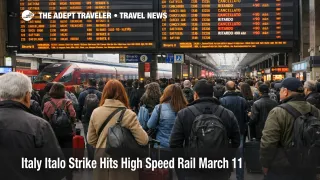
Italy's private high speed rail network is under same day pressure on Tuesday, March 11, 2026, because Italo says a strike runs from 901 a.m. to 459 p.m. local time and has published a guaranteed trains list for the day. That does not mean the network is stable. It means some core departures are protected, while many others can still disappear or become poor bets once the day compresses around the guaranteed list. Travelers making airport transfers, cruise embarkations, or city to city moves across Italy should treat March 11 as a timing problem first, and a rail problem second.
The practical issue is not just whether your train is canceled. It is whether your whole day still works if one rail leg slips. On a strike day like this, a nominally simple move such as Milan to Rome, Rome to Naples, or Venice to Rome can stop being a clean intercity transfer and turn into a missed airport train, a lost hotel night, or a forced late arrival. The guaranteed list gives travelers something real to work with, but it also reveals where capacity is likely to bunch and where recovery space will be thin.
Italy Italo Strike, What Changed
Italo's official notice says the strike runs from 901 a.m. to 459 p.m. on March 11, and that the carrier has published guaranteed trains to reduce disruption. The guaranteed list shows protected service on a meaningful share of the network, but not across every departure pattern travelers normally rely on. Some trains are explicitly marked guaranteed, while others are outside the strike window only in a narrow technical sense, such as trains arriving within one hour of the strike start, which is not the same thing as having broad recovery options if earlier delays spread.
The list makes clear that Italy's biggest tourist and business corridors stay in play, but in a thinner and more brittle form. Protected trains appear on Milan Centrale to Roma Termini, Roma Termini to Venezia Santa Lucia, Napoli Centrale to Milano Centrale, Torino Porta Nuova to Roma Termini, and several north south runs linking Venice, Naples, Salerno, Turin, and Bari. That is good news compared with a near blank timetable, but it is still a reduced network where one missed protected departure matters more than usual because the next workable option may not fit the rest of the itinerary.
Which Travelers Face the Most Disruption
The highest risk sits on corridors where Italo is not just one option among many, but the backbone of a same day plan. Milan, Rome, Naples, and Venice stand out because the guaranteed list confirms they remain central nodes in the strike day timetable, which also means remaining seats and fallback options are likely to concentrate there. Travelers moving between Milano Centrale, Roma Termini, Napoli Centrale, and Venezia Santa Lucia should expect a network that still functions, but with less slack and less forgiveness if they arrive late to the station, need to change trains, or are traveling on a separate ticket chain.
Airport access is where rail trouble becomes a full trip repair issue. Italo does not need to serve an airport directly to break an airport plan. If your trip depends on reaching Rome or Milan on time and then continuing onward by airport rail, shuttle, or taxi, the weak point is the handoff, not just the train itself. Cruise travelers and day movers are exposed for the same reason. A protected high speed departure that arrives too late to preserve port check in, a private tour, or a timed hotel transfer still fails operationally. The same logic applies to Paralympic period travel in northern Italy, because the Milano Cortina 2026 Paralympic Winter Games run from March 6 to March 15, which raises the cost of same day mistakes in already busy city to city corridors.
What Travelers Should Do Now
Start with the guaranteed list, not with your original booking assumptions. If your exact train is not shown as guaranteed, or if it sits too close to a must keep event such as airport check in, cruise embarkation, or a timed arrival in another city, treat the rail leg as conditional. On March 11, the best self repair is often to move earlier, travel on a guaranteed departure even if it is less convenient, or reposition the night before. Waiting for the day to sort itself out is how a rail delay becomes a hotel, flight, or cruise problem.
The threshold for switching modes is lower than on a normal day. If you need a same day handoff that cannot slide, such as a Rome airport connection, a Venice embarkation, or an event ticket in another city, private transfer or an overnight reposition is usually smarter than betting on a non guaranteed midday train. Travelers with flexible hotel nights and fully changeable tickets can wait longer. Travelers on separate tickets, nonrefundable tours, or cruise sailings should not. For broader strike pattern context, see Italy Rail Strike 9:00 p.m. Start Raises Misconnect Risk and Naples March 6 EAV Strike Disrupts Pompeii Trains.
Through the rest of March 11, monitor only operator channels that can confirm the actual train you plan to board. The Italo strike notice and guaranteed list are the base documents, but real value comes from checking your specific service close to departure. The right mindset is simple. The Italy Italo strike is manageable for travelers who reduce dependence on one perfect connection, and much harsher for travelers still trying to run a normal day on a strike timetable.
How the Disruption Spreads Through Travel
The reason this kind of strike matters beyond rail is that Italy's high speed network is not just transportation, it is the timing spine for multi city trips. Italo says its network connects 54 major cities across Italy and 62 stations, which helps explain why even a partial reduction creates more than train specific pain. The first order effect is canceled or changed departures. The second order effect is compression, remaining trains matter more, stations crowd faster, later options sell out sooner, and last mile transfers become the real failure point.
That is why the guaranteed list helps, but does not fully solve the traveler problem. It tells you which departures have the best chance of running, yet it also shows how much demand will likely be forced onto a narrower band of services on the country's biggest corridors. In practical terms, the Italy Italo strike is not a reason to cancel an entire trip across the board. It is a reason to stop pretending that a tightly timed March 11 rail move is routine, and to protect the part of the itinerary that is hardest or most expensive to rebuild.