

Israel Consular Suspension Extends Taba Exit Push
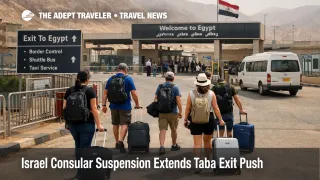
Israel consular suspension is now a traveler movement story, not just a paperwork story. U.S. Embassy Jerusalem says routine consular services at the embassy in Jerusalem and the branch office in Tel Aviv remain suspended through March 13, 2026, while its security alerts continue to point Americans toward the Taba land crossing into Egypt, limited emergency passport processing, and onward flights from carriers including Arkia and TUS. That matters because the operating problem has shifted again since earlier airline disruption coverage. Travelers are no longer deciding only whether Ben Gurion is usable, they are deciding whether to move overland before the weekend, while consular access, shuttle capacity, cash needs, and onward seat availability remain tight.
The practical consequence is that in country support is thinner at the same moment the embassy is steering people toward a more manual exit chain. Earlier Adept coverage, including Israel Exit Options Update Adds Taba Bus Route, focused on the existence of the route. The new issue is that the route is now doing more work in the traveler decision tree because routine consular services are still paused and no public return to normal has been posted yet. For travelers already booked on canceled or unstable Israel itineraries, this is the point where waiting for a cleaner air recovery may cost more than repositioning early.
Israel Consular Suspension: What Changed for Travelers
What changed since March 12 is the center of gravity. The embassy's March 13 alert still says routine consular services are suspended through March 13 at both the Jerusalem embassy and the Tel Aviv branch office. At the same time, the same alert family continues to describe emergency passport services, with fees paid in advance through Pay.gov, and says U.S. consular officers may be present in Taba for limited assistance. That is a meaningful operational distinction. Routine help is paused, but a narrow emergency channel remains available for travelers who are actively trying to get out.
The other important carryover is that the embassy is still treating Taba as the main practical land exit to Egypt. Its earlier updates said the crossing was scheduled to operate 24 hours a day, and that the embassy was organizing bus service for U.S. citizens who needed help reaching the crossing. U.S. Embassy Cairo guidance referenced by those alerts says travelers should carry at least $85.00 (USD) in cash per person for the crossing, and later updates added that a 30 day Sinai visa on arrival at Taba costs $30.00 (USD) in cash for travelers using Sinai as the bridge to airports such as Sharm el Sheikh.
Which Travelers Face the Most Pressure Now
The most exposed group is short term visitors still in Israel without a firm commercial seat out, especially anyone who needs consular help, passport replacement, or airline intervention to keep the trip moving. They are now relying on a layered exit chain, local transport to the crossing, border processing, enough cash on hand, possible visa issuance, then a shuttle, hotel, or onward flight from Egypt. Each layer works, but each layer also introduces another failure point.
Transit passengers and premium travelers are exposed in a different way. If they were treating Saudi Arabia, Jordan, Cyprus, or Egypt as backup gateways, this Israel consular suspension makes those substitutions more operationally relevant, but also more crowded and more expensive. Reuters reported earlier in the crisis that Israeli carriers were building rescue flights to Taba and nearby regional gateways, while TUS separately says it is operating several daily special flights between Taba and Athens and Larnaca. That keeps the lane alive, but it also means seats can disappear quickly once more stranded travelers choose the same path.
Travelers with longer dated tickets into Tel Aviv should read this as a planning signal, not just a same day alert. If your carrier has already pushed restart dates deeper into late March or early May, as in Air Canada Extends Dubai, Tel Aviv Suspensions, the tradeoff changes. The question is no longer whether the disruption is real. It is whether preserving the original itinerary is worth absorbing more hotel nights, ad hoc ground transport, and uncertain consular availability.
What Travelers Should Do Now
Travelers already in Israel who may need the Taba route should act as though this is a cash and timing operation first, and a booking operation second. Carry enough cash for border fees and immediate transport, keep passport and payment confirmations accessible offline, and do not assume ATMs or card acceptance will solve a same hour problem at the crossing. If you may need an emergency passport, use the embassy's emergency channel rather than waiting for routine services to resume.
The rebook versus wait threshold is fairly clear now. Reposition sooner if you are already inside a disrupted itinerary, lack a reliable outbound seat, need document help, or are traveling with children or medical constraints that make an overland scramble harder after dark or over a weekend. Waiting makes more sense only if you already hold a confirmed near term departure that your carrier still shows as operating, and you can absorb a quick pivot if that changes.
The next 24 to 72 hours matter because March 13 is the published end point for the current consular suspension, but no publicly visible update in the sources reviewed confirms a normal weekend resumption yet. Travelers should monitor three things in order, first, whether the embassy posts an extension or resumption notice, second, whether Arkia, TUS, and other regional carriers keep selling and operating Taba linked capacity, and third, whether border processing and onward transport through Sinai remain orderly enough to justify a same day push. Until those pieces stabilize, tight onward connections out of Egypt or Cyprus are a bad bet.
Why the Disruption Now Runs Through Ground Exits
The mechanism is straightforward. When routine consular services are suspended, travelers lose one layer of normal in country support at exactly the point when commercial flying is still only partly rebuilt. That does not eliminate exit options, but it pushes more demand into assisted or semi assisted corridors such as Taba, where success depends on border operations, cash, bus seats, local visas, and onward inventory rather than a single clean airport departure. The first order effect is that overland exits become more attractive. The second order effect is that they also become more fragile, because road transfer delays, sold out hotel rooms near staging points, and missed flights from Egypt or Cyprus can all compound quickly.
There is also a structural reason the embassy keeps highlighting Taba. The State Department's Israel country page notes that Israeli authorities control immigration and security screening at the Egypt and Jordan land crossings, and that travelers can face prolonged questioning or denial of entry or exit. In other words, these are workable routes, but they are not friction free. Once more travelers are funneled toward them, they behave less like a casual border hop and more like an irregular operations corridor.
Sources
- Security Alert, U.S. Embassy Jerusalem, March 13, 2026
- Israel, the West Bank, and Gaza International Travel Information, U.S. State Department
- Security Alert, U.S. Embassy Jerusalem, March 9, 2026, Update 2
- Security Alert, U.S. Embassy Jerusalem, March 11, 2026
- Security Alert, U.S. Embassy Jerusalem, March 10, 2026, Update 1
- TUS Airways, Special Flights to and From Taba
- Israel's Main Airport to Reopen on Monday in "Extremely Limited Format," Reuters, March 2, 2026