

Israel Exit Planning Shifts to Managed Departure Lanes
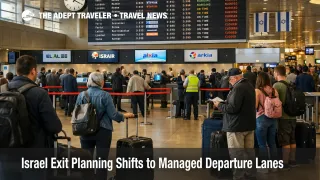
Israel exit planning is no longer just a scramble for any seat out. As of March 8, 2026, the U.K. Foreign, Commonwealth and Development Office, or FCDO, says Ben Gurion Airport resumed gradual outbound operations on El Al, Israir, Arkia, and Air Haifa, but under passenger caps tied to Home Front Command rules. At the same time, British nationals in urgent or exceptional circumstances can use a Ministry of Transport assistance form, while Taba remains a live land exit with onward help toward Sharm El Sheikh Airport. That matters because travelers now have defined lanes out of Israel, but each lane fails differently, so the next decision is not just whether to leave, but which exit chain is most likely to hold.
The change since The Adept Travelers March 13 coverage is structure. Earlier reporting centered on consular strain and Taba as a practical fallback. The newer traveler problem is that Israel now has a managed departure stack, limited commercial lift from Ben Gurion, a formal assistance path for urgent British cases, and a functioning overland fallback through Taba, which means travelers can compare real exit channels instead of reacting to pure airline chaos.
Israel Exit Planning: What Changed
What changed is not that Israel suddenly became easy to leave. It did not. What changed is that the departure map is clearer than it was a week ago. FCDO says Ben Gurion Airport started a gradual outbound restart on March 8 through four Israeli carriers, with passenger numbers initially limited by security regulations. That gives some travelers a direct air option again, but it is a thin one, because limited seats and short notice operational changes mean a reopened airport is not the same thing as normal departure capacity.
The same FCDO update also added a more formal help lane for British nationals, including dual nationals, facing urgent or exceptional circumstances. Those travelers can submit a Ministry of Transport assistance form, and the FCDO says they must use a British passport to apply. That is a meaningful operational upgrade for travelers with acute needs, but it is not a general guarantee of fast departure for everyone else.
Taba remains the other live lane. FCDO says eligible travelers can still move by transport from major cities to Eilat, then continue through the Taba border crossing, with a British Embassy team on the Egyptian side pointing British nationals toward onward options at Sharm El Sheikh Airport. For travelers without a confirmed Ben Gurion seat, or for those whose onward trip already points toward Sinai or southern Egypt, that overland route still matters. Earlier Adept coverage, including Israel Consular Suspension Extends Taba Exit Push, captured why Taba was still doing real work in the exit chain. The new distinction is that Taba is now one leg in a clearer three part departure framework, not the only obvious fallback.
Which Travelers Should Wait for Ben Gurion, and Who Should Pivot to Taba
Travelers with a confirmed near term seat on El Al, Israir, Arkia, or Air Haifa, valid onward documents, and a shelter capable hotel near Tel Aviv or Jerusalem are the strongest candidates to wait for Ben Gurion. The airport route is still the cleanest exit if the booking is real, the airline is still operating the flight, and the traveler can tolerate the risk that caps or security deterioration could still change the plan with little notice. This group includes travelers whose final destination is not Egypt, those carrying heavy luggage unsuited to a border transfer, and those who would be badly hurt by a manual land crossing with multiple payment and visa steps.
Taba is the better pivot for a different traveler profile. If you do not have a confirmed Ben Gurion seat, if your booking is on a carrier outside the currently approved group, if you are already planning to continue via Sinai, or if your risk tolerance is lower than your desire for a direct airport exit, the ground route may be more controllable. That is especially true for travelers who can overnight near Eilat and treat Sharm El Sheikh as the real air gateway. Adept's earlier Taba Border Cash Rules Raise Egypt Exit Risk and the guide Egypt Tourist Entry Requirements For 2026 remain relevant here, because a successful Taba plan depends on visa fit, cash, and whether you are staying within Sinai or flying onward into mainland Egypt.
Document and payment rules are where some Taba plans still break. FCDO says the Sinai tax is $25.00 (USD) per person, cash only, for Taba entry into Egypt, and that travelers going beyond Sinai, including onward to Cairo or Hurghada, need a $30.00 (USD) entry visa plus a $25.00 (USD) letter of guarantee. It also says there are no ATMs dispensing U.S. dollars at the Taba crossing, so travelers should obtain U.S. cash before arrival. For self driving travelers, Israel Airports Authority also says that from March 1, 2026, anyone departing Israel to Jordan or Egypt with a private vehicle must arrive with a vehicle registration license translated into English in advance, because translation services are no longer provided at Menachem Begin, also called Taba, or other listed crossings.
What Travelers Should Do Now
Travelers who can still use Ben Gurion should not treat "airport resumed" as a reason to improvise. They should keep the booking live, verify the operating carrier directly, confirm the airport access plan shortly before leaving, and hold enough food, water, medication, and shelter margin to survive a same day disruption. FCDO is explicit that commercial options can change at short notice if the security situation deteriorates, and that travel within or out of Israel is at your own risk.
Travelers considering Taba should make the whole chain work on paper before they move. That means checking whether their nationality can use the Sinai limited entry path or needs a fuller Egypt visa solution, carrying the required U.S. cash, and deciding whether Sharm El Sheikh is the actual onward airport or only a temporary staging point. The border route is often stronger than an unconfirmed flight, but weaker than a confirmed flight with margin. The tradeoff is control versus simplicity. Taba gives you a working lane, but it replaces one airport transaction with buses or taxis, a border crossing, Egyptian entry formalities, and an onward flight market that can tighten quickly.
Over the next 24 to 72 hours, the key thresholds are simple. Wait for Ben Gurion if your booking stays confirmed on one of the currently approved carriers and the local security picture does not worsen. Pivot to Taba if you lose the seat, fall outside the current airline group, or cannot tolerate another short notice cancellation. Deterioration signals would include new airline suspensions, tighter passenger caps, or fresh official warnings that commercial air travel has become too dangerous. Until then, Israel exit planning has improved from pure scarcity to managed scarcity, which is better, but still far from stable.
Why the Exit System Is Working This Way
The mechanism is straightforward. Israel has reopened only a narrow slice of outbound flying, not a full commercial schedule, because Home Front Command rules still constrain how many passengers can be carried on each flight. That turns Ben Gurion Airport (TLV) into a controlled valve rather than a normal hub. First order, some travelers regain a defined air exit. Second order, everyone else competes harder for the limited seats that exist, which keeps hotel staging, ground transport timing, and backup border options under pressure even after flights resume.
That is why Taba still matters. Overland exits absorb demand that the airport cannot yet handle, but they do so by pushing complexity into a different part of the system, buses or taxis to Eilat, border queues, cash only fees, Egyptian entry rules, and the onward seat market from Sharm El Sheikh. In practice, Israel's current exit picture is not one recovered channel. It is a split network, one capped airport lane, one formal assistance lane for urgent British cases, and one manual but functioning land to air workaround through Sinai. Travelers who understand that split will make better decisions than those who read "flights resumed" as a return to normal.