

Oman Khasab Suspension Breaks Musandam Air Access
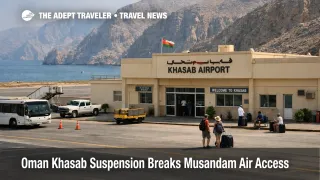
Khasab flight suspension in Oman is now a more useful traveler signal than a broad regional caution note. As of March 14, 2026, the UK says commercial flights to and from Khasab Airport in Musandam Governorate are currently suspended, while commercial flights from Muscat to the UK continue and internal flights from Salalah to Muscat are still operating. That split matters because it turns Oman from a single country level risk story into a location problem: Muscat still works, but Musandam has lost its cleanest air link. Travelers with Musandam stays, cruise calls, or dhow based itineraries should now plan around a broken Khasab air option, not assume Oman is uniformly inaccessible.
The security advisory is broader than Khasab alone. The same UK update says British nationals in Oman should exercise increased caution, and notes press reports of limited missile and drone activity around the commercial ports and industrial areas of Duqm, Salalah, and Sohar. That does not mean Oman's main passenger system has shut down. It does mean travelers should separate functioning passenger gateways from industrial area risk and avoid building an itinerary that depends on last minute improvisation.
Khasab Flight Suspension: What Changed for Travelers
What changed is not that Oman stopped moving passengers. What changed is that the country's most practical air access point for Musandam is now out, while Muscat remains usable. The UK advisory is explicit on both points, which is more decision useful than a generic regional warning because it tells travelers where the break in the network actually sits.
That changes the math for anyone who treated Khasab as a clean in and out point for the Musandam Peninsula. A Musandam trip that once relied on a short domestic or regional air segment now has to be rebuilt around surface transport, sea transport, or a longer positioning move through Muscat and, in some cases, through the United Arab Emirates. In practice, the Khasab flight suspension turns a simple arrival plan into a sequencing problem with more handoffs, more timing risk, and less slack if one piece slips.
There is also a capacity issue hiding underneath the routing problem. Muscat remains one of the Gulf's more workable fallback points, but earlier disruption coverage already showed that Muscat is useful only when seats, onward routes, and border logistics still line up. Adept's earlier reporting, Oman Air Cuts Nine Muscat Routes Through March 15, and UAE Oman Border Crossings Offer Overland Exit, matters here because a broken Khasab link pushes more travelers into that narrower Muscat based fallback system.
Which Travelers Face the Most Musandam Exposure
The highest risk group is travelers with fixed Musandam timing. That includes cruise passengers with Khasab shore plans, hotel guests with prepaid transfers, travelers booking dhow cruises or mountain excursions on a tight schedule, and anyone trying to use Musandam as a short stop inside a larger Oman or Gulf trip. These travelers are exposed because the loss of the air link does not just add time, it removes recovery options. Miss one handoff and the whole day can collapse.
A second exposed group is travelers trying to connect Musandam with Muscat on the same day. That plan is now much less forgiving. Muscat flights continue, but Muscat is no longer a seamless bridge into Musandam if Khasab is unavailable. The first order effect is a longer ground or sea positioning requirement. The second order effect is pressure on hotel timing, driver availability, border processing if routing via the UAE is needed, and excursion start times that were built around a simpler arrival.
The lowest risk group is travelers whose Oman trip can stay centered on Muscat or southern Oman without touching Musandam at all. For them, the correct interpretation is caution, not cancellation. The UK still says commercial flights from Muscat to the UK are operating, and Reuters reported earlier this month that Muscat International Airport said it continues to facilitate commercial traffic.
What Travelers Should Do Now
First, stop treating Khasab as a bookable assumption until airlines or Omani authorities say otherwise. If your trip touches Musandam, rebuild the itinerary from the access leg outward. Confirm whether you can still reach Muscat, whether your hotel or tour operator can support a revised arrival pattern, and whether the surface leg into Musandam is realistic for your passport, budget, and time window. If those pieces do not line up cleanly, postpone the Musandam portion rather than hoping the last leg fixes itself.
Second, add more buffer than you normally would. For any Oman itinerary that still touches Musandam, same day precision is now the enemy. An overnight in Muscat before moving onward is the safer structure, especially if your trip depends on a cruise embarkation, a paid excursion, or an international departure afterward. The tradeoff is obvious, an extra hotel night costs money, but it is cheaper than losing a cruise call, a chartered dhow day, or a protected onward flight because the access chain was built too tightly.
Third, monitor three things over the next 24 to 72 hours. Watch for any official reopening statement on Khasab flights, any change in Muscat operating advice, and any fresh government guidance tied to industrial area risk in Duqm, Salalah, or Sohar. The main decision threshold is simple: keep Musandam in the plan only if you can reach it without relying on a last minute reversal of the Khasab flight suspension.
Why the Disruption Spreads Beyond Khasab
The mechanism here is geographic and operational, not just political. Khasab is not interchangeable with Muscat for traveler planning. Once the Khasab air link drops out, Musandam becomes harder to use as a neat entry or exit point, and the replacement options are slower, more segmented, and more vulnerable to delay. That is why the loss of one airport matters more than the small size of the airport might suggest.
This is also why "Muscat still works" is only half the story. A functioning main hub does not solve a broken regional access point if the traveler's real destination is elsewhere. First order, the Khasab flight suspension removes direct air utility for Musandam. Second order, it pushes demand into roads, border crossings, hotels, drivers, and excursion timing around Muscat and northern Oman. Travelers do not need to write off Oman wholesale, but they do need to stop confusing Muscat access with Musandam access. That distinction is now the core traveler takeaway from the Khasab flight suspension.