

Basque Strike Hits Euskotren Across Visitor Routes
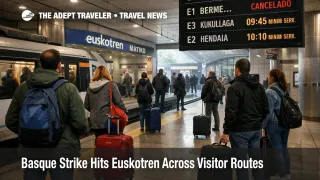
The Basque Euskotren strike is now a live regional mobility problem for travelers on March 17, 2026, not just a labor headline. Euskotren says all its services are affected, with only minimum service levels operating, and the operator's formal notice says the cut applies across rail in Bizkaia and Gipuzkoa, Metro Line 3 in Bilbao, the Bilbao and Vitoria Gasteiz trams, the Larreineta funicular, and several connected bus operations. For visitors, that matters because Euskotren is the connective tissue many use for Bilbao, Donostia San Sebastián, coastal towns, and some Bilbao side transfers rather than Spain's long distance rail network. The practical move is to add time, avoid tight same day sequences, and treat every connection as fragile until day of travel checks confirm what is actually running.
In plain terms, the Basque Euskotren strike reduces the region's local and medium distance transport backbone on the same day a wider general strike is meant to bring demonstrations and wider disruption across the Basque Country and Navarre. That combination is what raises traveler risk. Even where a train or tram still runs under minimum service, the feeder layer around it can slow enough to break a normal airport transfer, hotel arrival, or day trip plan.
Basque Euskotren Strike: What Changed
What changed is that Euskotren moved from normal service to a published strike day operating plan for Tuesday, March 17. The company says it will provide only the minimum services set by the Basque government, and the Spanish language strike notice pegs that minimum level at 30 percent. The same notice also confirms the disruption is network wide inside Euskotren's system, not limited to one rail branch or one city mode.
For travelers, the most important detail is breadth. Euskotren's strike notice explicitly covers the Bizkaia and Gipuzkoa rail network, Bilbao Metro Line 3, trams in Bilbao and Vitoria Gasteiz, the Larreineta funicular, and Euskotren run bus services tied into Bizkaibus and Lurraldebus operations. That means a visitor can get caught by the strike even if the original plan was not "take the train," because the weak point may be the tram into central Bilbao, the Metro Line 3 handoff, or a linked bus movement around a station area.
Which Visitor Corridors Are Most Exposed
The highest exposure sits on the visitor heavy Euskotren rail corridors that connect Bilbao with the coast and Donostia San Sebastián. Euskotren's own line attachments for the strike include E1 Matiko to Amara, E2 Lasarte Oria to Hendaia, E3 Lezama to Kukullaga Etxebarri, E4 Matiko to Bermeo, and Line 3 between Matiko and Kukullaga Etxebarri. San Sebastián tourism guidance specifically highlights Euskotren as the east to west narrow gauge rail link between Bilbao and San Sebastián, passing places such as Zarautz, Hendaye, and Lasarte, while Bilbao tourism points to Euskotren for movements toward Gernika, Urdaibai, Durango, and onward along the Gipuzkoa coast.
That makes several common visitor patterns vulnerable. Bilbao based travelers heading to coastal day trips such as Gernika, Bermeo, or Urdaibai lose frequency and flexibility. Donostia visitors using Euskotren for Zarautz, border side moves toward Hendaye, or westbound links toward Bilbao also face thinner service. And travelers relying on Bilbao's local mesh, especially Line 3 and tram interchanges, may find that even if the airport flight itself is fine, the city to station chain becomes unreliable enough to threaten check in timing.
Bilbao Airport (BIO) is part of this story indirectly, not because Euskotren serves the terminal directly, but because many travelers combine the airport bus with Bilbao city rail or metro segments. Aena and Bilbao Turismo both point travelers to the A3247 airport bus as the core public transport link between the airport and central Bilbao. On a normal day that still works cleanly. On a strike day, the airport bus can remain available while the onward urban or regional leg becomes the failure point, which is why Bilbao arrivals connecting onward by Euskotren should build more slack than they usually would.
What Travelers Should Do Now
For March 17 travel, the safest move is to simplify. If you are sleeping in Bilbao, keep Bilbao plans in Bilbao. If you are sleeping in Donostia San Sebastián, keep the day local rather than stacking coastal hops, museum bookings, and a fixed return. Travelers moving between cities should assume lower frequency, longer platform waits, and more crowding on whatever minimum service actually runs. A practical buffer is at least 60 to 90 extra minutes for Bilbao or Donostia urban transfers, and more if you are combining airport arrival, luggage, and onward rail the same day.
For airport planning, do not build a same hour chain from Bilbao Airport into a rail departure. Use the airport bus first, then reassess in central Bilbao before committing to an onward move. For San Sebastián arrivals or departures, favor direct coach or private transfer options if the day includes a flight, a cruise style embarkation deadline, or a hard timed tour. The tradeoff is cost versus reliability, and on March 17 reliability is the scarcer asset.
The next decision point is whether this remains a one day disruption or turns into a pattern. Right now, Euskotren's public notice is tied specifically to March 17, and the broader union material frames that date as part of a general strike push over a regional minimum wage demand. That supports caution about follow on labor tension, but not a claim that more Euskotren strike days are already scheduled. Travelers with Basque Country rail dependent plans later this week should monitor Euskotren advisories rather than assume a repeat. For broader planning context, Europe Transport Strike Dates 2026 for Flights and Trains, Western Europe Strike Spillover Risk For Airport Transfers, and Europe Airport Strikes: Compensation and Re-Routing Guide are the most relevant Adept references.
Why This Strike Spreads Beyond One Rail Line
The mechanism here is simple but easy to underestimate. Euskotren is not just one intercity train. It is a web of rail, tram, metro connected, funicular, and bus services that solve the middle distance and feeder problem across the Basque Country. When the operator drops to minimum service, the first order effect is fewer departures and longer waits. The second order effect is that the remaining transport options suddenly have to absorb more people with less timing certainty, which is what causes missed hotel check in windows, failed lunch reservations, and broken airport or border side transfers.
The wider March 17 general strike makes that propagation risk worse. Union material says the strike spans the Basque Country and Navarre, and the demand centers on a regionally set minimum wage. For travelers, the politics matter less than the operational result, which is that public transport stress can coincide with demonstrations, slower roads, and more crowding on substitute modes. A line that is technically running at minimum service can still become a poor choice if reaching it, or exiting it, takes far longer than planned.
That is why this is more than a rail story. A Basque Euskotren strike changes how you should sequence the day. It favors point to point plans over hub and spoke sightseeing, direct buses over multi leg improvisation, and overnight stability over ambitious same day chaining between Bilbao, Donostia San Sebastián, airport arrivals, and coastal stops. Travelers who trim complexity can still move. Travelers who rely on normal local frequency may find that the trip breaks at the connections.