

Berlin Airport Strike Stops Flights March 18
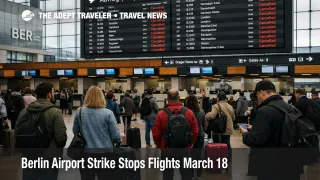
The Berlin airport strike has shut down regular passenger flights at Berlin Brandenburg Airport (BER) on Wednesday, March 18, 2026, turning a labor dispute into a full airport closure day for most travelers. BER said no scheduled passenger flights would be possible, and Reuters reported roughly 445 arrivals and departures and about 57,000 passengers were affected. For travelers, this is not a normal delay day. It is a reroute, refund, or overnight decision day.
This is also an update story, not just a repeat warning. The new fact is that the airport closure is live and operational, not merely threatened. Lufthansa Group's advisory framed the BER strike disruption window as 400 a.m. to 1059 p.m. CET on March 18, while the airport's own message was even clearer, no regular passenger flights would operate that day.
The high level decision is straightforward. Travelers on single tickets should work through their operating airline first and preserve protection to the final destination. Travelers on separate tickets, same day tours, or short city breaks should be more willing to cut losses early, because the second order damage here is missed onward flights, nonrefundable hotel nights, and baggage separation, not just a late departure.
Berlin Airport Strike: What Changed for Travelers
What changed is scope. BER and Berlin officials said regular passenger operations would be completely suspended on March 18, and Reuters matched that with the estimate of roughly 57,000 affected travelers. That makes Berlin one of the clearest same day airport shutdown stories in Europe this month.
For outbound passengers, the practical meaning is that leaving for the airport without a confirmed replacement plan is hard to justify. For inbound passengers, Berlin is no longer a reliable same day arrival point, so rebookings may push arrivals into other German hubs or into next day operations. The airport is directing passengers to their airline or tour operator for rebooking and alternative transport, which is another sign that this is being managed as a full passenger schedule stop, not a selective trim.
Some carriers may still move passengers through other cities, but that does not mean the trip is intact. The first order effect is canceled departures and arrivals at BER. The second order effect is pressure on replacement seats, longer surface transfers, and more travelers trying to rebuild itineraries at once.
Which Travelers Face the Most Disruption
The most exposed travelers are those booked to start or end a trip in Berlin on March 18, especially anyone with onward same day connections, separate tickets, cruise embarkations, prepaid tours, or event bookings that lose value if arrival slips by a day. Short haul travelers inside Germany or nearby Europe may still have rail based rescue options. Long haul travelers usually have less room to improvise because alliance protection, baggage handling, and legal duty of care work best when the airline keeps the trip on one protected booking.
Berlin also has a strong rail link to the airport area, which matters for self rescue and for repositioning away from BER. Official BER ground transport information shows the Airport Express, FEX, running between Berlin Central Station, Potsdamer Platz, Südkreuz, and BER, with Berlin Central Station to BER taking about 23 minutes, plus regional and S Bahn options serving the airport station under Terminal 1. That does not save the flight schedule, but it does help travelers get back into the city quickly, reach hotels, or reposition for long distance rail.
This is where earlier German disruption patterns matter. Germany Transit Strike Feb 27, 28 Hits Airport Access showed how city transport failures can break the trip before the flight does. Lufthansa Strike Hits German Hubs March 12 To 13 showed how fast hub level aviation disruption can ripple across Germany. For broader planning logic during this kind of rolling labor cycle, Europe Transport Strike Dates 2026 for Flights and Trains is the better framework than watching one airport in isolation.
What Travelers Should Do Now
The immediate move is to stop treating BER as a viable same day departure point unless your airline has already issued a specific protected reroute. If your ticket is within EU passenger rights scope and your flight is canceled, you have the right to reimbursement or rerouting, and the carrier still owes assistance and care while you wait for alternative transport. That can include meals and accommodation when needed.
The harder judgment is compensation. EU guidance says compensation is not owed when the disruption was caused by extraordinary circumstances that could not have been avoided even if all reasonable measures were taken. Because this disruption stems from an airport labor action rather than a normal airline controlled operating problem, travelers should expect refund, rerouting, and care to be the stronger claims than cash compensation, though the airline's final handling of each case still matters.
For the next 24 to 72 hours, watch three things. First, whether your airline rebooks you onto a protected itinerary or leaves you to choose a refund. Second, whether alternative routings through other German or nearby European hubs remain same day bookable. Third, whether labor negotiations produce a settlement signal before the next scheduled round of talks on March 25, which will shape whether this remains a one day shock or part of a wider pattern.
Why This Is Happening, and How the Disruption Spreads
The strike was called by ver.di in an ongoing pay dispute tied to public sector employers. Reuters reported the union rejected the employers' offer during the second bargaining round, and the airport operator said the warning strike meant no scheduled passenger flights would be possible on March 18.
Operationally, airport labor actions spread differently from airline specific strikes. When the airport layer fails, the breakdown is broader. Check in, handling, security related processes, and terminal flow all come under pressure at once, so even airlines willing to operate cannot necessarily preserve a normal passenger schedule. That is why BER moved straight to a no regular passenger flights message rather than promising partial continuity.
That system level failure is what makes the traveler tradeoff so stark. Waiting can save money if your carrier later restores options you like, but rebooking early can save the itinerary when replacement seats begin disappearing. On March 18, Berlin is less a flight delay story than a network recovery story, and the next decision point is not at the gate. It is whether you can still preserve the trip before the replacement market tightens further.
Sources
- No regular flights at BER on Wednesday, Berlin Brandenburg Airport
- Flights Halted at Berlin Airport as Strike Grounds Operations, Reuters
- German Union Calls Strike at Berlin Airport on Wednesday, Reuters
- Arrival and Departure by Public Transport, BER Airport
- Air Passenger Rights, European Union
- Air Passenger Rights FAQ, European Union
- Strike Announcement by the Trade Union ver.di at Berlin Airport on 18 March 2026, Lufthansa Group
- Strike at Berlin Airport, All Flights Cancelled on Wednesday, Euronews