

Israel Taba Exit Rules Tighten Beyond The Border
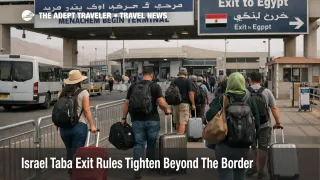
Israel Taba exit rules changed again on March 18, 2026, not because the crossing shut, but because the support structure around it thinned out while the border itself stayed usable. The U.S. Embassy in Cairo said it ended its presence at the Taba border crossing on March 18, while the crossing remains open and operating normally. At the same time, updated British government advice now spells out a harder cash and paperwork reality for anyone trying to go beyond Taba into Sinai or mainland Egypt, including a recommended minimum of $110.00 (USD) in cash per person, higher charges for deeper travel, and a "letter of guarantee" requirement for some onward Egypt entries.
This is the meaningful shift from our earlier Israel exit coverage. Before, the traveler problem was mainly how to reach Taba and whether the route was functioning. Now the route is functioning, but travelers must assume less on site handholding, more self managed cash and document preparation, and a higher chance that a workable border exit still turns into a failed onward plan if they arrive underfunded or without the right visa path. For most travelers, the practical move is to treat Taba as a border process plus a second Egypt logistics stage, not as a complete exit solution.
Israel Taba Exit Rules: What Changed On March 18
The core fact is simple. Menachem Begin Crossing at Taba remains open 24 hours a day, seven days a week, and both the Israel Airports Authority and the U.S. Embassy in Jerusalem continue to describe the crossing as operating. The change is that the U.S. Embassy in Cairo says its team ended its presence at the crossing on Wednesday, March 18, 2026. That does not close the route, but it does remove one visible layer of U.S. assistance at the handoff point between Israel and Egypt.
British advice now adds the clearest public pricing ladder yet for what happens after you cross. Travelers staying only in Taba should expect a $10.00 (USD) border tax for an entry permission stamp valid up to 15 days. Travelers going farther within South Sinai, including Sharm El Sheikh, should expect a $60.00 (USD) border tax. Travelers heading beyond Sinai, including those trying to continue by air from Cairo or Hurghada, should expect that same $60.00 (USD) border tax, a $30.00 (USD) standard entry visa, and at Taba, a "letter of guarantee" that British guidance says is provided by travel agents and costs around $20.00 (USD).
That is why the new minimum cash guidance matters. The British government now recommends bringing at least $110.00 (USD) cash per person, and more if you may need additional onward transport or charges. It also warns that ATMs at Taba are unreliable and often run out of cash, which means the crossing can fail as a practical exit for travelers who are technically allowed through but arrive without enough U.S. currency in hand.
Which Travelers Face The Biggest Taba Border Risks
Travelers whose plan ends in Taba have the simplest case. If the goal is just to cross into Egypt and stay in the Taba area for a short period, the process is lighter, the cash requirement is lower, and the Sinai only permission stamp is usually enough. This group still needs passport validity, cash, medications, charging access, and a realistic transfer plan out of Eilat, but it avoids the visa and onward Egypt complexity that now causes the biggest friction.
The next risk tier is travelers going deeper into South Sinai, especially to Sharm El Sheikh for onward flights. The U.S. Embassy in Jerusalem says shared minibuses and private taxis are readily available from Taba to Sharm El Sheikh, and overland transport to Cairo can also be arranged, though that drive can run eight to nine hours and routes may be constrained by security restrictions. That means Taba can still work well for travelers targeting Sharm flights, but only if they budget for the higher Sinai border charge, ground transport time, and a missed connection buffer that is much wider than a normal same day airport transfer.
The highest risk group is anyone trying to use Taba as a bridge to mainland Egypt, especially Cairo or Hurghada departures. This is where the letter of guarantee becomes operationally important, not just bureaucratic. Without the right visa path, enough cash, and enough time, a traveler can cross out of Israel successfully and still fail to continue. Families, older travelers, travelers with limited mobility, and anyone depending on same day domestic Egypt air tickets have the most to lose from that kind of partial success.
What Travelers Should Do Before Heading To Taba
The first decision is whether Taba is your endpoint or only your bridge. If you only need to get out of Israel and can stay near Taba or elsewhere in South Sinai, the process is still comparatively manageable. If you need Cairo, Hurghada, or another mainland Egypt point, build the trip backward from the visa and cash rules, not from the flight schedule. That means carrying the required U.S. cash before you leave for Eilat, confirming passport validity, and assuming you may need to buy the onward visa and guarantee letter at the border.
The second decision is timing. Taba is open 24/7, but onward transport and onward flights are not. Travelers should leave a wide margin between crossing and any domestic Egypt flight, and a hotel night in Taba, Taba Heights, or Sharm El Sheikh can be the safer choice when the onward leg is important. This matters more now because the crossing remains a practical exit, but the U.S. Embassy's on site presence is no longer part of the process, so travelers should expect more self navigation if something stalls.
The third decision is what to monitor over the next 24 to 72 hours. Watch the U.S. Embassy Jerusalem alerts for route status, the U.K. travel advice pages for fee or paperwork changes, and Egyptian entry guidance if you plan to move beyond Sinai. Also keep an eye on related Adept coverage, including Israel Exit Planning Shifts to Managed Departure Lanes, Israel Consular Suspension Extends Taba Exit Push, and the evergreen guide Egypt Tourist Entry Requirements For 2026.
Why The Taba Route Still Works, But Feels Harder
The mechanism is not a border closure story. It is a border systems story. Taba still works because the physical crossing remains open, Israeli and foreign travelers can still use it, and Egyptian entry options still exist for Sinai only or wider Egypt travel. What changed is that the route now demands tighter coordination between border fees, visa type, onward transport, and flight timing. That raises the penalty for loose planning.
First order, travelers who prepared well can still get out through Taba. Second order, everyone else pushes pressure onto the weak points around it, shuttle seats to Eilat, cash sourcing before arrival, hotel inventory for a stopover night, and domestic Egypt flight timing from Sharm El Sheikh International Airport (SSH), Cairo International Airport (CAI), or Hurghada International Airport (HRG). That is why this update matters even though the crossing itself remains open. The route is viable, but it is no longer forgiving.
Sources
- Security Alert: U. S. Embassy Cairo, Egypt (March 18, 2026)
- Security Alert, U.S. Embassy Jerusalem, March 18, 2026
- Israel Travel Advice, GOV.UK
- Egypt Entry Requirements, GOV.UK
- Egypt Travel Advisory, U.S. Department of State
- Israel Airports Authority, Land Border Crossing Updates
- Menachem Begin Opening Hours, Israel Airports Authority