

London Tube Strike Pause Eases Late March Transfers
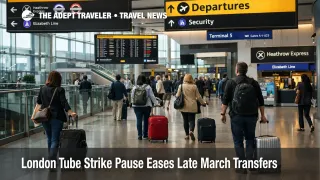
London's late March transfer picture has improved quickly, because the planned London Underground driver walkouts for March 24 to March 27 are now suspended. What changed since Adept Traveler's March 17 coverage is the reversal itself, not the underlying dispute. Transport for London says services will operate as normal on the suspended March dates, which takes immediate pressure off Heathrow, London Gatwick, Eurostar, and central hotel transfers, at least for next week's travel window. Travelers should still treat this as a pause, not a full settlement, because both RMT and Reuters say talks are continuing and the dispute remains live.
The main practical change is that travelers who were about to rebuild London plans around strike timetables can mostly shift back to normal Underground assumptions for Tuesday, March 24, through Friday, March 27. That reduces the need for costly last minute coach, taxi, hotel, and rail workarounds that were becoming more likely when the March action was still on the calendar. It also lowers the odds of crowding spilling from the Piccadilly line onto the Elizabeth line, Heathrow Express, and National Rail interchange points such as Paddington and Farringdon.
London Tube Strike Pause, What Changed for Travelers
TfL's current strike page says the Tube drivers' strikes are suspended on Tuesday, March 24, to Wednesday, March 25, and on Thursday, March 26, to Friday, March 27, and adds that services will operate as normal on those dates. That is the key late March traveler takeaway. If you were holding off on airport transfer bookings, deciding whether to move a hotel night, or pricing backup road transport, the immediate late March urgency has eased.
That said, this is not a clean labor peace story. RMT said on March 18 that it suspended strikes this month after progress in talks with London Underground management, but it also said the dispute over compressed four day working remains "far from over," that further talks are planned, and that strike dates from April onward remain in place, with additional action set for June 16 to 19. Reuters separately reported that the dispute remains live.
For readers coming from London Tube Strike Dates Threaten Late March Transfers, the practical update is simple. The late March risk window that mattered most for same day airport, hotel, and rail moves has been pulled back, but the forward risk has not disappeared. It has shifted deeper into spring and early summer unless the talks produce a full settlement.
Which London Itineraries Look Better Now, and Which Still Need Caution
The biggest immediate winner is Heathrow planning. Heathrow's own rail guidance points travelers toward the Piccadilly line, the Elizabeth line, and Heathrow Express as core options into central London. When Tube action is suspended, the cheapest direct rail option to many parts of London is back in play, which matters for budget travelers, families, and anyone trying to avoid a last minute car transfer.
Gatwick linked itineraries also look steadier, especially for travelers depending on a rail based move between the airport and central London before connecting onward. London Gatwick says central London is reachable by train in under half an hour, which becomes more dependable when the Underground is not simultaneously absorbing strike related displacement from other corridors. Eurostar passengers, West End hotel guests, and meeting heavy business travelers also benefit because a normal Tube week reduces the chance that a single cross city handoff breaks the rest of the day.
The trips that still deserve caution are the ones later in the spring. TfL is still listing Tube driver strike dates on April 21 to 24, May 19 to 22, and June 16 to 19. That means travelers booking Easter-adjacent business trips, late April city breaks, or May airport rail connections should not assume the story is over. The cleanest warning signs to watch are whether TfL keeps those dates posted, whether RMT starts using harder language again, and whether London Underground and the union stop describing talks as productive.
What Travelers Should Do Now
For travel in London next week, the sensible move is to revert to a normal transport plan, but keep one backup route in mind. If you are flying through London Heathrow Airport (LHR), know your best non Tube fallback, usually the Elizabeth line or Heathrow Express, and keep an eye on TfL's live travel tools before you leave for the airport. If you are staying farther from a rail hub, price a car transfer early anyway, then decide later whether you need it.
For April and May trips, do not spend money yet just because future strike dates still exist, but do avoid fragile same day connections that depend on everything working perfectly. That means tighter caution on Gatwick to Heathrow transfers, cruise embarkation days, early Eurostar departures, and separate ticket itineraries. Waiting may save money if talks keep improving, but locking in a hotel near the airport or a flexible backup rail route can save the trip if the dispute turns hard again.
Travelers who have never worked London's transfer logic before should also read London Travel Guide: The Ultimate 7-10 Day Itinerary for First-Time Visitors, especially the airport to city transport sections. The main threshold is simple. For late March, you can mostly plan normally again. For April and beyond, you should monitor the dispute and build buffer into any itinerary with a hard downstream clock.
Why the Dispute Is Paused, Not Solved
The dispute centers on proposed changes to Tube driver working hours. Reuters reported on March 10 that the conflict was tied to a plan to compress the working week into four days, which RMT argued raised fatigue, safety, and work life balance concerns. On March 18, RMT said London Underground had taken steps in the right direction and was now willing to negotiate, which is why the March action was suspended. But the union also said the dispute remains live, and TfL's own public strike page still preserves multiple future dates.
That matters because Tube strikes are rarely just a commuter inconvenience for visitors. The first order effect is weaker Underground service. The second order effect is substitution pressure across airport trains, road corridors, station interchanges, hotel check in timing, and even same day onward rail or cruise connections. When the Tube weakens, demand shifts onto Heathrow Express, the Elizabeth line, Thameslink, buses, taxis, and coaches, and those alternatives can become the real bottleneck. The pause removes that near term March pressure, but it does not remove the structural risk if negotiations fail later.