

Qatar Depart Now Advisory Keeps Exit Pressure High
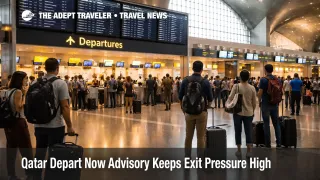
The Qatar depart now advisory is still an active travel decision, not background noise. As of March 21, 2026, the U.S. State Department still says non emergency U.S. personnel were ordered out on March 2, U.S. Embassy Doha has suspended routine consular services until further notice, and Americans are strongly encouraged to depart using commercial transportation while it remains available. At the same time, Qatar Airways says it is operating only a revised limited schedule through March 28, 2026, which means the exit window is open in a narrow, managed way rather than through normal hub operations. Travelers already in Doha, especially those with expiring documents, complex onward plans, or little buffer, should treat this as an active departure threshold.
Qatar Depart Now Advisory, What Changed
What changed is not the existence of risk, it is the combination of official U.S. departure guidance with a still constrained air system. The State Department's Qatar pages continue to tell Americans to depart now, to be prepared to shelter in place if they remain, and to have an emergency departure plan that does not depend on U.S. government help. The embassy's March 20 security alert also says routine consular services remain suspended and public access to the embassy is not permitted at this time.
That matters because Qatar is no longer just a story about whether Hamad International Airport (DOH) is technically moving passengers. It is now also a consular access story. A traveler who loses a passport, needs routine documentation help, or expects a normal embassy support channel is operating with less margin than usual. Qatar Airways is still running only a limited schedule, and the carrier says its scheduled operations continue to be capped by the closure of Qatari airspace and temporary restricted corridors approved by authorities. That keeps the system usable for some departures, but fragile for missed connections, rebookings, and same day recovery.
In an earlier Adept Traveler article, Doha Hamad Airport Pulls Back as Flights Stay Limited tracked how the operating environment in Doha was still being treated as serious by airport leadership, even as limited flying continued. The picture now is similar, but the traveler decision is clearer. This is still an exit planning problem, not a routine wait it out situation.
Which Travelers In Doha Face the Hardest Exit Risk
The most exposed travelers are not all in the same category. U.S. citizens and other foreign visitors who expected embassy access for routine services face one obvious problem. Transit passengers or short stay visitors with onward long haul plans face another. Anyone whose trip stacks air, hotel, and land arrangements tightly is more vulnerable because a limited schedule gives fewer ways to recover from a canceled or retimed leg.
Document timing is one of the sharper practical risks. In an earlier Adept Traveler article, Qatar Visa Extension Eases Overstay During Airspace Halt, the site reported that Qatar's Ministry of Interior said certain entry visas that were expired or near expiry would be extended automatically for one month, with no fees, during the disruption window. That helps, but it does not turn Qatar into a low risk place to wait indefinitely. Visa relief does not restore routine consular access, increase flight capacity back to normal, or remove the chance that a narrowing flight network leaves travelers competing for fewer exit options.
The next group at risk is travelers who think "commercial transportation remains available" means normal commercial transportation. It does not. The State Department language means some paths out still exist. Qatar Airways' own advisories show those paths remain limited, date bound, and operationally constrained. That distinction matters. A normal hub can absorb rebookings and missed connections with frequency. A limited hub cannot.
What Travelers Should Do Now
Travelers already in Qatar should first decide whether their trip can tolerate failure. If a one day slip would break a cruise embarkation, guided tour, business event, school return, visa timeline, or complex onward itinerary, the safer move is to leave while a commercial option is still available. Waiting may preserve a preferred routing, but it reduces slack in a system that is already running on restricted capacity.
The second priority is documentation and redundancy. Keep digital and paper copies of passports, visas, tickets, and hotel records. If you are a U.S. traveler, use the embassy's emergency contact channel rather than assuming routine in person services are available. Confirm whether your airline ticket is on Qatar Airways' limited operating schedule, and do not assume a transfer that looks legal on paper will be easy to recover if one segment moves late. Build more ground time into airport arrival, and avoid last flight of day logic where possible.
The practical threshold for waiting versus leaving is simple. Waiting is more defensible if you have several days of flexibility, no urgent document issue, secure lodging, and a backup plan that does not rely on embassy routine services. Leaving is the stronger choice if your documents are time sensitive, your budget cannot absorb extra hotel nights, your onward trip has hard deadlines, or you would struggle to manage a sudden shelter in place period. The State Department has already laid out the baseline: if you remain, be prepared to shelter in place, and have an emergency departure plan that does not depend on U.S. government help.
Why the Qatar Exit Window Still Matters
The mechanism is straightforward. Consular access, flight capacity, and traveler resilience are three different layers. Qatar's current problem is that all three are under pressure at once. Routine embassy services are suspended. Flight capacity is still restricted. The result is that ordinary travel friction, a missed connection, a passport issue, a late schedule change, can escalate faster than it would in a normal hub environment.
First order, travelers face fewer flights, thinner rebooking options, and less routine consular backup. Second order, those constraints spill into hotel costs, onward itinerary failure, baggage recovery delays, and documentation stress if something changes unexpectedly. Reuters reported earlier this month that the U.S. was urging Americans across parts of the region to use available commercial transportation without offering a government backed exit lane, which reinforces the core point here: availability is not the same as stability.
What happens next depends on two signals. The first is whether the State Department and U.S. Embassy Doha soften their departure language or restore routine services. The second is whether Qatar Airways moves from a limited temporary program back toward broader normal scheduling. Until those two things change, Qatar remains a place where travelers should think in terms of exit planning, not ordinary trip management.
Sources
- Qatar International Travel Information, U.S. Department of State
- Qatar Travel Advisory, U.S. Department of State
- Security Alert, U.S. Embassy Doha, Qatar, March 20, 2026
- Travel Alerts, Qatar Airways
- Qatar Airways to Operate Limited Flights
- Doha Hamad Airport Pulls Back as Flights Stay Limited
- Qatar Visa Extension Eases Overstay During Airspace Halt