

Air Canada Dubai Suspension Stretches to April 30
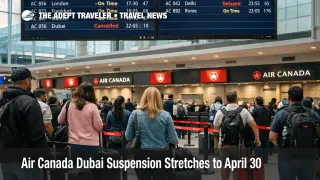
Air Canada has turned Dubai from a late March disruption into a deeper spring planning problem for Canadian travelers. The carrier's current Middle East advisory says flights to and from Dubai International Airport (DXB) are suspended through April 30, 2026, inclusive, while Tel Aviv remains suspended through May 2, 2026, inclusive. For travelers, the main change is not just the cancellation itself. It is that Air Canada now pairs that longer Dubai suspension with a wider rerouting and credit framework that reaches beyond Dubai and Tel Aviv into other Middle East airports, which changes how April trips should be repaired or abandoned.
The practical consequence is straightforward. Direct Air Canada Dubai itineraries are off the table for the rest of April, and self built replacements are likely to be more fragile than they looked a week or two ago. Travelers trying to preserve Gulf, India, Africa, or Europe trips by stitching together separate tickets now face higher odds of misconnects, baggage breaks, overnight holds, and fare pressure through alternate hubs. The next decision point is whether to take Air Canada's controlled options, or to rebuild only if the rest of the trip still works with more time, more cost, and less protection.
Air Canada Dubai Suspension, What Changed
The clearest new fact is the date. Air Canada's current advisory now shows Dubai canceled through April 30, 2026, inclusive. That is materially different from the carrier's March 6 update, which had Dubai suspended only through March 28, 2026, inclusive. In an earlier Adept Traveler article, Air Canada Extends Dubai, Tel Aviv Suspensions, the story was a late March planning problem. Now it is an April planning problem, which reaches into Easter period demand, spring family travel, and Canada to Gulf connecting flows.
The second meaningful change is the breadth of Air Canada's recovery language. Its March 19 goodwill policy says eligible customers on Air Canada ticket stock can rebook once without a change fee, keep the same destination on later Air Canada operated flights within the published window, switch to another Air Canada destination in Europe, the U.K., India, or Africa, or take AC Wallet or a future travel credit. Refunds remain subject to fare rules, which means some passengers will still face a harder money decision than a simple no questions asked cash refund.
That matters because a dated suspension plus a bounded reroute menu is more useful than open ended disruption language, but it is also more limiting than many travelers will assume. Air Canada is not offering an unrestricted rebuild across any partner or any Middle East point. The airline is offering a narrower self rescue path centered on its own network, which works best for travelers whose real destination can be substituted with Europe, India, or Africa, and much less well for travelers whose actual need is Dubai itself.
Which Spring Travelers Are Most Exposed
The most exposed group is Canadian travelers who specifically wanted Air Canada's nonstop or single ticket Dubai flow rather than a generic Gulf itinerary. That includes passengers originating in Toronto, Ontario, Canada, plus domestic feeders from Western Canada, Atlantic Canada, and smaller Ontario markets that were meant to connect onto Dubai on one protected ticket. When the long haul nonstop disappears, the replacement trip usually gets longer, less protected, and more expensive at the same time.
The next group at risk is travelers using Dubai as a hinge rather than a final stop. Some Canada based passengers were using Dubai for onward links to India, East Africa, the Gulf, or separate luxury and business itineraries that assumed easy hub functionality. Those travelers are now pushed toward Europe, India, or Africa alternatives on Air Canada's side, but the rest of the journey may still require a second ticket, a separate baggage check, or an overnight buffer. That is where a manageable airline cancellation turns into hotel costs, lost transfer bookings, and a bigger chance that one delayed leg breaks the whole chain.
There is also a wider Middle East exposure bucket, even for people not ticketed to Dubai or Tel Aviv. Travelweek reports that Air Canada's updated policy also covers credit or alternate destination relief for customers ticketed on or before March 16, 2026, to a broader set of airports including Abu Dhabi, Amman, Baghdad, Bahrain, Basrah, Beirut, Damascus, Dammam, Doha, Erbil, Jeddah, Kuwait City, Madinah, Riyadh, and Tehran. That does not mean those airports are all canceled by Air Canada in the same way Dubai is. It means the airline recognizes a wider regional planning problem and is giving some affected customers a way to get out of exposed itineraries without trying to force the original routing.
What Travelers Should Do for April Plans
For April Dubai departures, the cleanest move is usually to decide whether Dubai is the trip, or whether Dubai was only the bridge. If Dubai itself is the point of the trip, the Air Canada Dubai suspension should push most travelers toward rescheduling, taking credit, or waiting for a carrier led restart rather than trying to improvise a complex same week rebuild. If Dubai was only the bridge, then Air Canada's alternate destination policy may preserve the broader trip, but only if the replacement endpoint still works operationally and financially.
The threshold for self repair should be stricter than normal. Rebuild only if you can keep most of the trip on one protected ticket, absorb at least one overnight buffer at a connecting point, and tolerate baggage not checking through to the final stop. If the replacement depends on separate tickets through a pressured European or Gulf gateway, or if arriving one day late breaks a cruise embarkation, guided tour, or meeting sequence, the safer move is usually to reset the itinerary rather than chase a fragile April departure.
Travelers should also read the ticket rules carefully before assuming cash will come back automatically. Air Canada's goodwill page says refunds remain subject to fare rules, while credit options and one free change are the clearer relief paths. That means passengers holding nonrefundable hotels, tours, or separate onward flights should line up those supplier decisions at the same time, not after accepting an airline credit that may solve only one part of the trip. In the final stretch of an April plan, the best use of the Air Canada Dubai suspension advisory is as a decision deadline, not as a reason to wait indefinitely.
Why the Reroute Problem Extends Beyond Dubai
Dubai is only one node in the problem. The bigger mechanism is that Gulf aviation has been running in a partial recovery environment for weeks, with rolling suspensions, selective hub restart behavior, and narrower usable corridors. In an earlier Adept Traveler article, Middle East Airspace Closures Ground Gulf Hubs, the issue was immediate network shock. By late March, the problem has shifted into a spring capacity and reliability story, where some flights exist again, but not enough to make every hub or every connection dependable.
That is why seat pressure does not stay confined to one carrier. When Air Canada removes Dubai for another month, some of that traffic spills into Europe, some into India, some into Africa, and some into other Gulf gateways that are themselves operating with less slack than normal. First order, travelers lose the nonstop. Second order, they compete harder for alternate seats, ground transfers, and hotel rooms around replacement hubs. Third order, the trip becomes less tolerant of even small timing errors, especially when it is rebuilt across multiple bookings.
What happens next depends on whether carriers start publishing firmer May recovery plans or extend again. For now, Air Canada has given travelers a clearer answer than many airlines do, which is useful. It is also a warning. The Air Canada Dubai suspension now reaches far enough into spring that waiting for a near term normalization is no longer the smart default for most April departures.