

Dubai Airport Weather Risk Hits Departures Through March 27
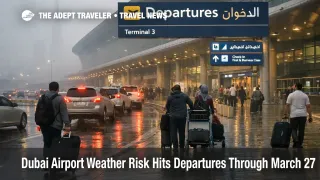
Travelers departing Dubai International Airport (DXB) now face a second execution problem on top of the Gulf's wider flight disruption cycle. Emirates said on March 23, 2026 that customers departing Dubai between March 23 and March 27 should allow extra time for the trip to the airport because adverse weather may affect road visibility and driving conditions, and it advised arriving no less than two hours before departure. That shifts part of the risk away from the terminal and onto the airport approach itself, which matters for passengers who were already trying to time departures through a partially recovered hub.
Dubai Airport Weather Risk: What Changed
The new fact is operationally narrow, but important. Emirates is not warning only about flights. It is warning that the journey to DXB may take longer because reduced visibility and hazardous driving conditions could slow the road leg into the airport, and it set a clear buffer floor of at least two hours before flight time. The airline also told passengers to check flight status, review operational updates before leaving, and make sure booking contact details are current.
That changes the planning assumption for Dubai departures through Thursday, March 27. A published departure is no longer enough. Travelers also need a viable surface access window, especially if they are relying on ride hailing, hotel transfers, chauffeur service, or a tightly timed hotel checkout. Dubai Airports has carried parallel public messaging, reported by The National, telling passengers to allow additional time when traveling to DXB or Dubai World Central, Al Maktoum International Airport (DWC), and to check status directly with their airline before heading out.
Which Dubai Departures Face the Most Exposure
The highest exposure is on outbound trips where the margin was already thin. That includes early departures, premium itineraries built around last minute airport arrival habits, and any trip where a missed flight would also break a long haul connection, cruise embarkation, or same day event on arrival. Travelers using Dubai as a departure hub rather than as a final destination are especially exposed because one missed outbound sector can still leave them stranded inside a network that has not fully normalized.
The weather backdrop supports that caution. The UAE National Center of Meteorology said in its March 23 five day bulletin that unstable weather, rainfall of varying intensity, and winds strong enough to blow dust and sand are expected across the country through March 27, with horizontal visibility reduction specifically flagged on March 23, March 24, March 26, and March 27, and wind speeds reaching up to 60 km/h on Friday. That does not guarantee severe airport shutdowns in Dubai itself, but it does confirm a multi day access and operating window where road and airside timing can both degrade.
What Travelers Should Do Before Leaving for DXB
The practical move is to rebuild the pre airport timeline, not just the flight plan. Travelers departing through March 27 should treat the road journey to DXB as a variable leg, not a predictable one. Leaving earlier than usual is the cleanest protection, especially for checked bag travelers, families, and anyone starting from a beach resort, outer suburb, or another emirate. Emirates' minimum advice is no less than two hours before departure, but that is better read as a floor than a target in bad conditions.
The decision threshold is simple. If missing the flight would also break an onward long haul itinerary, burn a premium cabin redemption, or trigger hotel and ground transfer losses at destination, do not optimize for convenience. Optimize for execution. If your departure is flexible and your airline has already changed or reduced service, check whether moving to a later flight lowers risk more than gambling on a tight road run into the airport. In an earlier Adept Traveler article, flydubai Reduced Schedule Keeps Dubai Trips in Flux the main risk was confirmation. In an earlier Adept Traveler article, Dubai Phantom Flights Raise Gulf Transit Risk the risk was assuming a departure meant a successful arrival. This weather window adds another failure point before travelers even reach the terminal.
The next thing to monitor is not only your airline app. Watch for any strengthening of Dubai or UAE weather warnings, repeated visibility language, or fresh carrier instructions affecting airport arrival timing. If official messaging keeps emphasizing road conditions rather than only flight schedules, that is a sign the disruption remains a surface access problem as well as an air travel problem.
Why This Matters in Dubai's Partial Recovery Phase
This is a meaningful friction layer because Dubai is still operating in a recovery environment, not a clean slate. Emirates' live operations page still says it is running a reduced schedule after the partial reopening of regional airspace, and city check in points across Dubai remain temporarily closed until further notice. That means travelers have fewer slack points in the system than they would during normal operations. When surface access slows at the same time, the whole departure chain gets less forgiving.
First order, some passengers will simply arrive later than planned and face more stress at bag drop, security, or the gate. Second order, any road delay can collide with reduced schedules, thinner same day recovery options, and fragile onward connections through the Gulf. The practical reading is that Dubai departures through March 27 are still workable, but the old assumption that the airport run is the easy part no longer holds.