

U.S. Airport Security Strain Nears Continuity Risk
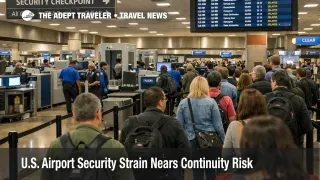
U.S. airport security strain moved closer to a continuity problem on March 23, 2026, not just another bad spring break line story. The latest shift is that the staffing shortfall at Transportation Security Administration checkpoints is now being discussed in operational terms that include airport shutdown risk at smaller fields, while the administration has also moved ahead with using Immigration and Customs Enforcement officers to support limited airport duties. For travelers, that means the main problem is no longer only how long a checkpoint wait might be. It is whether screening capacity at some airports becomes too thin to operate normally, or at all, if absences keep climbing.
That change matters most during a week when spring break demand is already pushing checkpoint throughput. Reuters reported on March 19 that Transportation Secretary Sean Duffy warned some small U.S. airports could soon shut if absenteeism worsens, because large hubs can sometimes consolidate lanes or terminals while smaller airports often depend on a single checkpoint. AP reported on March 23 that the political standoff remained unresolved, and that ICE officers would begin assisting TSA with support functions such as line management and ID checking at some airports, rather than full passenger screening.
The operational seriousness is higher than a normal busy travel day because the system is losing resilience at the checkpoint itself. AP reported on March 21 that 376 TSA officers had already quit during the funding lapse, while Reuters and AP separately described absenteeism above 10 percent nationally, with far higher rates at some airports. Once that kind of staffing erosion hits a checkpoint network, the consequences spread fast, first into long and uneven waits, then into missed departures, weak same day reaccommodation options, and airports that have less ability to absorb even modest disruption.
Which Airports Face the Most Fragility
The highest risk is not necessarily at the biggest airports. Large hubs such as Hartsfield, JFK, or Houston can suffer brutal waits and terminal imbalances, but they usually have more lanes, more physical space, and more options to reallocate staff or channel passengers. The more fragile airports are smaller commercial fields with one main checkpoint, limited staffing depth, fewer later departures, and little room to reroute passengers if screening output drops. That is why the small airport warning matters operationally even if headline images keep coming from the biggest hubs.
At the same time, major airports are where travelers will feel the most visible pain first. AP said several major airports were already seeing multi hour waits and missed flights, and local airport guidance in Houston shows how that strain starts to translate into reduced checkpoint options, terminal specific PreCheck availability, and closed screening points that force longer walks and earlier arrivals. John F. Kennedy International Airport has also suspended public wait time reporting because staffing and passenger volume are changing too quickly for the numbers to stay reliable.
That split creates two different traveler problems. At larger hubs, the first order effect is long, uneven screening waits and a higher risk of missing flights even when aircraft are operating. At smaller airports, the first order effect can become partial or full screening interruption. The second order effects are broader, hotel nights that were not planned, rental car extensions, broken domestic to international handoffs, and weakened recovery because aircraft, crews, and passengers all end up out of position. In an earlier Adept Traveler article, U.S. Shutdown Airport Risk Shifts to Continuity, that fragility was already becoming visible. On March 23, the difference is that the support measures are now live, while the underlying staffing problem is still not fixed.
What Travelers Should Do Now
Travelers should make decisions based on airport type, flight timing, and how hard the itinerary is to recover if something breaks. At a large hub, the practical move is to treat screening as unstable, even if your airline still shows the flight on time. For morning departures, holiday returns, or flights tied to cruises and international connections, arriving materially earlier than normal is the safer tradeoff because checkpoint delays are now less predictable than flight operations themselves. Houston airports are explicitly advising passengers to arrive early because open lanes can change shift by shift.
At a smaller airport, the key threshold is whether you have a same day backup if screening operations get constrained. If there is no practical second departure, no nearby alternate airport, or a tight onward connection, the better move is often to rebook proactively into a larger hub or an earlier flight rather than hope a fragile checkpoint setup holds. This is especially true for travelers beginning a long international itinerary on a regional feeder, because one missed domestic leg can collapse the whole trip.
The next threshold is what happens at check in or in airport alerts, not only what appears in an airline app. If an airport is warning of reduced checkpoint options, suspended wait time reporting, terminal specific screening changes, or unusually early arrival windows, treat that as a signal that the airport is operating with less slack than usual. In an earlier Adept Traveler article, U.S. Airports ICE Plan Raises New Travel Risks, the focus was on what ICE support could and could not solve. The answer now is clearer, those measures may help crowd flow at the margins, but they do not replace trained TSA screening capacity.
What Happens Next if Staffing Slips Further
What happens next depends less on another headline from Washington than on staffing behavior over the next several operational days. TSA told Congress in February that it was preparing surge staffing for the spring travel period, but Reuters and AP reporting since mid March shows the agency has already been leaning on that flexibility while unpaid staffing losses continue. If absences stabilize, the likely outcome is an ugly but manageable pattern of long lines, sporadic checkpoint closures, and airport specific screening changes. If absences rise again after another missed paycheck or more resignations, the risk shifts toward selective continuity failures, especially at smaller airports with minimal redundancy.
Travelers should watch for three signals. One is airport advisories that narrow where screening is available. Another is public guidance telling passengers to arrive four or five hours early, which usually means the local system is already operating under strain. The third is any confirmation that an airport is consolidating checkpoints or suspending screening at certain times of day. Once those signals appear together, U.S. airport security strain has moved beyond inconvenience and into a more serious continuity phase, where rebooking early can protect the itinerary better than waiting for the airport to recover on its own.
Sources
- Oversight Hearing - Potential DHS Shutdown Impacts - TSA
- ICE officers will begin assisting TSA as shutdown frustrates travelers and screeners
- TSA officers are quitting as a funding standoff forces them to staff airports without pay
- U.S. official warns small airports could soon shut down over TSA absences
- Government shutdown impacts TSA, passengers
- John F. Kennedy International Airport