

ICE at U.S. Airports Starts, Raising TSA Travel Risk
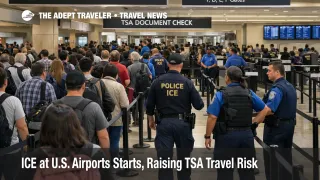
ICE at U.S. airports moved from threat to live operating change on March 23, 2026, and that pushes the U.S. spring travel problem into a more complicated phase. The deployment is aimed at relieving Transportation Security Administration staffing shortages during the partial Department of Homeland Security shutdown, not replacing core screening work, but it still changes how some checkpoints and terminal flows will be managed. Travelers now need to plan for both long lines and uneven security operations, especially at major hubs already warning of multi hour waits.
ICE At U.S. Airports: What Changed
Reuters reported on March 23 that hundreds of Immigration and Customs Enforcement officers and Homeland Security Investigations personnel were sent to 14 airports to help with security operations strained by unpaid TSA staff and rising absences. The administration's stated goal is to free TSA officers for certified screening roles by shifting other tasks, such as exit lane monitoring, line management, and some ID check support, to other federal personnel. That is an operational change, not a cosmetic one, because it alters how travelers move through checkpoints at a moment when staffing gaps are already slowing the system.
The clearest early signal came from Hartsfield Jackson Atlanta International Airport (ATL), where city officials said federal personnel would report to TSA and focus on line management and crowd control rather than immigration enforcement. Atlanta also advised passengers to arrive four hours early after hours long waits over the weekend and into Monday. AP and local reporting both described the role shift as unusual for airport checkpoint operations, even if immigration and customs personnel are already common in other parts of major airports.
Which Travelers Face the Most Disruption
The most exposed travelers are domestic passengers departing from large hubs with severe TSA absenteeism, especially those flying on peak spring break banks, early morning waves, or itineraries with short onward connections. Reuters reported national TSA absences at 10.2 percent on March 19, with much higher rates at some airports, including Atlanta and Houston Bush. That means the main risk is not only a slower checkpoint, but a less resilient departure chain when one weak point, security, breaks the timing of everything behind it.
Passengers at the largest airports may still have more backup options than travelers at smaller fields. In an earlier Adept Traveler article, U.S. Shutdown Airport Closure Risk Hits Small Fields outlined why smaller airports can become operationally fragile faster when staffing thins out. At the same time, major hubs remain the places where the longest visible lines and the biggest same day misconnect risk are showing up first. In an earlier Adept Traveler article, U.S. Airports ICE Plan Raises New Travel Risks examined the weekend announcement phase, but the March 23 shift matters more because the policy has now reached live airport operations.
What Travelers Should Do Now
Travelers should treat ICE at U.S. airports as a throughput issue first. Leave more time than normal for departures, protect tight same day connections, and avoid assuming that a staffed terminal exterior means the checkpoint inside is moving normally. At airports already publishing extreme waits, a four hour predeparture buffer is no longer excessive for standard passengers during peak periods. PreCheck still helps where open, but local reporting from Houston showed even premium access lanes were not consistently available.
The next decision point is whether to rework the itinerary before leaving for the airport. Travelers with checked bags, family groups, or connections under 90 minutes should be quicker to move to later flights than travelers with carry ons and nonstop itineraries. If the departure airport is a smaller station with limited daily service, rebooking before the trip day can be safer than trying to recover after a missed flight. In an earlier Adept Traveler article, TSA Shutdown Delays Deepen at U.S. Airports tracked how this problem expanded from lines to broader network risk as the shutdown dragged on.
Why This Is Happening, And What Comes Next
The mechanism is straightforward. TSA officers are working without pay during the partial shutdown, absences rise, screening capacity falls, lines grow, and the administration tries to protect the most visible choke points by moving other federal personnel into adjacent support roles. That can help at the margin, but it does not create more certified screeners, and even White House officials and union leaders have acknowledged limits on what ICE personnel can actually do inside aviation security operations.
That is why the seriousness of this change is meaningful, but not yet a full solution. First order, some airports may move lines more efficiently if crowd control and exit lane work are handled by additional personnel. Second order, travelers still face missed flights, broken domestic to international connections, extra hotel nights, rental car extensions, and uneven performance from airport to airport because the underlying shortage remains unresolved. Reuters also reported the political funding fight was still stalled on March 23, which means the next 24 to 72 hours matter more than the symbolism of the deployment itself. Travelers should watch three signals, airport advisories, published checkpoint wait trends, and whether Congress restores Department of Homeland Security funding before another missed pay cycle deepens absences again.
Sources
- Reuters, ICE agents begin deploying at some U.S. airports
- Reuters, U.S. says TSA absences rose slightly to 10.2% Wednesday
- Reuters, Trump ties DHS funding deal to approval of voter bill
- AP News, Federal immigration agents seen at Atlanta airport after Trump order amid partial shutdown
- Axios Atlanta, Atlanta airport TSA lines stretch for hours amid shutdown
- Houston Chronicle, Long TSA lines sprawl across three floors at Houston's Bush airport amid shutdown