

Spain Easter Airport Strikes Sharpen Flight Risk
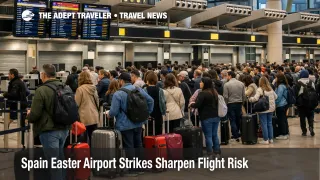
Spain Easter airport strikes now look more operationally defined, and that changes how travelers should plan the holiday week. Current reporting points to two different handling disputes with different clocks, not one single nationwide stoppage. In an earlier Adept Traveler article, Spain Airport Strikes Threaten Easter Flight Plans, the risk was broader. What is clearer now is where Groundforce's repeated partial stoppages could slow airport flow, and where Menzies' full day action could create a harder baggage, boarding, and turnaround problem. For travelers with checked bags, short connections, island transfers, or same day cruise and hotel commitments, that makes the decision window more urgent before March 27, 2026.
Spain Easter Airport Strikes: What Changed
Groundforce staff are reported set to begin an indefinite partial strike on Friday, March 27, 2026. The reported pattern is Mondays, Wednesdays, and Fridays, with stoppages from 500 a.m. to 700 a.m., 1100 a.m. to 500 p.m., and 10:00 p.m. to midnight. Separate Menzies action is reported as 24 hour stoppages on March 28 to 29 and April 2 to 6. That split matters because repeated partial windows tend to degrade the system in waves, while full day handling stoppages can hit baggage, passenger processing, refueling, cleaning, and aircraft turnaround across an entire operating day.
The airport exposure is also sharper now. Reporting tied to the Groundforce dispute points to 12 airports: Adolfo Suárez Madrid Barajas Airport (MAD), Josep Tarradellas Barcelona El Prat Airport (BCN), Palma de Mallorca Airport (PMI), Málaga Costa del Sol Airport (AGP), Alicante Elche Miguel Hernández Airport (ALC), Gran Canaria Airport (LPA), Valencia Airport (VLC), Ibiza Airport (IBZ), César Manrique Lanzarote Airport (ACE), Zaragoza Airport (ZAZ), Fuerteventura Airport (FUE), and Bilbao Airport (BIO). Menzies' Spanish network and current strike reporting align around seven airports: Barcelona, Palma, Málaga, Alicante, Gran Canaria, Tenerife South Airport (TFS), and Tenerife North Ciudad de La Laguna Airport (TFN).
Which Trips Face the Most Exposure
The most exposed travelers are not necessarily the ones on the longest flights. They are the ones whose itineraries depend on airport ground handling working on time. That means passengers checking bags, families moving with car seats and strollers, travelers needing special assistance, passengers on separate tickets, and anyone trying to connect from a short haul Spain sector into a long haul departure. Handling labor action often hurts the ground layer before it produces blanket cancellations, because the first pressure points are bag drop, baggage sorting, loading, unloading, gate staffing, and aircraft servicing.
The island and leisure markets are where second order damage can become expensive fast. Palma, Ibiza, Lanzarote, Fuerteventura, Gran Canaria, and Tenerife rely heavily on same day onward movement into ferries, resort transfers, tours, and holiday rentals. A flight that lands late, or lands on time but delivers bags slowly, can still break the day. Madrid and Barcelona carry a different risk. At those hubs, even moderate handling friction can spread into missed onward Europe, North America, and Latin America connections, especially once Easter demand compresses rebooking options into fewer open seats.
What Travelers Should Do Before The Strike Dates
The first decision is whether the trip can be redesigned around carry on only. For travel through the named airports on March 27, March 28 to 29, and April 2 to 6, checked baggage is one of the clearest failure points because every bag depends on multiple staffed handoffs. If the trip includes a cruise embarkation, an island ferry, a wedding, a tour departure, or a protected long haul connection, the safer move is to protect the most time sensitive leg first rather than wait for the airport to reveal how much slack it has left.
The second decision is whether to rebook now or wait for waiver flexibility. Waiting can make sense for a simple point to point trip with no checked bag and a flexible arrival date. It is a weaker bet for separate tickets, late evening arrivals, first wave morning departures, or any itinerary that depends on one narrow same day chain. Travelers who need a broader planning frame should also read Europe Transport Strike Dates 2026 for Flights and Trains, because Spain is landing inside a wider European spring strike pattern rather than acting in isolation.
The third decision is recovery discipline. AESA says passengers facing cancellations or significant delays have rights to information, care, and rebooking or reimbursement pathways, and EU passenger rights rules still cover cancellations, delays, and baggage issues in the normal way. Keep airline messages, boarding passes, bag receipts, and hotel or meal receipts if disruption forces extra spending. If your carrier does not provide care or rerouting when it should, that documentation will matter later.
How Groundforce and Menzies Could Disrupt Easter Travel
The mechanism is straightforward. Ground handling is the airport layer between the curb and the runway. It covers passenger processing, baggage handling, aircraft turnaround, and in some cases ramp and related ground services. When staffing drops inside those processes, flights do not need to be officially canceled to become operationally unreliable. Early morning stoppages can break the first departure bank before the system has room to recover. Midday stoppages can slow turns and create rolling delay. Late evening stoppages increase the chance of misconnected bags, missed final departures, and forced overnight stays.
What happens next depends on mediation, any minimum service orders, and how carriers thin or protect schedules before the first strike dates arrive. In the sources reviewed, I did not find a published Easter 2026 minimum service resolution covering these exact disputes, so travelers should not assume that official protections have already reduced the risk. The likely near term pattern is uneven operations first, then targeted cancellations if baggage backlogs, turn delays, or staffing gaps become too large at the affected airports. That leaves a narrow planning conclusion. Travelers whose holiday chain must not fail should fix the fragile part now, while travelers with simple flexible itineraries can keep watching airline advisories through the next several days.
Sources
- Spain Airport Strikes Threaten Easter Flight Plans
- Europe Transport Strike Dates 2026 for Flights and Trains
- Las huelgas convocadas en los aeropuertos españoles podrían causar retrasos en Semana Santa 2026
- Esta Semana Santa, huelga en los aeropuertos españoles
- Menzies Aviation wins seven ground handling licenses in landmark Spanish tender
- Airports, Groundforce
- Derechos de los pasajeros, AESA
- Preguntas frecuentes sobre derechos de los pasajeros, AESA
- Air passenger rights, European Commission
- Air passenger rights, Your Europe