

Delta Ends Congress TSA Perk as U.S. Shutdown Risk Grows
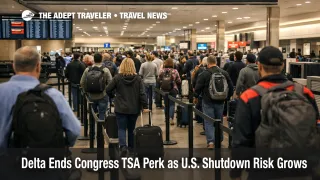
U.S. shutdown airport risk took on a new, more visible form on March 24, 2026, when Delta Air Lines said it was suspending specialty services for members of Congress because the long running Department of Homeland Security funding lapse is straining airline resources. For ordinary travelers, the practical meaning is not that lawmakers lose a convenience. It is that shutdown damage has spread far enough into airport operations that even nonessential VIP handling is being cut while TSA staffing losses continue to produce long and erratic security lines, especially at Hartsfield-Jackson Atlanta International Airport (ATL) and other stressed hubs. Travelers should treat security screening as the first weak point in the trip and build more buffer before departure.
U.S. Shutdown Airport Risk: What Delta Changed
Delta said the suspension is temporary and tied it directly to resource pressure from the shutdown, adding that members of Congress flying Delta will now be handled like other passengers based on SkyMiles status rather than office. Delta had already warned on March 19 that TSA wait times could run longer than usual and that expedited security lines might not be available while the shutdown continues. That turns this from a symbolic Capitol Hill story into a broader operating signal, because the airline is now reallocating attention away from a long standing VIP exception and back toward regular passengers moving through stressed airports.
The timing matters because the staffing picture is still worsening. Reuters reported on March 24 that more than 450 TSA officers have quit since the shutdown began on February 14, 2026, about 50,000 officers are still going without pay, and nearly 11 percent of TSA officers nationwide did not report to work on March 23. Earlier Reuters reporting also showed absentee rates far above the national average at major hubs, including Atlanta and the Houston airports. That is why a Delta concierge change deserves traveler attention. It points to a system still cutting around the edges because the core checkpoint problem has not been solved.
Which Travelers Should Read This as a Warning
This matters most for travelers departing from airports where screening is already fragile, especially Atlanta, Houston, the New York airport system, New Orleans, and smaller airports with fewer screening lanes or fewer recovery options. Adept Traveler's recent reporting already identified Atlanta as one of the easiest airports to underestimate in the current shutdown because long lines there do not stay local. They spill into missed domestic banks, weaker connection reliability, and harder rebooking across the Southeast. A move like Delta's does not create those risks, but it confirms that airlines are operating inside them.
Travelers with fixed time exposure have the most to lose. That includes international departures, cruise embarkations, weddings, major meetings, and itineraries built around one short connection. Congress members losing a shortcut does not materially change the public line by itself. The bigger point is that when an airline decides even a politically sensitive service is not worth the staffing drag, the system is still prioritizing triage over normality. That is a useful signal for passengers deciding whether to trust an ordinary airport run, especially at ATL, where the airport's homepage is still warning travelers to allow at least four hours or more for screening under current federal conditions.
What Travelers Should Do Before Leaving for the Airport
The immediate move is to stop planning around old screening assumptions. At airports already under pressure, the safer threshold is to arrive about four hours before departure for flights that really matter, even if that sounds excessive for a domestic trip. Travelers should also check the local airport website before leaving, because airport specific guidance is now more useful than generic national advice. Delta's own shutdown guidance says customers should check local airport wait times and allow additional time for screening, and ATL is still posting an unusually aggressive four hour warning.
The rebook versus wait decision is also getting clearer. If the trip can absorb a miss, waiting may still be reasonable, especially outside the worst affected hubs. If the trip cannot absorb a miss, the smarter move is to rebook early, shift to a later departure, or avoid a tight connection that depends on a clean checkpoint experience. Travelers should not assume premium status, PreCheck, or a normally efficient airport will fully protect them while staffing remains unstable and some expedited lanes may be unavailable.
Over the next 24 to 72 hours, the signals to watch are straightforward. First, whether more airports move to four hour style guidance. Second, whether checkpoint consolidations or closures spread, as happened at Baltimore/Washington this week. Third, whether Congress reaches a funding deal before the next missed paycheck worsens attrition again. Until those signals improve, travelers should assume U.S. shutdown airport risk is still in the deepening phase, not the recovery phase.
Why This Move Matters Beyond Congress
The mechanism here is simple. When TSA staffing thins out, airports and airlines do not just get longer lines. They start making secondary operational choices to preserve core throughput. That can mean fewer open checkpoints, less reliable premium lane access, more staff diverted to crowd management, and less tolerance for any service that does not directly help the main passenger flow. Delta's suspension fits that pattern. It does not fix the checkpoint bottleneck, but it shows the shutdown is now forcing choices inside the travel system that would have been easy to avoid under normal conditions.
What happens next depends less on this Delta policy than on whether DHS funding is restored quickly enough to stabilize staffing. ABC reported on March 24 that negotiators in Congress were sounding more optimistic about a deal, but Transportation Secretary Sean Duffy also warned that conditions would worsen if the funding fight continued. For travelers, the honest read is that this story is still a warning signal, not a turning point. Congress losing a line skipping perk will get attention. The operational story that matters is that unpaid TSA staffing losses are still reshaping how airports and airlines allocate limited resources.
Sources
- Delta advocates to end partial government shutdown, Delta News Hub
- US says more than 450 TSA officers have quit since funding standoff, Reuters
- ICE agents deployed to more than a dozen US airports amid staffing gaps, Reuters
- Travel disruption continues even after ICE agents deployed to airports, ABC News
- The official website of Hartsfield-Jackson Atlanta International Airport
- U.S. Shutdown Airport Risk Shifts to Continuity, Adept Traveler
- Worst TSA Lines Hit Atlanta, Houston, and New York, Adept Traveler