

Israel Jordan Exit Buses Shift Departure Decisions
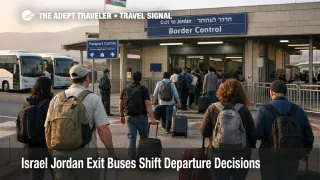
Travelers still trying to leave Israel now have a more structured fallback than waiting on scarce outbound seats. The U.S. Embassy in Jerusalem said on March 23, 2026 that the State Department began organizing buses from rally points in the Jerusalem and Tel Aviv areas to Amman's airport via the Jordan River, Sheikh Hussein crossing, with travelers then responsible for arranging and paying for onward flights themselves. That changes the decision point for stranded U.S. citizens because the workaround is no longer only private transfers, ad hoc border runs, or hoping Ben Gurion throughput improves. The immediate move is to treat this as an organized land to air handoff, not a full evacuation, and to line up passport validity, Jordan entry requirements, and an onward ticket before committing.
Israel Jordan Exit Buses: What Changed
The new fact is the organized bus link itself. U.S. Embassy Jerusalem said the buses started on March 23 and run from pickup areas near Tel Aviv and Jerusalem to Queen Alia International Airport (AMM) through the northern Jordan River, Sheikh Hussein crossing. Embassy and related official notices say travelers must register first, then wait for confirmation of date and pickup details, and they remain responsible for booking and paying for onward travel from Amman.
Operationally, that is a meaningful step up from the earlier workaround phase. In an earlier Adept Traveler article, Ben Gurion Departure Cap Pushes Border Exits explained how Israel's tighter outbound limits were pushing more travelers toward land borders. The new bus route lowers the coordination burden on the Israel side, but it does not remove the border, visa, or onward ticketing burden once travelers reach Jordan.
Which Travelers Benefit Most, and Where the Limits Still Are
The clearest fit is for U.S. citizens who do not have a reliable same day flight out of Israel, or who want a more organized handoff than booking a private car and improvising the border sequence. Travelers who are already close to Jerusalem or Tel Aviv benefit most because those are the published rally areas. People traveling from elsewhere in Israel still need to solve the domestic leg to the pickup point, which means the bus option is helpful, but not friction free.
The main limit is that this is assisted departure, not end to end extraction. Travelers still need a passport that works for Jordan entry, and the State Department's Jordan country page says U.S. citizens generally need six months of passport validity, one blank page, and a tourist visa, with visa on arrival available at Queen Alia International Airport and most international land crossings. The embassy's March 22 and March 23 notices also make clear that Jordan side fees and visa processing still apply.
That creates the real Jordan side pressure points. First order, more organized departures can lengthen queues at the border crossing and compress arrival waves into Amman. Second order, those same waves can tighten hotel inventory for travelers who miss onward flights, and they can absorb last minute seats out of Queen Alia faster than stranded travelers expect. Those last two effects are the most likely near term consequence of funneling more people into one land to air corridor, even though neither the State Department nor Jordanian authorities have yet published projected volumes.
What Travelers Should Do Before Taking the Bus Route
The cleanest version of this plan is to treat the Amman leg as the start of a new trip, not the end of the old one. Register first through the embassy process, then secure onward air options from Queen Alia before you show up assuming seats will still be there. If your schedule, cost tolerance, or destination makes a same day connection unrealistic, build in an Amman overnight from the start rather than counting on a border to airport sprint.
Document prep matters more than many travelers will expect. A valid passport with enough remaining validity is the basic requirement, and travelers should also expect Jordan entry processing and fees. In an earlier Adept Traveler guide, Jordan Entry Requirements For Tourists In 2026 explains why Jordan entry can look simple at first and then become more complicated once visa on arrival rules, crossing specific procedures, and onward travel assumptions come into play.
The decision threshold is now clearer than it was yesterday. Waiting on Ben Gurion still makes sense only if you already hold a credible, near term confirmed seat and can tolerate another schedule shift. Travelers without that should treat the assisted Jordan route as a serious alternative now, because the organized bus lowers one layer of uncertainty while leaving the Jordan border and Amman onward chain as the new bottleneck to solve in advance.
Why the Pressure Now Shifts to Jordan and Amman
This route exists because the outbound problem from Israel is no longer just about whether flights exist. It is about throughput. Once Israel tightened air departures and the embassy began steering Americans toward land options, the practical chokepoint moved from flight search screens to border capacity, document compliance, and the ability to convert a border crossing into a usable onward itinerary.
That is why the Jordan side matters so much. The bus gives stranded travelers a more predictable first segment, but the second segment is still commercial travel out of Jordan. U.S. Embassy Amman has said commercial flights are operating from Queen Alia, while the State Department's Jordan advisory remains at Level 3, Reconsider Travel, because of terrorism and armed conflict concerns and changed embassy operations. So the route is workable, but it is not low risk or unlimited capacity. What happens next depends on volume. If organized departures scale up, expect the crossing itself, Amman hotels, and late booked flights from Queen Alia to become the next variables travelers need to manage tightly.
Sources
- U.S. Department of State Launches Assisted Overland Departures via Jordan
- Security Alert, U.S. Embassy Jerusalem, March 23, 2026 Update
- Security Alert, U.S. Embassy Jerusalem, March 22, 2026 Update
- Jordan International Travel Information, U.S. Department of State
- Jordan Travel Advisory, U.S. Department of State
- Consular Information for Americans in the Middle East, U.S. Department of State
- Security Alert, U.S. Embassy Amman, Jordan, March 11, 2026
- Security Alert, U.S. Embassy Amman, Jordan, March 17, 2026
- Ben Gurion Departure Cap Pushes Border Exits
- Jordan Entry Requirements For Tourists In 2026