

Europe-Middle East Flight Cuts Reach Into Autumn
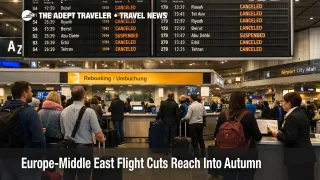
Europe Middle East flight cuts are no longer just a late March or April problem. Reuters' latest carrier roundup, Lufthansa Group's current travel information page, and Eurowings' March 24 notice all show that parts of this disruption now run into late spring, summer, and autumn, with Lufthansa Group keeping Dubai and Tel Aviv suspended through May 31, 2026, and a wider set of cities including Abu Dhabi, Amman, Beirut, Dammam, Riyadh, Erbil, Muscat, and Tehran suspended through October 24, 2026. For travelers, that changes the planning case. Waiting for a quick recovery now looks weaker on several city pairs, and travelers booking for summer or early autumn need to treat some routes as structurally thinner, not temporarily messy.
Europe Middle East Flight Cuts: What Changed
The main change is duration, and the second change is breadth. Lufthansa Group is now signaling that the pullback reaches far beyond one or two headline markets. Its public advisory shows Dubai and Tel Aviv paused through May 31, 2026, while Abu Dhabi, Amman, Beirut, Dammam, Riyadh, Erbil, Muscat, and Tehran remain suspended through October 24, 2026. Eurowings is following a similar pattern on a smaller map, with Tel Aviv, Beirut, and Erbil suspended through April 30, 2026, and Dubai, Abu Dhabi, and Amman also pushed out to October 24, 2026. Reuters also reports that Wizz Air has suspended Israel until March 29, 2026, and Dubai, Abu Dhabi, Amman, and Jeddah from mainland European destinations until mid September.
That is materially different from the earlier stage of this story, when many travelers were watching for short extensions measured in days or a few weeks. In an earlier Adept Traveler article, Lufthansa Middle East Suspensions Stretch to April 30 framed the issue as a route by route spring disruption. The new reality is a deeper seasonal cut, especially for cities that now sit under October timelines rather than April ones.
Which Travelers and Itineraries Face the Most Risk
The most exposed travelers are those who still want a nonstop from Europe into the Gulf or Levant on carriers that have pulled back deepest, and those building trips around a single narrow connection bank. Dubai and Tel Aviv remain the most visible examples because of their volume, but the more operationally serious pressure point is the wider list of secondary and regional cities. When Abu Dhabi, Amman, Beirut, Dammam, Riyadh, Erbil, Muscat, and Tehran stay cut on one major airline group through October 24, the network loses recovery depth, not just seats.
First order, some nonstops simply disappear. Second order, displaced passengers concentrate onto the remaining airlines and safer transfer hubs, which can raise fares, weaken same day rebooking options, and force extra hotel nights when a connection breaks. That matters most for leisure travelers with cruises, tours, weddings, or fixed resort arrivals, and for business travelers trying to hold short trips together with one stop each way. In an earlier Adept Traveler article, British Airways Middle East Cuts Stretch Into Spring showed that this thinning is not confined to Lufthansa Group alone. In another, KLM Dubai, Riyadh, Dammam Suspensions Extend to May 17 showed the same problem emerging on other Europe Gulf corridors.
What Travelers Should Do Now
For trips in April and May, the practical move is to stop treating these routes as normal until proven otherwise. If your itinerary depends on Lufthansa Group, Eurowings, or Wizz Air on one of the affected city pairs, check whether your booking is on a carrier still publishing a live suspension window, and compare that with alternatives through hubs that still have multiple daily frequencies and stronger reaccommodation depth. Lufthansa says affected passengers can rebook for a later date free of charge or request a refund, and Eurowings' advisory confirms the same disruption pattern on its affected routes.
For summer and early autumn trips, the decision threshold is stricter. If your routing depends on Abu Dhabi, Amman, or Dubai on a carrier with suspensions already published into October, waiting may save money but can cost itinerary resilience. Travelers with fixed onward commitments should favor bookable routings with more than one backup option on the day, even if the fare is higher or the trip is less convenient. A cheap itinerary with one fragile connection is now a worse value than it looked a month ago.
Over the next 24 to 72 hours, watch three things together, airline advisories, actual schedule depth, and whether other large European carriers lengthen their own suspension windows. A route returning to sale does not mean it has recovered real depth. Travelers should look for multiple operating frequencies, realistic same day alternatives, and enough buffer to absorb late changes before treating a corridor as dependable again.
Why Recovery Still Lacks Depth
The mechanism here is not just one airline being cautious. It is the interaction of regional security risk, airspace restrictions, and carrier by carrier risk tolerance, which produces an uneven recovery map. Some hubs and airlines recover faster than others, but Europe to Middle East connectivity remains patchy enough that the system can look more normal in search results than it is in practice. Reuters' carrier matrix shows exactly that, a market where some airlines are extending route suspensions deep into the year while others are only partially back or shifting capacity elsewhere.
That is why this has become a summer and autumn story. Once suspensions reach May 31, mid September, or October 24, they stop being a short operational wobble and become a planning constraint for peak season travel. The next meaningful sign of recovery will not be one carrier reopening one route. It will be several carriers restoring overlapping service on the same city pairs, enough to rebuild pricing competition, backup options, and real connection resilience. Until then, Europe Middle East flight cuts should be treated as a thinner market with higher stopover risk, not a near normal one.