

Lufthansa Middle East Suspensions Stretch to April 30
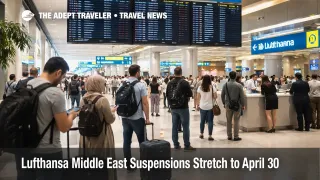
Lufthansa Middle East suspensions are now a longer planning problem, not a short disruption burst. Lufthansa says flights to and from Dubai International Airport (DXB), Dubai World Central, Al Maktoum International Airport (DWC), Zayed International Airport (AUH), Queen Alia International Airport (AMM), Erbil International Airport (EBL), and Beirut Rafic Hariri International Airport (BEY) are suspended through March 28, 2026, while Tel Aviv Ben Gurion Airport (TLV) is suspended through April 2, 2026, and Tehran is suspended through April 30, 2026. The sharper new detail is that Dubai airport authorities ordered Lufthansa Group carriers to cancel during the covered period, and any exception would still need case by case approval from authorities in the United Arab Emirates, which means technically possible is not the same thing as dependable.
That is the real traveler takeaway. Lufthansa Middle East suspensions now come with clearer outer dates and a weaker planning case for waiting on UAE routings to normalize at the last minute.
Lufthansa Middle East Suspensions: What Changed
The practical change since earlier Gulf disruption coverage is the date ladder. Dubai, Abu Dhabi, Amman, Erbil, and Beirut are frozen through Friday, March 28, 2026. Tel Aviv stays offline through Wednesday, April 2, 2026. Tehran remains suspended through Thursday, April 30, 2026. Lufthansa also says the Dubai suspension was specifically extended from March 16 through March 28 after both Dubai airports significantly reduced flight movements for capacity reasons.
For booked travelers, the city pair map is simple even if the operational details behind it are not. Treat Lufthansa Group nonstop service touching those destinations as unavailable for the dates above, and treat any UAE itinerary that depends on a late approval as operationally fragile until the airline shows it as confirmed. Dubai Airports is still telling passengers not to go to DXB or DWC unless they have received a confirmed departure time directly from their airline, which reinforces that airport access and schedule certainty remain linked.
Which Travelers Face The Most Rebooking Risk
The most exposed travelers are not only those starting in Dubai, Abu Dhabi, Amman, Erbil, Beirut, Tel Aviv, or Tehran. The broader risk sits with people using Frankfurt, Germany, Munich, Germany, Zurich, Switzerland, Vienna, Austria, Brussels, Belgium, or Milan, Italy, as Lufthansa Group connection points to reach the Gulf and Levant. When one side of that hub network stays offline, the first order effect is canceled nonstop service. The second order effect is harder rebooking, because aircraft, crews, and seats that would normally support those flows are not available where planners expected them to be.
This matters most for short trips, premium itineraries, cruise joins, and any booking with a same day rail or short haul European onward connection. A traveler who loses a Frankfurt to Dubai sector is not just missing one flight. They may be burning a hotel night, missing a connection onto a separate ticket, or losing the last usable arrival window for a meeting, tour, or embarkation. That is why travelers threading the Gulf through Europe should read the current Lufthansa dates as itinerary risk, not only as destination risk.
What Travelers Should Do Now
Travelers booked to Dubai, Abu Dhabi, Amman, Erbil, or Beirut before March 29, 2026, should assume the original plan is broken unless the airline has already reprotected them onto an acceptable alternative. Travelers booked to Tel Aviv before April 3, 2026, or Tehran before May 1, 2026, should make the same assumption. Lufthansa says passengers on affected canceled flights can request a full refund or rebooking on a later Lufthansa Group operated flight, and it says some travelers holding tickets issued on or before March 1, 2026, for certain affected markets may also request a refund even if the flight has not yet been canceled.
The tradeoff is straightforward. Waiting may preserve a preferred fare basis or a cleaner airline managed reroute, but rebooking earlier usually protects the trip better when seats are tight. For UAE trips in particular, do not build a rescue plan around a flight that is merely showing for sale or appears technically possible. Lufthansa says UAE approvals are reviewed case by case and are not guaranteed, while Dubai Airports says passengers should only head to the airport once the airline has directly confirmed departure timing.
Over the next 24 to 72 hours, watch for three things, confirmed rebooking options, any expansion or shortening of the suspension dates, and whether airport access language in Dubai softens. Travelers already triangulating around the Gulf should also read UAE Airport Access Tightens Into No Ticket Rule and TUI Extends UAE and Qatar Decision Window to March 31, because the wider operating environment is still punishing last minute improvisation.
Why The Disruption Still Spreads Through Travel
The mechanism here is not mysterious. Lufthansa says the current Middle East situation has created massive restrictions on air traffic, and in Dubai it adds a more specific bottleneck, both DXB and DWC significantly reduced flight movements for capacity reasons, after which the airports ordered Lufthansa Group airlines to cancel all flights in the covered period. That means this is not only an airline preference or a soft warning. It is a network capacity problem meeting an airport control problem.
As a result, recovery does not look like a clean on off switch. Even when a route is theoretically reopenable, local approval, aircraft positioning, crew legality, and available airport movements still have to line up. That is why Lufthansa Middle East suspensions matter beyond the canceled city pairs themselves. They keep Europe to Gulf and Levant trip planning in a reduced network state, where fewer dependable paths mean higher misconnect risk, more hotel extensions, and less room for travelers to wait and see.