

Salalah Port Shutdown Raises Oman Cruise Risk
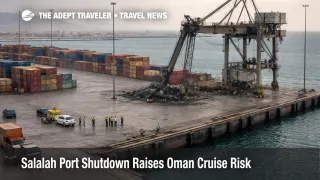
A Salalah port shutdown is now a live travel and logistics risk in Oman after a March 28 security incident involving reported drone activity and explosions halted operations at the Port of Salalah, damaged a terminal crane, and prompted an evacuation. Maersk said the current estimate is that operations will remain on hold for about 48 hours, while also saying its crew, vessels, and cargo were not directly affected. For travelers, the immediate issue is not only whether a cruise call is canceled. It is whether port side transfers, provisioning, shore arrangements, and onward movement start slipping before operators issue clean passenger guidance.
Salalah Port Shutdown: What Changed
The confirmed facts are narrow, but serious enough to change near term planning. Maersk said the incident happened in the early hours of Saturday, March 28, 2026, at the Port of Salalah in Oman, with drone activity understood to be involved and explosions also reported. The company said a terminal crane was damaged, one port worker suffered minor injuries, the facility was evacuated, and operations across the port were temporarily suspended for an estimated 48 hours.
What is not yet confirmed is just as important. As of publication, there is no verified line by line cruise notice showing a canceled Salalah call tied directly to this incident, and no public operator statement found so far saying passengers have already been moved through an alternative Omani port. Public cruise schedule sources reviewed on March 28 also suggest immediate cruise passenger exposure may be more limited than the cargo shutdown itself. One schedule source shows the most recent March 2026 Salalah call on March 24, while another lists the next 2026 call on May 5. Those are third party schedule trackers, not official line advisories, so they help frame risk but do not settle it.
That distinction matters. If there is no ship due alongside during the shutdown window, the first order traveler effect shifts away from embarkation chaos and toward shore side services, cargo handling, ship supply chains, and any itinerary planning built around Salalah as a later call rather than an immediate same day stop. If a ship was due but has not yet updated guests, the risk moves quickly from uncertainty into missed tours, compressed port time, or a full call swap.
Which Oman Travelers Are Most Exposed
The most exposed travelers are not all the same group. Cruise passengers with Salalah on their itinerary are the clearest watchlist segment, but the immediate practical exposure is probably higher for people tied to port dependent services around the city, including shore operators, transfer providers, and any travel stack that depends on ship arrival timing being precise. Salalah calls typically use an industrial port setting rather than a purpose built downtown cruise terminal, which already makes transfer timing more sensitive when port access changes suddenly.
Cargo related disruption also matters to travel sooner than many readers assume. The Port of Salalah describes itself as part of an integrated ecosystem linking the port, free zone, and airport, and it remains one of the region's major shipping hubs. When a facility like that stops, even briefly, the problem can spread beyond containers. Ships may need revised berthing windows, local transport providers can be held in place or rescheduled, and any cruise call that needs fresh stores, waste handling, or coordinated ground services can lose buffer.
There is also an Oman wide transfer angle. Salalah Airport is Oman's secondary international airport, which means it remains the most realistic air side fallback for travelers already in Dhofar Governorate if a cruise or port side movement breaks. But that is not the same as a port substitute. Inside Oman, Port Sultan Qaboos in Muscat is the country's primary tourism gateway and leading cruise destination, yet shifting a call there would require an operator level itinerary change, not a simple same day passenger reroute by road.
What Travelers Should Do Now
Travelers with a Salalah cruise call in the next several days should stop waiting for general regional headlines and look for ship specific instructions. Check the cruise line app, email, and shore excursion portal first, then verify whether any privately booked tours or transfers in Salalah are refundable if the call is shortened, moved, or removed. If your trip depends on a same day port call for onward ground arrangements, treat those pieces as at risk until the line confirms the ship's actual plan.
The next decision point is whether the disruption stays close to 48 hours. If the port reopens on that timeline and no ship was due in the closure window, the traveler impact could remain limited. If the shutdown stretches, or if security controls tighten after reopening, the main risk shifts from one missed operation to rolling schedule compression. That is when a later Oman call, hotel transfer, or provisioning stop becomes more likely to slip even if the itinerary survives on paper.
Travelers already in Oman should also separate port access from broader country access. A port shutdown does not automatically mean airport closure or countrywide transport failure. For anyone building a backup, Salalah Airport is the obvious local air option, while Muscat is the more plausible national rebooking hub if operators start reworking programs deeper into Oman. The wrong move is assuming a cruise line, tour provider, and port operator will all update at the same speed.
Why the Salalah Port Incident Matters Beyond 48 Hours
This story lands in a region that already has too little slack. In an earlier Adept Traveler article, Gulf Cruise Cancellations Reach Into Early May, the issue was trapped ships and longer cancellation windows. In another, Gulf Flight Suspensions Expand by Carrier, the problem was shrinking air fallback options across the Gulf. A port disruption in Oman does not have to be huge to matter in that context. It adds one more point of fragility to a regional network already operating with thinner recovery options.
The mechanism is straightforward. Ports are not just places ships stop. They are timing nodes for fuel, stores, ground handling, crew movement, tours, and onward transport. When a port halts unexpectedly after a security event, the first order effect is a stopped local operation. The second order effect is that every connected service has to either wait, compress, or move elsewhere. In a stable market that can be absorbed. In the current Gulf environment, where cruise repositioning and flight options are already under strain, even a 48 hour Salalah port shutdown can force disproportionately messy rework.
What happens next is likely to be decided by two signals, not one. The first is whether Port of Salalah operations resume on the timeline Maersk cited. The second is whether cruise lines or local operators publish any call changes, shortened stops, or transfer rewrites after that reopening window. Until those appear, the cleanest read is this: the Salalah port shutdown is already a real Oman logistics problem, and it remains a conditional cruise problem that travelers near the area should actively monitor, not dismiss.