

Lufthansa Middle East Cuts Spread Through October
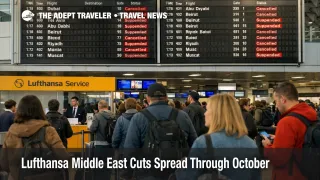
Lufthansa Group has turned what looked like a short term disruption into a much longer planning problem for Europe to Middle East travelers. Lufthansa, SWISS, Austrian Airlines, Brussels Airlines, ITA Airways, and Edelweiss have now pushed Dubai and Tel Aviv suspensions through May 31, 2026, while a wider group of cities, Abu Dhabi, Amman, Beirut, Dammam, Riyadh, Erbil, Muscat, and Tehran, remains suspended through October 24, 2026. Eurowings is also keeping several Middle East routes offline on its own timeline. For travelers, that means many one stop routings that would normally work through Lufthansa Group hubs are no longer realistic summer assumptions.
The practical shift since earlier coverage is the duration. In an earlier Adept Traveler article, Lufthansa Middle East Cuts Deepen Summer Booking Risk, the concern was already moving beyond a near term operational wobble. This update is more severe because the suspension map is now clearly split into late May and late October windows, which changes not only April trips, but also summer itineraries, cruise positioning, tours, and business travel that were still hoping for a normal hub recovery.
Lufthansa Middle East Suspensions: What Changed
The Lufthansa Group network notice now lays out two separate cutoff dates. Dubai and Tel Aviv stay suspended through May 31, 2026. Abu Dhabi, Amman, Beirut, Dammam, Riyadh, Erbil, Muscat, and Tehran stay suspended through October 24, 2026. SWISS says affected passengers can rebook to a later date free of charge or receive a full refund, and advises travelers to check flight status before going to the airport and to keep booking contact details current. Reuters reports the same timetable across Lufthansa, SWISS, Austrian Airlines, Brussels Airlines, ITA Airways, and Edelweiss, while noting that Lufthansa Cargo keeps the same pattern except Tel Aviv, which is suspended through April 30 for cargo.
Eurowings adds a second layer to the problem. Its own update says Tel Aviv, Beirut, and Erbil are suspended through April 30, while Dubai, Abu Dhabi, and Amman are suspended through October 24. A Lufthansa Group holiday restrictions page also reflects the broader group suspension map and notes proactive refund handling for some package customers into Dubai and Abu Dhabi. That matters because travelers cannot assume the low cost arm of the group will provide a simple fallback where the full service carriers have pulled back.
Which Travelers Now Face the Biggest Reroute Problem
The most exposed group is travelers who built one ticket Europe to Middle East itineraries around Lufthansa Group hubs such as Frankfurt, Munich, Zurich, Vienna, Brussels, Rome, or seasonal Edelweiss feed, then expected onward flying into the Gulf or Levant. Those passengers are now dealing with a network gap that extends well past immediate conflict week logic. Travelers heading to Dubai or Tel Aviv lose Lufthansa Group access through the end of May. Travelers bound for Abu Dhabi, Amman, Beirut, Dammam, Riyadh, Erbil, Muscat, or Tehran are facing a problem that, on current notices, lasts through the end of the northern summer schedule.
The second group is travelers who only looked at one city pair instead of the wider system. A canceled Frankfurt to Riyadh or Zurich to Beirut flight does not just remove that one leg. It also weakens alliance based connections, narrows protected same day rebooking choices, and increases the chance that a missed onward segment turns into an overnight hotel cost or a broken tour join. The pressure spreads fastest when the Middle East leg sits in front of a cruise embarkation, a guided tour start, or a fixed work event. In an earlier Adept Traveler article, Europe Middle East Flight Cuts Stretch to October, the core warning was that thinner capacity was already becoming a structural booking risk. This update reinforces that reading.
Alliance shopping also looks weaker than usual. Reuters shows IAG owned British Airways has extended cancellations to Amman, Bahrain, Dubai, and Tel Aviv through May 31, with Abu Dhabi suspended until later this year, which means oneworld is not offering a clean broad substitute on many of these corridors either. At the same time, Reuters says Emirates is on a reduced schedule, Etihad is operating a commercial schedule from Abu Dhabi, and Qatar Airways is gradually increasing flights to more than 120 destinations by mid May. That leaves travelers comparing not brand comfort, but whether a carrier is actually operating the city pair, whether the hub is outside the current suspension map, and whether the ticket structure protects onward segments if conditions shift again.
What Travelers Should Do Now
Travelers with departures in April or May should stop treating Lufthansa Group reinstatement as the base case for these markets. If your routing depends on Dubai or Tel Aviv on Lufthansa Group metal, redesign now rather than waiting for a late rollback that may not come. For Abu Dhabi, Amman, Beirut, Dammam, Riyadh, Erbil, Muscat, or Tehran, the October 24 date is long enough that summer travelers should plan as though the suspension is operationally real until proven otherwise.
The main decision threshold is ticket structure. If you are still holding a future itinerary on Lufthansa Group into one of the October suspended cities, waiting may preserve flexibility, but it does not preserve the trip plan. A free rebooking or refund helps only if replacement space still exists at workable prices and times. That is why travelers with cruises, packaged tours, weddings, conferences, or multi city land arrangements should usually redesign the whole trip once the Middle East segment is critical to arrival timing. A traveler with a flexible city break can afford to wait longer than a traveler whose hotel, ship, or driver meet is fixed.
Travelers comparing alternatives should prioritize three things over loyalty. First, use a carrier and hub that are actually operating your route now, not one still publishing a distant suspension clock. Second, keep long haul and onward sectors on one protected ticket where possible. Third, leave more connection buffer than normal, because reduced schedules across the region mean a missed inbound often has fewer same day recovery options. That is especially true if the fallback requires crossing from air to rail, changing airports, or absorbing an overnight stop in Europe or the Gulf.
Why the Suspension Window Matters Beyond Spring
The real significance here is not just that Lufthansa Group is canceling flights. It is that one of Europe's biggest airline groups is effectively telling travelers that normal access to a broad slice of the Middle East cannot yet be sold with confidence for much of the 2026 summer season. When a network carrier group marks large parts of a region as unavailable through October 24, the effect reaches beyond its own customers. Seats on remaining operators tighten, indirect routings get longer, premium cabin alternatives can become sharply more expensive, and hotel demand around unplanned stopovers can rise when rebookings bunch into fewer hubs.
The mechanism is straightforward. A long suspension window removes both nonstop seats and alliance connection inventory. That pushes more passengers onto the carriers still flying, while also concentrating recovery traffic through a smaller set of hubs. Reuters' latest airline roundup shows this is not a Lufthansa only issue. British Airways has extended multiple Middle East cancellations, several Asian and European carriers are still trimming schedules, and some airlines are adding Europe flying elsewhere to capture displaced demand. That mix tells travelers what happens next, the market keeps adapting, but not in a way that restores normal choice quickly.
For now, the Lufthansa Middle East suspensions are best read as a structural planning constraint, not a short pause. Travelers should watch for any carrier specific reinstatement notices, but the safer working assumption is that Europe to Middle East itineraries touching these cities need a different hub, a later date, or a different trip design altogether. The longer this pattern holds, the less sense it makes to wait for the old itinerary to come back on its own.