

Genoa Intercity Strike Disrupts Liguria Trains Jan 8
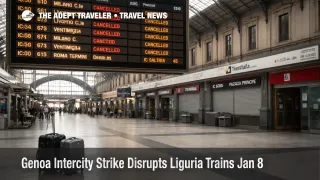
A strike affecting Trenitalia Intercity onboard crews tied to Genoa is disrupting long distance train service in Liguria on Thursday, January 8, 2026. The published strike window runs from 901 a.m. to 500 p.m. local time, and rail operators warn that service changes can occur before the start and after the end as trains and crews fall out of rotation. If your itinerary relies on an Intercity train through Genoa or along the Liguria coastal corridor today, the safest next step is to re check your specific train status and pivot early to a protected alternative rather than arriving at the station and hoping it runs.
The notice is specifically framed as an Intercity operations issue linked to Genoa, which matters because Intercity is the layer many travelers use to connect the coast to larger hubs and onward transport. When that layer drops capacity, the travel system does not just lose one train, it pushes demand into fewer remaining departures, creates platform crowding, and compresses your margin for any timed connection later in the day.
Who Is Affected
Travelers booked on Trenitalia Intercity services that pass through Genoa, or that rely on Genoa based Intercity crew diagrams, are the most exposed to cancellations and timetable modifications today. The risk is highest for itineraries that chain together dependent steps, such as arriving by rail and then boarding a cruise in Genoa, reaching a hotel check in window with limited reception hours, or connecting onward to another long distance train that will not wait.
If you are moving within Liguria for a shorter hop, you still need to plan for the second order ripple. Even if your specific segment is not Intercity, displaced Intercity passengers tend to overflow into whatever is running, and that can mean fuller trains, longer lines at ticketing and customer assistance, and more last minute seat scarcity for travelers trying to salvage the day.
The situation also matters for airport positioning. Many visitors reach Milan Malpensa Airport (MXP) or Milan Linate Airport (LIN) by combining a rail leg into the Milan area with a separate airport transfer, and that chain becomes fragile if the first rail leg is an Intercity arrival that now has cancellation or delay risk. When the rail layer fails, travelers shift to road options at the same time, which is why taxis, private transfers, and short notice hotel nights can tighten quickly.
What Travelers Should Do
If you are traveling today, treat the strike window as a hard constraint and move your decision forward in time. Check your exact train in Trenitalia channels before leaving for the station, then choose an alternate that reduces dependency on Intercity, even if it is slower, because certainty beats speed when a single cancellation can break a cruise embarkation or a flight. Trenitalia indicates Frecce and Regional trains circulate regularly during this specific action, so those categories are your first place to look for a workable reroute.
Use clear thresholds for rebooking versus waiting. If you have a cruise embarkation, a flight departure, or a timed tour start that cannot move, do not accept a plan that arrives inside your last safe buffer, because the strike impact is explicitly described as capable of spilling outside the posted hours. If your only option requires an Intercity train that arrives less than three hours before a non refundable commitment, rebook to an earlier departure or add a buffer night, and treat any same day plan as a bonus rather than a promise.
Over the next 24 to 72 hours, monitor three signals that predict whether disruption stays local or propagates. First, watch for rolling timetable edits and late notice cancellations on the specific Intercity services you need, because those are the direct strike outputs. Second, watch for crowding and recovery delays after the strike window ends, since equipment and crews may be out of place for the evening wave. Third, if you are continuing onward in Italy, keep an eye on the broader strike calendar so you do not solve today's problem by walking into a larger national disruption tomorrow. For context on the next major dates, see Italy Jan 9 Strikes Disrupt Flights and Trains and Italy Rail And Freight Strike January 20 Disrupts Trains.
Background
Italian rail strikes often look short on paper but behave longer in practice because rail operations are a tightly coupled system. A crew action aimed at one operational base can still strand a train away from its next crew, force a late turnback, or cascade into later departures as dispatchers protect the network by consolidating service. That is why official notices emphasize that impacts can appear before the start and after the end, and why you should assume the afternoon and early evening can remain unstable even after 5:00 p.m.
For travelers, the most useful concept is "guaranteed service" versus "scheduled service." Trenitalia publishes minimum service guidance for strike days, including guidance on refunds, where the timing and eligibility differ by train category. For this Genoa tied Intercity action, Trenitalia also points travelers to its Infomobility tools, and it states that Frecce and Regional trains circulate regularly, which helps you build a reroute plan that stays on rail rather than jumping immediately to road.
The immediate trigger for this particular walkout has been reported locally as a response to a serious on duty assault on a conductor near Imperia, with unions invoking the provision used for grave events affecting worker safety. That context matters for travelers because safety driven actions can be called with short lead times, and they can be more likely to recur if the underlying security dispute remains unresolved.