

Middle East Airspace Closures Hit Dubai, Doha Hubs
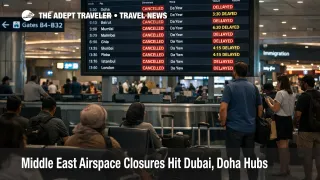
Middle East airspace closures that began on February 28, 2026, after U.S. and Israeli strikes on Iran, and subsequent retaliation, are still breaking flight plans into Sunday, March 1, 2026, with Gulf hub routings behaving like irregular operations rather than reliable connectors. Multiple countries across the region have closed or restricted airspace, and flight tracking data has shown traffic thinning sharply over key corridors, forcing mass cancellations, diversions, and long detours. For travelers, the immediate decision is whether to keep a Dubai International Airport (DXB) or Hamad International Airport (DOH) connection in the plan, or to rebook onto routings that avoid the region until airspace access stabilizes.
Middle East Airspace Closures: What Changed for Travelers
The travel system impact is not limited to one airport closure or one airline pause. This is a corridor problem, because airlines that would normally cross Iran, Iraq, and adjacent airspace are either suspending service, detouring south over Saudi Arabia, or building longer routings that can add hours and trigger knock on delays into later connections. That is why a flight that still operates can still fail the trip, because a longer airborne time can break minimum connection times, crew duty limits, and inbound aircraft rotations for later departures.
On the ground, the situation has also escalated into airport operations and safety incidents in the United Arab Emirates, with reporting that Dubai International Airport (DXB) saw injuries, and Zayed International Airport (AUH) reported casualties tied to strikes, raising the odds that restart timing comes in uneven phases rather than one clean reopening moment. Travelers should expect rolling cancellations even after some flights resume, because the first flights back often prioritize aircraft repositioning and disrupted long haul banks, not restoring every short haul spoke immediately.
Which Itineraries Are Most Likely to Break
The highest risk travelers are those with same day connections through Gulf hubs, especially itineraries built around tight bank timing where a small delay becomes a missed onward flight with limited same day replacement seats. This includes Europe to Asia and Africa to Asia routings that were intentionally built through Dubai, Doha, or Abu Dhabi for speed and frequency, because those advantages disappear when airspace constraints force carriers into detours and cancellations.
Separate ticket travelers remain the most financially exposed. If the long haul into the hub and the onward leg are on different tickets, a cancellation or diversion can break the chain without automatic protection, even when the marketing brand makes the itinerary look unified. In practice, this is where travelers get stuck buying expensive walk up replacement tickets, paying for unplanned hotels, and losing prepaid tours or cruise embarkation timing.
A third group to treat as fragile is anyone checking bags through a disrupted hub. When airlines reroute passengers quickly, baggage can lag behind because the original bag plan no longer matches the passenger's new flight number, departure time, or even carrier. That is not a reason to panic, but it is a reason to plan for essentials in carry on, and to keep receipts and written guidance from the airline if you must buy necessities during an unplanned overnight.
What Travelers Should Do Now
Start by treating your booking as two different questions, whether your operating carrier is flying, and whether your ticket issuer can reissue quickly if it is not. Operating carrier matters more than marketing carrier during disruptions, because codeshares can hide who actually controls the aircraft and the recovery plan. If you booked through an online travel agency, assume reissue speed may be slower than dealing directly with the airline, and move earlier if you have a hard deadline within 48 hours.
Use a clear threshold instead of waiting for perfect clarity. Rebook now if your flight is canceled, if you have a cruise embarkation, a tour start, or a family event you cannot miss, if you are on separate tickets, or if your itinerary relies on a single Gulf hub connection with no same day backup. Waiting can make sense only if your flight is still operating, you can tolerate an overnight, and you have flexibility to accept a longer routing without breaking the purpose of the trip. Airlines have issued waivers in many cases, but waivers do not create seats, and the seat crunch often gets worse as disrupted passengers compete for the same limited alternatives.
If you are already in transit, treat hotels, entry rules, and document constraints as part of the recovery plan. Ask the airline what it will provide for an overnight during a security driven disruption, then book your own backup lodging if inventory near the airport is tightening. Also verify whether you can legally enter the transit country if you are forced landside, because not every traveler can clear immigration on short notice. For operational context and practical system planning, see Middle East Airspace Closures Snarl Gulf Hub Flights and Doha, Dubai Hub Pauses Break Connections Feb 28.
Why The Disruption Spreads Beyond The Middle East
This disruption propagates because international airline networks are built on predictable corridors and banked connections. When large blocks of airspace close, airlines either cancel outright or reroute around the risk, which stretches flight times and breaks the timing that hubs rely on to connect long haul arrivals to short onward departures. The first order effect is cancellations, diversions, and missed connections at hubs. The second order effect is aircraft and crew displacement that causes tomorrow's cancellations far from the region, because planes and crews end up out of position for their next scheduled segments.
There is also a capacity squeeze mechanism. When many carriers avoid the same region, the remaining viable corridors become crowded, which can force air traffic flow constraints and create new delay points even for flights that are not headed to the Gulf. That is why travelers can see itinerary failures that feel indirect, such as a missed connection in Europe after a long detour, or a canceled rotation because a long haul aircraft arrived too late to operate its next leg. For a deeper explainer on how air traffic control capacity becomes a binding constraint during shock periods, see U.S. Air Traffic Control Privatization: Reality Check.
Sources
- Airlines cancel flights after US, Israel strikes Iran
- Dubai airport, iconic Burj Al Arab hotel damaged in Iranian missile strikes
- U.S. and Israel attack on Iran leaves hundreds of thousands of travelers stranded
- U.S. and Israel's attack on Iran disrupts commercial flights across the Middle East
- Hundreds of thousands of travellers stranded or diverted by airspace closures in Middle East
- Israel-Iran conflict: 19,000 flights delayed as Middle East aviation comes to a standstill