

Tel Aviv Ben Gurion Reopens, Overland Exits Key
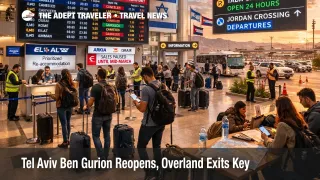
Ben Gurion Airport limited reopening starts Monday evening, March 2, 2026, but travelers should treat it as a constrained restart, not a return to normal service. Israeli authorities are reopening civilian flying in an "extremely limited format," with any expansion dependent on security conditions, and with initial operations expected to be centered on Israeli carriers. The practical consequence is that many tickets will remain unusable even if the airport is technically open, and the fastest workable exit plan for many people will still be overland via the Egypt and Jordan land borders.
The airline side is also being managed as a recovery pipeline, not a normal sales market. Reuters reports that El Al is halting ticket sales until March 21, 2026, while Arkia and Israir have paused sales into mid March, which signals that early seats are being reserved for displaced passengers and rescue rotations, not new discretionary demand. This is the key change versus a shutdown story, travel decisions today need to assume limited capacity, priority reaccommodation, and a continued role for land crossings as the pressure valve.
Ben Gurion Airport Limited Reopening: What Changes for Travelers
The first thing that changes is the decision tree at check in. A reopening notice does not mean your specific flight is operating, and it does not mean there will be enough staff, ramp capacity, or airspace stability to run normal banks of departures and arrivals. The official plan described to Reuters is gradual expansion starting Tuesday, March 3, 2026, conditional on the security picture, which keeps day to day volatility high for anyone trying to fly in or out on tight timelines.
The second change is that overland routing is no longer a fringe workaround, it is a mainstream operational path. Israel's Airports Authority has published that the Menachem Begin (Taba) Crossing is operating 24 hours a day, and it has flagged the Yitzhak Rabin crossing near Eilat as a key option with operating limits that matter for same day onward flights. Reuters also highlighted carrier planning for charter and recovery flights that connect to border points near Taba, Egypt, and Aqaba, Jordan, which is a strong clue that airlines expect land crossings to carry a meaningful share of near term movement.
For context on how this fits into the wider regional disruption picture, the earlier breakdown in Middle East Airspace Closures Halt Dubai, Doha Flights still matters because it explains why hub connectivity stays brittle even after partial reopenings.
Which Travelers Face the Most Disruption
Travelers with onward long haul connections remain the most exposed, especially anyone relying on a same evening departure from Tel Aviv after an overland exit, or anyone holding separate tickets that depend on perfect timing. The limited restart increases the odds that you clear the first hurdle, leaving Israel, but miss the second, catching a protected onward itinerary.
Inbound travelers are also exposed because initial operations are expected to be concentrated on Israeli carriers, which can leave foreign carrier tickets stranded in limbo even when the airport is nominally open. Tourists already in Israel, and travelers trying to reunite with family, face a different bottleneck, they may be able to move, but only through narrow windows that shift daily with security constraints and airline prioritization.
Land crossings create their own choke points. The Menachem Begin (Taba) Crossing may be open 24 hours a day, but demand concentrates fast when flights are scarce, and the onward transport layer becomes the limiting factor, taxis, buses, hotel inventory, and seats out of nearby airports. For travelers staging via Jordan, the Yitzhak Rabin crossing runs on set hours, and arriving late can turn a plan into an unplanned overnight in Eilat, Israel, or Aqaba, Jordan.
What Travelers Should Do Now
Treat Monday night, March 2, 2026, through at least Wednesday, March 4, 2026, as a high volatility window where you decide based on operating confirmation, not schedules. If you have a flight out of Tel Aviv, do not travel to Ben Gurion on the strength of a reopening headline alone. Your threshold should be explicit operating confirmation for your flight from your carrier, plus confirmation that the airline is actually accepting passengers for that departure, not only running rescue rotations.
If you must leave Israel within 24 to 72 hours and you do not have confirmed air uplift, pivot early to a land exit plan and build buffers like you would for irregular operations, because that is what this is. For Egypt routing, the Airports Authority notice that the Begin (Taba) Crossing is open 24 hours a day makes it the most time flexible exit, but you should still plan for congestion, document checks, and transport scarcity on both sides. For Jordan routing, use the Airports Authority hours as hard constraints: Yitzhak Rabin is 630 a.m. to 800 p.m. Sunday through Thursday, and 800 a.m. to 800 p.m. Friday and Saturday, while Allenby is currently posted as 800 a.m. to 500 p.m. Sunday through Thursday, and 800 a.m. to 330 p.m. Friday, with Saturday closed. For the Jordan River crossing, Saturdays are closed, and last admission times are earlier than closing, which can quietly break late afternoon plans.
Decision threshold for rebooking versus waiting is simple. Rebook now, or reroute overland, if you have a fixed event, a cruise embarkation, a nonrefundable tour, or a work obligation that cannot absorb a multi day slip. Wait only if you can move by several days and you are comfortable being prioritized behind displaced passengers while airline sales are paused to triage the backlog. If any reroute changes your entry or transit assumptions, use Israel Entry Requirements For Tourists In 2026 to sanity check documents and screening expectations before you commit to a new path.
Why Limited Reopenings Push Travelers to Land Borders
A constrained airport restart fails in two ways that matter for traveler planning. First, capacity returns unevenly, because security conditions, air traffic constraints, crew availability, and aircraft positioning all gate how many flights can run, and in what time blocks. Second, the backlog is not theoretical. Carriers are explicitly pausing ticket sales to prioritize reaccommodation, which means "available seats" are often not truly available to new buyers, and even to some ticketed passengers, until the recovery queue clears.
Land borders become the release valve because they bypass the immediate airspace and slot constraints at Ben Gurion, but they introduce ground friction that compounds quickly. When thousands of people pivot to the same crossing, the limiting factor becomes processing throughput, transportation supply, and the ability to stage safely with lodging. That is why the Airports Authority posting about 24 hour operation at Taba and extended operating hours messaging matters, it is not a travel tip, it is a sign that authorities are actively using land crossings to carry evacuation and repatriation load while aviation restarts in narrow bands.
For the wider security and movement context across the region, Worldwide Security Alert Flags Airspace, Hotel Risk is still relevant because it explains why disruptions can recur even after partial reopenings, and why travelers should plan for sudden changes in airport access and lodging conditions.
Sources
- Israel's main airport to reopen on Monday in "extremely limited format" (Reuters, March 2, 2026)
- Israel's Ben Gurion Airport set to reopen airspace in very limited format on Monday (Reuters, March 2, 2026)
- Airports Authority Spokesperson Announcement, Land Border Crossings (Israel Airports Authority, February 28, 2026)
- Menachem Begin Crossing (Taba) Opening Hours (Israel Airports Authority)
- Yitzhak Rabin Crossing Opening Hours (Israel Airports Authority)
- Allenby Bridge Terminal Opening Hours (Israel Airports Authority)
- Jordan River Crossing Opening Hours (Israel Airports Authority)