

BA Muscat Exit Flights Tighten as March 8 Sells Out
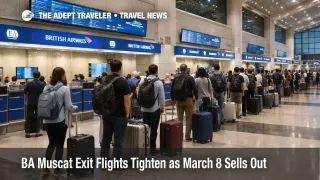
British Airways' Muscat, Oman, to London Heathrow rescue lift has moved into a new phase, capacity, not just availability, is now the main constraint. The airline said on March 5, 2026 that its extra March 8 Muscat flight was already fully booked, and by March 6 it had added more Muscat to Heathrow flights for March 9 through March 12, but those seats are still limited to BA customers already in Oman or the United Arab Emirates with an existing booking. For stranded travelers, that changes the problem from finding a usable exit point to winning space on a tightly controlled channel. Travelers should not go to Muscat International Airport (MCT) unless BA has confirmed a booking, and they should keep lodging, ground transfer, and onward plans flexible while they work the airline's dedicated contact flow.
The practical shift since earlier Muscat coverage is that British Airways is no longer just testing whether it can add special lift from Oman. It has proved that Muscat works as a Heathrow exit lane for some customers, but it has also shown that demand is outrunning near term inventory. That matters because Muscat remains one of the few usable pressure release points while BA still says it cannot operate flights from Abu Dhabi, United Arab Emirates, Amman, Jordan, Bahrain, Doha, Qatar, Dubai, United Arab Emirates, and Tel Aviv, Israel.
BA Muscat Exit Flights: What Changed
The immediate change is straightforward. British Airways said at 200 p.m. on March 5 that its March 8 Muscat to London Heathrow flight was fully booked. On March 6, at 1200, the airline expanded the Muscat plan again, adding further Heathrow departures at 2:30 a.m. local time on March 9, March 10, March 11, and March 12. That is useful news, but it is not open sale normalization. It is still a controlled recovery channel for a defined customer pool, and that means availability can disappear faster than stranded passengers can reposition into Oman.
This also sharpens the traveler decision window. A few days ago, the key question was whether BA would keep building lift out of Muscat at all. Now the better question is whether waiting for one of these flights is still rational once hotel nights, transfer costs, and Heathrow onward misconnect risk are added up. Travelers with hard deadlines, cruise embarkations, medical appointments, work starts, or separate tickets beyond Heathrow should treat these Muscat flights as scarce recovery capacity, not as a stable published schedule.
Which Travelers Still Have a Realistic Path Out
BA is explicit about who these flights are for. The Muscat departures are for British Airways customers who are in Oman or the UAE and who already have an existing booking. The airline says customers who want one of these flights should use the dedicated phone line, +44 203 467 3854, and it also says its teams are contacting some affected customers directly by email. That means the practical priority is procedural, existing BA customers in the right geography, handled through BA's own disruption channels.
That is a narrower pool than the broader government repatriation effort. The UK government has separately said it is working with airlines and governments to maximize commercial seats for British nationals from the UAE, and that Oman charter flying is being used to prioritize vulnerable citizens who need to return home. Those statements matter because they show two different tracks now operating at once, airline managed recovery for carrier customers, and government backed evacuation support for vulnerable nationals. Travelers should not confuse the two. British Airways has not said these Muscat flights are open to anyone outside its own affected customer base.
The other exposed group is travelers who can physically reach Oman, but do not yet have confirmed inventory. For them, Muscat is an option in theory, but not a completed plan in practice. Once one extra flight sells out several days ahead, the bottleneck shifts to room availability in Muscat, road transfers from the UAE, and the risk of arriving in Oman without a locked seat onward.
What Travelers Should Do Now
First, do not self deploy to the airport. Both BA and UK government travel advice say passengers should only travel to the airport once the airline has confirmed the reservation. If you are a BA customer in Oman or the UAE, the immediate action is to work the dedicated BA phone line, monitor your email closely, and keep every booking reference, passport detail, and onward Heathrow itinerary ready so you can accept a seat quickly if one opens.
Second, use a hard decision threshold, not hope. Waiting for a BA Muscat seat makes sense if you are already within BA's eligible group, can safely remain in Oman or the UAE for multiple more nights, and your onward plans from London can absorb delay. Rebuild the trip another way if the purpose of travel breaks when Heathrow is missed, if you are traveling on separate tickets after London, or if the cost of extra hotel nights and transfers is starting to exceed the value of staying inside the BA recovery flow.
Third, watch the next 24 to 72 hours for two things, added BA Muscat sectors and any broader reopening that reduces pressure on Oman as the temporary exit valve. BA has already shown it will add flights when it can, but every added sector is being absorbed into a constrained pool of stranded passengers. Until ordinary flights resume from the hubs BA still cannot serve, Muscat remains less a convenient workaround than a managed queue.
Why Muscat Became the Bottleneck
The mechanism is simple, but brutal. When BA cannot operate from Abu Dhabi, Amman, Bahrain, Doha, Dubai, and Tel Aviv, demand that would normally spread across several city pairs collapses onto one functioning outlet, Muscat. As a result, Muscat is no longer just another airport in the region. It is a funnel. That concentrates first order pressure at check in, hotel inventory, and same day surface transport into Oman, then pushes second order strain into Heathrow onward bookings, missed self connections, and reaccommodation pressure after arrival in London.
This is also why official advice keeps emphasizing commercial options from the UAE and Oman only where people can access them safely. A route can exist on paper and still fail operationally if travelers cannot reach it, cannot secure inventory, or cannot protect the rest of the trip once they land. That same pattern has shown up across other Muscat based exit channels this week, including Muscat Relief Flights Become Qatar Airways Exit Route and the earlier Muscat Evacuation Flights Become Gulf Exit Hub, both of which pointed to Oman becoming the region's temporary safety valve when normal Gulf hub flows could not be trusted.
Sources
- Travel news | Information | British Airways
- Our Middle East operation: 06 March 2026 | British Airways Media Centre
- United Arab Emirates travel advice | GOV.UK
- Foreign Secretary statement on the ongoing situation in the Middle East | GOV.UK
- PM remarks on the situation in the Middle East: 5 March 2026 | GOV.UK