

Etihad Abu Dhabi Flights Resume on Limited Routes
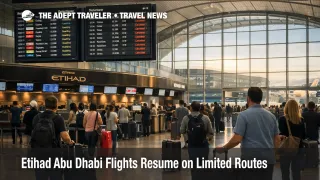
Etihad Abu Dhabi flights are back on sale, but only in a constrained recovery window. Etihad said on March 6, 2026, that it is resuming a limited commercial schedule between Abu Dhabi and selected destinations through March 19, 2026, while all other scheduled commercial services to and from Abu Dhabi remain suspended. That changes the traveler decision from "is Abu Dhabi still shut" to "does my city actually have an operating flight, on my day, with a protected onward plan." Travelers with fixed trip dates should treat this as a narrow restart, not a normal hub recovery, because Etihad also says not all destinations operate daily and all services remain subject to operational approvals.
The practical shift since prior coverage is that Etihad is no longer working only from a suspension cutoff. It has now published a live, limited route map and says guests with previous bookings will be accommodated on these flights as soon as possible, while new tickets are also on sale. That helps stranded passengers, but it also means scarce recovery seats will now be contested by both disrupted travelers and fresh demand. The Etihad Abu Dhabi flights restart therefore creates bookable options without removing the underlying fragility.
Etihad Abu Dhabi Flights, What Changed on March 6
The biggest factual update is that Etihad's restart is broader than a handful of flagship routes. The airline's March 6 notice lists a long set of destinations scheduled to operate to and from Abu Dhabi between March 6 and March 19, including Cairo, Delhi, Frankfurt, London Heathrow, New York JFK, Paris, Moscow Sheremetyevo, Toronto, and Zurich, but also many other cities across Europe, Asia, Africa, Australia, and North America. Etihad says all other scheduled commercial services remain suspended, additional destinations may be added later, and not every listed city operates every day.
That matters because a published destination list is not the same thing as a restored hub. A city can be on the restart map and still be hard to use if frequency is thin, operating days do not line up with your onward connection, or your original itinerary depends on a segment that remains suspended. Travelers should therefore read the restart as selective network triage. It restores a limited number of escape lanes first, while keeping the rest of the Abu Dhabi system in a constrained posture.
Which Travelers Can Benefit, and Who Still Faces Risk
The best positioned travelers are passengers already holding Etihad tickets on routes that now appear in the restart window, especially if their journey stays on one Etihad reservation. Etihad says guests with previous bookings will be accommodated as soon as possible, and it has also published waiver rules that allow some affected passengers to rebook free of charge or request refunds, depending on ticket issue date and original travel window.
The highest risk group remains travelers trying to rebuild an itinerary in pieces. If your long haul leg into Abu Dhabi is on Etihad but your onward travel is on another carrier, another ticket, or a separate rail or hotel chain, a limited restart can still break the trip even when your first segment operates. This is the same structural problem Adept noted in Etihad Extends Abu Dhabi Flight Suspension to March 6 and in Middle East Airspace Closures Keep Global Reroutes, where partial hub recovery raised the odds of missed onward legs, baggage separation, and forced overnights.
Travelers trying to self deploy to the airport without a confirmed seat also remain exposed. Etihad says passengers and members of the public should not travel to the airport unless they have been contacted directly by the airline or hold a confirmed booking on one of the new flights. That instruction is important because restart periods often create landside congestion, long queue times, and false hope for standby options that never materialize.
What Travelers Should Do Before Choosing Etihad
Use a hard decision threshold. Pivot to Etihad now if your city is on the operating list, your flight day is visible in the live schedule, and the airline can protect your trip on one ticket all the way to your real destination. That is where the restart has real value, because a confirmed end to end booking is still safer than improvising across multiple carriers during an unstable regional recovery.
Keep working alternate exits if your route depends on a city that is still suspended, if your listed destination is not operating on the day you need, or if your onward plan still relies on a separate ticket. In those cases, the narrow Abu Dhabi restart can look better on paper than it performs in practice. Travelers in the Gulf who are already exploring Oman options should compare Etihad against the still relevant Muscat channel described in Muscat Relief Flights Become Qatar Airways Exit Route, especially when Abu Dhabi inventory is gone or misaligned with the rest of the trip.
Over the next 24 to 72 hours, monitor three things closely, whether your city remains on the operating list, whether your specific flight number survives schedule trimming, and whether airport access instructions change. Etihad says the situation remains dynamic, schedules may change at short notice, and all services remain subject to operational approvals tied to regional airspace conditions. That means a route announcement is useful, but the live flight status page is still the final checkpoint before you move.
Why Limited Resumption Is Not Normal Service
The mechanism here is straightforward. Etihad is not reopening Abu Dhabi because the regional system is stable again. It is reopening only a controlled subset of flying after safety and security assessments with relevant authorities, while retaining the right to adjust flights as airspace conditions evolve. In other words, the network is being rebuilt under constraint, not under normal commercial logic.
First order, that gives stranded passengers a real but scarce set of commercial exits from Abu Dhabi. Second order, it pushes pressure into the parts of the trip that limited schedules do not solve on their own, seat scarcity, misconnects on separate tickets, baggage lag, hotel extensions, and terminal congestion as more passengers converge on a small number of operating flights. Reuters also reported the broader regional pattern, airlines are cautiously restoring only some services while Middle East airspace disruptions continue to distort normal operations.
That is why travelers should not mistake Etihad Abu Dhabi flights resuming for full hub normalization. The restart is useful precisely because it is selective, but that same selectivity is what keeps risk high for anyone whose itinerary still needs flexibility, protection, or a backup exit.