

KLM Muscat Exit Flight to Amsterdam, March 6, 2026
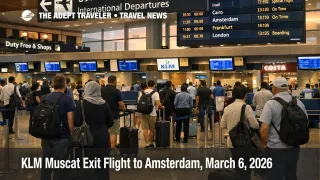
KLM's March 6, 2026 special flight from Muscat, Oman, to Amsterdam Airport Schiphol (AMS) via Cairo turns Muscat from a general fallback point into a named, state backed Europe exit lane. That is the meaningful change from Adept's March 5 Muscat relief coverage. This is now a specific carrier, a specific route, and a specific government run allocation process, not just loose relief capacity somewhere in the region. For stranded travelers who can reach Oman, the practical decision shifts again, waiting for normal Gulf hub operations is less compelling if you qualify for a confirmed seat on a managed flight into Amsterdam.
The Dutch government says the Muscat flight is being arranged in cooperation with KLM, and KLM says the flight is expected to arrive at Schiphol on Saturday morning, March 7, 2026. That timing matters because it turns the itinerary into an overnight recovery path into Europe rather than a vague promise of help later. It also matters because Muscat is now doing more than serving as a staging point for Qatar and other improvised exits. It is functioning as one of the few workable handoff nodes where governments and airlines can still build controlled departures while regular schedules across parts of the Gulf remain suspended or heavily constrained.
KLM Muscat Repatriation Flight: What Changed for Travelers
The immediate traveler relevance is simple. If you are an eligible Dutch traveler already stranded in Oman, or can safely and legally reach Oman in time, there is now a concrete route to Europe that bypasses the need to wait for Doha, Dubai, or Riyadh to normalize. KLM has also said it remains unable to resume its regular schedule in the region and is still suspending flights to Dubai, Riyadh, and Dammam through March 8, 2026, which reinforces why this special Muscat departure matters.
This is also an update story, not a fresh disruption in isolation. Earlier coverage focused on Muscat as a relief concept and a practical exit hinge. The new fact is that the Dutch state and KLM have now attached a named European endpoint to that logic, Amsterdam, with the flight assigned through the Ministry of Foreign Affairs rather than normal public booking channels. Travelers cannot buy or manage this seat as an ordinary KLM reservation by contacting the airline directly.
For Europe bound travelers, the bigger significance is that Oman is no longer just absorbing spillover. It is being used as a controlled bridge back into Schengen. That gives stranded passengers a clearer decision tree, get to Oman if you qualify and have a confirmed path, or continue treating the larger Gulf hubs as unstable until normal schedules actually resume, not merely until rumors of reopening circulate.
Who Can Actually Use the Muscat to Amsterdam Flight
Eligibility is narrower than "anyone trying to get to Europe." The Dutch government says the flight is for stranded travelers who live in the Netherlands or the Caribbean parts of the Kingdom, have Dutch nationality, or are the partner or child of a Dutch national and can prove that relationship with documents. The crisis form is only for travelers stranded in a defined list of regional countries, including Oman, Qatar, the United Arab Emirates, Israel, Jordan, Saudi Arabia, and others named by NetherlandsWorldwide.
Just as important, registration is not the same as a seat. The Ministry says only travelers who completed the Crisis Contact Form, meet the eligibility conditions, and are specifically contacted by the government may be invited onto the flight. It also says travelers cannot obtain information about or book these flights by contacting the airline, and should only go to the airport after receiving confirmation. Showing up at Muscat International Airport (MCT) without that confirmation is not a viable backup plan.
There is also a cost component. NetherlandsWorldwide says Dutch travelers taking government organized repatriation flights must agree to a €600.00 (EUR), about $653.00 (USD), contribution per person age two and older, billed after return, and must sign a payment obligation before departure. That is not a minor detail for families deciding whether to wait, reroute commercially, or accept a state managed seat when one is offered.
What Travelers Should Do Before Betting on This Exit Lane
If you are eligible and already registered, keep your phone reachable and make sure it does not block unknown numbers. The Dutch government says it may call from a withheld number, and missed contact can delay or derail your allocation. If you are not yet confirmed, do not reposition to the airport on speculation. The government's guidance is explicit, only passengers already contacted and assigned to that specific flight can board.
If you receive a seat, treat the Cairo stop as an operational unknown rather than a normal self planned connection. KLM and the Dutch government have confirmed the routing via Cairo, but neither public notice spells out whether passengers remain onboard, deplane for processing, or face any additional security handling during the stop. In practice, that means travelers should assume a longer and less predictable journey than a simple Muscat to Amsterdam nonstop, keep medicines, chargers, paper documents, and essentials in carry on bags, and avoid building a tight self connection after arriving at Schiphol on March 7.
The decision threshold is fairly hard now. Waiting for Gulf hub normalization still makes sense if you are ineligible for Dutch assistance, cannot safely reach Oman, or hold a confirmed commercial alternative that gets you out sooner. But if you are eligible, reachable by the Dutch system, and can execute the Oman leg without creating a new border or transport problem, waiting for Doha or another Gulf hub to "probably reopen soon" is increasingly a gamble, not a plan.
Why Muscat Has Become Europe's Temporary Safety Valve
The mechanism is straightforward. KLM says it is still not flying through the airspace of Iran, Iraq, and Israel, and flights to key Gulf destinations remain canceled or adjusted. At the same time, Reuters reports European governments have been using Muscat, along with a smaller number of other regional points, as evacuation and repatriation staging hubs. When a major Gulf connector such as Doha or Dubai cannot reliably function as a normal transfer platform, governments need an airport that is operational enough, reachable enough, and politically stable enough to assemble passengers, crews, and aircraft. Right now, Oman fits that role better than many alternatives.
That creates second order pressure almost immediately. Once Muscat becomes the funnel, the friction moves there, road transfers, same day rooms, check in queues, seat allocation, and document handling. Then the strain shifts again to the European end, especially at Schiphol, where late arrivals can break self booked rail, hotel, or short haul onward plans. The Muscat to Amsterdam flight solves one layer of the problem, getting travelers out of the immediate disruption zone, but it does not restore normal trip geometry across Europe.
That is why this KLM flight matters beyond Dutch travelers alone. It is evidence that Oman is no longer just a temporary shelter point. It is becoming a structured extraction node for Europe bound passengers while regular Gulf hub operations remain unreliable. Travelers and advisors should read that as a signal, the workable question is not "when will the old hub restart," but "which alternative hub is actually moving people today, under what rules, and into which downstream airport system."
Sources
- Statement situation Middle East, KLM
- Situation Middle East, updates from the Ministry of Foreign Affairs, Government of the Netherlands
- Crisis Contact Form, NetherlandsWorldwide
- Governments plan repatriations as Middle East flights stop, Reuters
- Muscat Relief Flights Become Qatar Airways Exit Route
- Muscat Evacuation Flights Become Gulf Exit Hub