

Middle East War Shifts Travel Demand Away From GCC
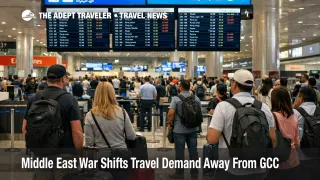
Mabrian says the Middle East war is now doing more than disrupting flights, it is starting to reshape where travelers want to go next. In data through March 4, 2026, the firm says security perception dropped sharply across several Gulf Cooperation Council destinations, with Bahrain, Oman, and Qatar seeing the steepest declines, while demand in key European and U.S. source markets is beginning to tilt toward closer to home options, Asia, and a handful of substitute long haul destinations. That matters because perception often moves before bookings do, which gives travelers, advisors, airlines, and tourism boards an early warning that route demand, pricing, and recovery patterns may not look the way they did in January.
The useful way to read this is not as a forecast that Gulf demand has collapsed forever. It is an early signal that the region's reputational advantage around safety has been hit fast, and that some travelers are already starting to price more distance, more nonstop connectivity, or more familiar alternatives into their choices. If you are booking soon, flexibility matters more than optimism right now, especially for itineraries that still rely on unstable Gulf hub connections or destinations exposed to the same conflict narrative.
Middle East Travel Demand Diversion: What Changed
The new element in Mabrian's update is not simply that travelers feel less secure, it is that the company now sees three emerging diversion patterns from the United Kingdom, Germany, France, Italy, and the United States. One is a shift toward nearer European or Mediterranean alternatives, including Morocco, Greece, Croatia, Spain, Malta, Montenegro, Norway, and the Czech Republic. Another is continued interest in Asia, especially Japan, Thailand, Vietnam, Cambodia, and the Philippines, where direct air service can reduce both connection risk and traveler anxiety. A third is a move toward farther bucket list substitutes such as South Africa, the Maldives, Peru, and Brazil.
That is a meaningful reversal from Mabrian's January outlook, which said Western Asia was gaining market share in early 2026, with Jeddah, Riyadh, and Doha among the global leaders for travel intent growth. In other words, the region went from momentum story to fragility test in a little over a month. That does not automatically mean bookings will fall at the same speed, but it does mean destination marketers and travel sellers should expect softer conversion, more questions about safety, and more hesitation around itineraries that depend on the Gulf as a connection backbone.
Which Destinations Look Most Exposed
Within the Gulf, Bahrain showed the deepest single deterioration in Mabrian's Perception of Security Index, falling 81 points to 9.6 at its low. Oman fell 56.7 points to 24.8, and Qatar fell 54.9 points to 18.4. The United Arab Emirates and Saudi Arabia also declined, but from Mabrian's perspective they showed more resilience, with the UAE falling 48.3 points to 51.9 and Saudi Arabia down 13.6 points to 85.3. Outside the Gulf, Jordan lost 30.3 points at its low, Türkiye fell 25.8 points from an 83.8 peak, and Egypt fell 7.6 points, though Mabrian says Egypt has not shown a stable recovery signal yet.
The firm also says U.S. travelers are reacting more sharply than other long haul markets. In its dataset, Kuwait dropped 87.3 points among Americans, the UAE dropped 79.2, Saudi Arabia dropped 17.8, and Egypt dropped 32.6 at its low, with limited signs of near term recovery in those segments. That matters for premium leisure and longer haul demand because U.S. travelers often book higher value international trips further ahead, and a hit to perceived safety can change not just destination choice, but how early people commit and how much flexibility they demand.
What Travelers and Advisors Should Do Now
For travelers, the decision threshold is simple. Rebook or defer if your trip depends on a Gulf hub, a nearby destination, or a multi stop itinerary that still has narrow recovery margins, and you cannot tolerate a schedule change, an overnight, or a policy shift on short notice. Wait only if your trip is still several weeks out, your fare rules are flexible, and the destination itself is proving operationally stable, not just technically open. Adept's earlier coverage, Middle East Airspace Reopens, Closures Stay Fluid, remains relevant here because "limited operations" and "restored confidence" are not the same thing.
For advisors and destination marketers, this is the moment to separate exposure by segment. Travelers looking for nonstop or one stop simplicity may respond well to Asia if fares remain reasonable on direct routes. Travelers who want a shorter haul substitute may drift toward Southern Europe and North Africa. Egypt is the tricky middle case. Mabrian says demand from Germany, Italy, and France is still there, but it also warns that advisories, connectivity restrictions, or limits on access to tourism areas could change sentiment quickly.
Travel insurance and change conditions also matter more than usual. As UAE Travel Insurance Questions Surge as Flights Disrupt showed earlier this week, travelers are already testing what their policies cover when conflict related disruptions hit routing, lodging, or cancellation plans. In this environment, flexible inventory is not just a nice extra, it is part of the product.
Why Security Perception Is Moving Faster Than Bookings
Mabrian's PSI is a sentiment measure, not a government advisory scale and not a direct booking ledger. The company says the index tracks traveler confidence using social media monitoring and natural language processing, while its broader demand analysis relies on flight search behavior and air connectivity data. That makes this kind of report most useful as an early directional indicator. It can show where traveler confidence is bending before full booking data catches up, but it should still be read alongside real world constraints such as fares, schedules, advisories, and whether direct service exists.
That mechanism explains why Asia is holding up in Mabrian's scenario work. A destination that feels farther away geographically can still feel operationally safer if it offers strong nonstop access and sits outside the conflict narrative. The same logic helps explain why nearby substitute destinations like Morocco, Greece, and Spain can gain when Gulf demand wobbles. Travelers are not only reacting to headlines, they are responding to trip design. Fewer risky connections, clearer advisories, and easier recovery paths make a destination easier to say yes to.
The next thing to watch is whether this remains a perception shock or turns into a broader commercial one. If airspace remains unstable, if advisories harden, or if fares on substitute routes stay competitive, early diversion could become a real booking shift into spring and early summer. If the conflict cools and connectivity normalizes quickly, some of this demand may snap back. For now, the signal is clear enough to matter, but still early enough that travelers with flexible timing and flexible rules have better choices than travelers who lock themselves into a brittle itinerary.
Sources
- War in Middle East Triggers Volatile Security Perception and Early Signs of Demand Diversion, Hospitality Net
- Global Travel Intent for Early 2026 Points to Asia as the Main Growth Engine, Mabrian
- The Israel Gaza Conflict Affects the Security Perception of Destinations Up to 2,000km Away, Mabrian
- The Strength of Demand to Visit a Destination, Mabrian
- Middle East Airspace Reopens, Closures Stay Fluid, Adept Traveler
- UAE Travel Insurance Questions Surge as Flights Disrupt, Adept Traveler