

Middle East U.S. Evacuations Near 20,000
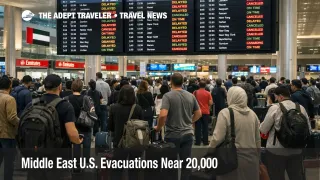
Middle East U.S. evacuations have moved from warning phase to active outbound movement, with the State Department now saying nearly 20,000 Americans have safely returned to the United States since February 28, 2026. That is a bigger and more useful traveler signal than the earlier warning cycle, because it shows the U.S. is not only urging people to leave, it is already moving large numbers out through a mix of charter flights, military options, and expanded commercial capacity. For travelers still in the region, the practical question is no longer whether to register, but whether their location is one of the places where Washington is actively matching people to departure options.
The main traveler takeaway is that this is a real exit network, but it is not uniform across the region, and that unevenness matters more than the headline number.
Middle East U.S. Evacuations: What Changed
What changed this week is scale, clarity, and urgency. On March 4, the State Department said more than 17,500 Americans had returned to the United States from the Middle East since February 28, including more than 8,500 on March 3 alone. By March 5, the department's broader overseas safety page raised that benchmark again to nearly 20,000. That matters because it shows the government is no longer speaking in vague contingency language. It is running a live departure effort while commercial flying across the region remains damaged by airspace restrictions, flight cancellations, and carrier suspensions.
The advisory posture also hardened. Reuters reported on March 2 that the State Department told Americans to leave more than a dozen countries in the region using available commercial transportation where possible. Travel advisory levels now split the map into three practical buckets. Iran, Iraq, Lebanon, Syria, Yemen, and Gaza sit in the highest risk category. Bahrain, Israel, the West Bank, Jordan, Kuwait, Oman, Qatar, Saudi Arabia, and the United Arab Emirates are under Level 3 reconsider travel warnings. Egypt remains at Level 2, but it is still included in the department's March 5 Middle East crisis information page.
That difference matters for travelers because a higher evacuation count does not mean the region has normalized. It means the United States has found ways to move people despite a badly degraded flight network.
Which Travelers Can Still Get Help Fast
The travelers with the clearest path to government-facilitated departure information are Americans in Bahrain, Israel, Kuwait, Oman, Qatar, Saudi Arabia, and the United Arab Emirates. As of the State Department's March 5, 2026, Middle East crisis page, those are the countries specifically named for the crisis intake form that can trigger follow-up information on U.S. government-facilitated departure options. That is a narrower list than the full set of countries under elevated warnings, and it is one of the most important details travelers can miss.
This means two Americans in the same regional crisis may face very different exit logic. Someone in the UAE or Oman can register through the crisis intake form and wait for information on facilitated options. Someone in Jordan or Egypt may still have workable commercial exits, but not the same clearly labeled U.S. departure pipeline on the current State Department page. In other words, advisory level and departure assistance are related, but they are not identical.
For corporate travelers and managed travel programs, that uneven map is already changing response behavior. Business Travel News reported that BCD activated enhanced response protocols, American Express Global Business Travel launched its incident response program, and private charter broker Chapman Freeborn said it is arranging emergency air support. First order, that helps higher-touch travelers and corporate clients get routed out faster. Second order, it puts more pressure on the same finite airport slots, hotel rooms, ground transfers, and premium cabins that individual travelers are also chasing.
What Americans Should Do Now
Americans still in the region who need help should start with the State Department's current workflow, not with social media fragments or stale embassy screenshots. Enroll in STEP at step.state.gov, then use the crisis intake form if you are in one of the countries currently listed for government-facilitated departure information. The department's 24 hour task force numbers are +1 202 501 4444 from abroad and 1 888 407 4747 from the U.S. and Canada. If you are moving between countries, update your location fast, because an evacuation system can only match you to seats or ground options if it knows where you actually are.
The next decision threshold is whether you are still waiting for your original airline to recover. In a normal disruption, waiting for a carrier waiver can be rational. In this environment, it often is not. If you are in a country with a clear U.S. intake pathway, register first and preserve flexibility. If you are in a country where commercial departures still exist, the better move may be to buy a workable exit now and sort reimbursement later, especially if your itinerary depends on self connections, border crossings, or an airport that has already shown repeated cancellations.
Travelers also need to think past the first flight. A seat out of the region is only the first layer. The second layer is whether you have the visa status, transfer rights, onward ticketing, and enough buffer to clear an unexpected overnight in Europe or Asia. The region's current disruption pattern is producing more partial journeys, not clean one ticket recoveries. That is why the smartest travelers are building a 24 to 48 hour buffer, carrying proof of onward travel, and avoiding same day long haul self connections unless there is no realistic alternative.
Why the Exit Picture Is Still Uneven
The mechanism is straightforward, even if the map looks chaotic. When armed conflict triggers airspace closures and carrier cancellations, the first failure is obvious, flights disappear. The second failure is less obvious but often more damaging, aircraft and crews end up out of position, which slows the restart even after some corridors reopen. Then the third layer hits travelers directly, everybody converges on the same fallback airports, the same border crossings, and the same limited bank of seats.
That is why an evacuation headline can be true without meaning the crisis is easing. Nearly 20,000 Americans leaving the region is a sign of throughput, not a sign that risk has fallen. It also explains why State Department help is being concentrated through intake forms, task force calls, and targeted departure options rather than a single uniform program across every country. The system is triaging around where commercial lift still exists, where charter operations are feasible, and where Americans can be moved without creating a second bottleneck on the ground.
For travelers, the practical reading is blunt. The U.S. has built a functioning departure pipeline, but it is selective, fast changing, and highly dependent on where you are standing today. That makes the next 24 hours more important than the next week. Register, decide whether your current location has a real exit path, and stop assuming that a regional warning automatically means identical help everywhere.
Sources
- Consular Information for Americans in the Middle East, Travel.State.Gov
- Statement from Assistant Secretary Dylan Johnson on Ensuring the Safety of American Citizens in the Middle East, U.S. Department of State
- Ensuring the Safety of American Citizens Overseas, U.S. Department of State
- US Urges Citizens to Immediately Depart Over a Dozen Middle Eastern Countries, Reuters
- U.S. State Dept. Urges Citizens Stranded in Middle East to Register, Business Travel News