

Israel Taba Shuttle Buses Reshape Tourist Exits
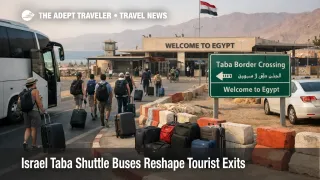
Israel Taba shuttle buses now matter more than they did earlier this week, because the UK Foreign, Commonwealth and Development Office, FCDO, says Israeli airspace remains closed, confirms commercial exits are still possible through Egypt's Taba border, and says the Israeli Ministry of Tourism is providing shuttle buses from Jerusalem and Tel Aviv for British tourists who entered on B2 visas. This sharpens the picture from U.S. Embassy Jerusalem Exit Guidance, Routes March 5, because the route is no longer just an improvised mix of buses, taxis, and border paperwork. It is now a named, government supported surface option for a defined traveler segment.
The practical consequence is simple. Eligible British tourists have a clearer land exit path even while flying out of Israel remains highly constrained. The harder part is what happens next, because the shuttle only gets travelers to Taba. It does not solve border queues, Egypt entry formalities, hotel pressure around Eilat and South Sinai, or the fight for onward seats from Sharm el Sheikh and other Egyptian gateways.
Israel Taba Shuttle Buses: What Changed
What changed since prior coverage is the added structure. The FCDO now says eligible travelers can register for Israeli Ministry of Tourism shuttle buses from Jerusalem and Tel Aviv to the Taba border, while regular transport from major cities to Eilat also continues through Israel's public transport system and private options. The ministry's own March 5 update said the shuttle departures were scheduled from Jerusalem's Arena Parking Lot and Tel Aviv's Savidor Center, which turns the concept into an actual ground movement plan rather than a vague promise of help.
That distinction matters operationally. A named bus program reduces some of the uncertainty for tourists who would otherwise need to string together intercity transport, then a final move from Eilat to the border. It also changes departure timing. Travelers no longer need to assume the only workable plan is to book a same day taxi south and hope the crossing is still manageable when they arrive.
Which Travelers Can Use the Taba Route
The shuttle offer is not open to everyone. The FCDO says British tourists who entered Israel on a B2 tourist visa are eligible to register, but British nationals who reside in Israel or hold dual Israeli nationality are not eligible for this service. That will create confusion fast, because the visible existence of a government backed bus can make the route look universal when it is not.
Travelers outside that eligibility bucket still have options, but they are more self managed. The same FCDO update points people toward regular Egged buses to Eilat, Moovit for public transport details, and Gett for private taxis. In other words, there are now two Taba pathways running in parallel. One is a supported bus lane for a narrow group of tourists. The other is the broader civilian transport network that still requires travelers to build their own surface transfer and border crossing plan.
The Egypt side matters too. The FCDO says travelers crossing at Taba must pay a $25.00 (USD) Sinai tax in cash, and that payment lets them stay in Sinai for up to 15 days without a full Egyptian visa. Travelers who plan to leave Sinai, including for onward flying from mainland airports such as Cairo or Hurghada, need an Egyptian entry visa and a letter of guarantee. For travelers staying inside South Sinai and aiming at Sharm el Sheikh Airport (SSH), that makes Taba more useful than it first appears, especially if they can secure a seat quickly. Readers who need a fuller visa refresher can use Egypt Tourist Entry Requirements For 2026.
What Travelers Should Do Before Moving South
The first decision is eligibility. If you are a British tourist in Israel on a B2 visa, the shuttle is potentially your cleanest way to stop improvising and start moving toward a real exit. If you are not eligible, do not assume showing up at the shuttle pickup point will solve the problem. Build your own route to Eilat, confirm border status, and treat Taba as a border strategy, not as guaranteed end to end evacuation.
The second decision is onward lift. Taba only beats waiting in Israel if you can realistically clear the crossing, absorb delays, and then access onward transport or accommodation on the Egypt side. The FCDO says a British Embassy team is present at Taba to point British nationals toward options for onward travel to Sharm el Sheikh Airport. That is useful, but it is not the same thing as a guaranteed ticket. Reposition only when you have either a confirmed onward booking, or enough buffer cash, medication, and time to handle an overnight hold if the crossing or seat market jams up.
The third decision is timing. Waiting for Israeli airspace to normalize can still make sense if you have a confirmed near term flight and secure accommodation near your current location. But travelers without a confirmed departure, or those facing repeated airline uncertainty, should treat the Taba route as stronger now than it was on March 5 because it has clearer structure and official support. This builds on Israel Tourist Exit Help Adds Taba Shuttles, Virtual Desk, but the FCDO update makes the British traveler decision threshold much more concrete.
Why Taba Is Gaining Weight as Israel's Exit Valve
Taba is gaining importance because it converts Israel's departure problem from an airspace problem into a ground transfer and border management problem. That is not the same as a normal exit. It is just a more controllable one for some travelers. First order, the shuttle option gives eligible tourists a defined way to move south while Israeli flying stays highly restricted in practical terms. Second order, it pushes pressure onto Eilat area staging, the border terminal itself, South Sinai transport, and the limited pool of onward seats that can actually carry people out of Egypt.
This also explains when Taba beats waiting. It is the better move when your risk is uncertainty inside Israel, not when your real bottleneck is lack of an onward plan from Egypt. Travelers who can cross and stay inside Sinai for a short period have a simpler path, because the Sinai tax can cover the entry side. Travelers who need to move beyond Sinai are taking on a more complex Egypt immigration problem, which can erase the advantage of getting out of Israel quickly.
The deeper point is that Israel's exit system is becoming segmented. Some people get structured support, some get only general public transport, and some still have to wait on aviation capacity to rebuild. That segmentation is why this is not just another border story. It is a traveler triage story, and Taba now sits at the center of it.