

U.S. Embassy Jerusalem Exit Guidance, Routes March 5
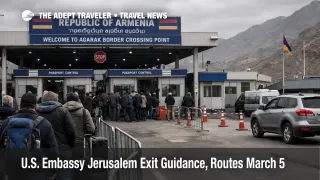
U.S. Embassy Jerusalem exit guidance updated on March 5, 2026, and it matters because the traveler problem has shifted from "should I leave" to "how do I leave without the plan collapsing mid move." With limited, volatile commercial aviation options, more travelers are relying on land crossings, then flying onward from nearby hubs, which makes paperwork, timing, and crossing selection the real constraints. Israel Airports Authority has also published current operating times for the main overland traveler crossings, which helps turn a vague exit idea into a schedulable plan.
U.S. Embassy Jerusalem Exit Guidance: What Changed
The new value in the March 5 guidance is operational sequencing. It emphasizes practical movement considerations, especially for departures by land, at the same time travelers are still dealing with constrained flight availability and short notice airline changes. The immediate takeaway is that a workable exit plan is built around what is open, when it closes, and what documentation is required for the country you are entering, not around the flight you hope will operate.
On the ground, the Israel Airports Authority "Lion's Roar" updates list operating times that travelers can use to back plan transfers. Menachem Begin (Taba) is listed as open 24 hours, Yitzhak Rabin (Arava) has defined passenger hours that shorten on Friday and Saturday, Allenby has a Saturday closure, and Jordan River runs on a day schedule.
This is a meaningful change from March 4 style evacuation coverage that focused on getting to an exit channel at all. The sequencing problem is now: pick a crossing that is open when you can actually arrive, confirm the entry requirements on the far side, then only buy or accept onward flights you can realistically reach with a buffer. Adept's prior reporting on exit options remains the right backdrop, but the March 5 guidance is about execution. For context, see Israel Tourist Exit Help Adds Taba Shuttles, Virtual Desk.
Which Travelers Face The Most Exit Friction
Travelers without flexible tickets, without a second passport, or without the ability to add an overnight are most exposed. The reason is simple: land crossings have hard operating hours, border processing times are variable, and onward flights from regional airports do not wait. If your only onward option departs late afternoon, you are betting that road conditions, queues, and document checks all cooperate on the same day.
The Allenby route is the highest paperwork risk for many travelers because Jordan does not reliably issue visas on arrival there. If you are planning to enter Jordan via the Allenby, King Hussein corridor, treat a pre obtained visa as the default, not the exception. Jordan's Ministry of Interior provides the e visa application pathways, and multiple official travel advisories and operator notes are pointing travelers to that system in the current environment.
Travelers aiming to fly out of Ben Gurion International Airport (TLV) are exposed in a different way. Even when TLV is operating, the restart has been described as limited and conditional, which means schedules can be a poor predictor of what actually moves, and reaccommodation can prioritize displaced passengers. If you are deciding between waiting for TLV uplift and taking an overland exit, the critical question is not "is the airport open," it is "is my specific flight confirmed, and will I still be able to reach the terminal and clear processing in time." For the earlier TLV context, see Tel Aviv Ben Gurion Reopens, Overland Exits Key.
What Travelers Should Do Now
Start by building your exit plan around an early day move. If you can, target morning arrivals at the border terminal and avoid plans that depend on late day processing. The Israel Airports Authority hours are your guardrails, and you should plan to arrive well before closing times rather than "just in time," because queues and internal bus transfers can add meaningful delay.
Next, remove visa ambiguity before you move. If your plan involves entering Jordan, confirm whether you need an e visa, and complete that step before you are in a taxi to the crossing. The Jordan Ministry of Interior e visa portal is the cleanest starting point for eligibility and application links. If you cannot confirm eligibility quickly, shift your routing to a crossing and onward country where your entry path is simpler, even if the flight is more expensive.
Finally, decide whether you are running a same day onward flight or an overnight buffer. Rebook immediately, or add an overnight near the onward airport, if you have a tight connection window, a late departure, checked baggage complexity, or any doubt about border processing time. Wait, or stay put briefly, only if you have safe accommodation, flexible tickets, and a credible reason to believe direct uplift from TLV will be stable for your departure window. If you need a refresher on entry document mechanics that can slow crossings even in normal times, use Jordan Entry Requirements For Tourists In 2026.
Why Exits Are Unstable Even When Crossings Are Open
Border terminals behave like capacity constrained checkpoints. They have operating hour ceilings, staffing limits, and procedures that include controlled transfers between sides, so when thousands of travelers pivot to the same few exits, the system does not fail all at once, it stretches. First order, queues and document checks lengthen at the terminal itself. Second order, road transfers to the terminal and onward airport become harder to predict, hotels fill in the nearest staging cities, and travelers miss flights that looked safe on paper.
The aviation layer adds another kind of instability. When regional airspace is constrained, airlines often operate in limited windows, prioritize repositioning and displaced passengers, and adjust day of departure. That is why embassy guidance that focuses on "how to move" becomes more useful than generic advice to depart. A crossing that is open does not guarantee a same day flight connection, and a flight that is scheduled does not guarantee passenger processing will run normally. In this environment, travelers do better with fewer assumptions, fewer handoffs, and more time margin.
Sources
- Security Alert - U.S. Embassy Jerusalem - March 5, 2026
- "Lion's Roar" Notices and Updates, Land Border Crossings, Israel Airports Authority
- Allenby Opening Hours, Israel Airports Authority
- Visa E Applications, Jordan Ministry of Interior
- Israel's main airport to reopen on Monday in "extremely limited format" (Reuters, March 2, 2026)