

Qatar Relief Corridor Opens Doha in Slices
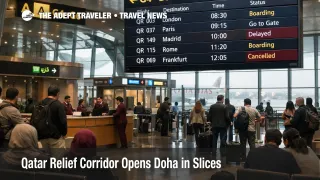
Qatar relief corridor is now the real traveler decision point in Doha, Qatar, not a normal network restart. Qatar Airways says its scheduled operations remain suspended because Qatari airspace is still closed, but it has been allowed to run a narrow set of repatriation flights out of Hamad International Airport (DOH) on March 7, 2026, plus a small number of inbound flights to Doha from Europe on March 7 and March 8 for passengers whose final destination is Doha. That is the key change since Qatar Flights Stay Suspended Into March 7 Window, because the question is no longer whether any movement is possible, it is who can move, in which direction, and under what limits. Travelers should not treat this as a full reopening, and they should not go to the airport unless Qatar Airways has directly confirmed their flight.
The practical divide is sharp. Outbound relief flying on March 7 is limited to London Heathrow Airport (LHR), Paris Charles de Gaulle Airport (CDG), Adolfo Suárez Madrid Barajas Airport (MAD), Rome Fiumicino Leonardo da Vinci International Airport (FCO), and Frankfurt Airport (FRA). Inbound flying to Doha is even narrower, with London and Frankfurt operating on March 7, and Paris, Madrid, and Rome on March 8, and those inbound services are only for passengers whose final destination is Doha. Qatar Airways has also said these flights do not confirm a return to scheduled commercial service, and it expects to issue another update on March 8 by 9:00 a.m. Doha time.
Qatar Relief Corridor: What Changed for Travelers
What changed on March 7 is not the return of Doha's hub function. It is the creation of a selective release valve. Qatar Airways says the outbound flights from Doha were pre allocated directly to affected passengers, with priority given to stranded travelers with families, elderly passengers, and people with urgent medical or compassionate needs. That means a traveler holding a canceled or disrupted booking should not assume they can self rescue by simply showing up at DOH and trying to stand by for Europe.
The airport is therefore usable again only in slices. Hamad International Airport separately confirmed that it would operate a limited number of repatriation flights for stranded passengers on March 7 after temporary authorization for partial flight movement. But the broader closure remains in effect, which matters because a limited outbound channel does not restore the connection banks that normally feed Europe, Asia, and Africa through Doha. Travelers with onward plans beyond the five European cities should expect continued breakage in normal through ticket logic, including missed onward segments, reissue friction, and forced overnight stops.
Which Doha Passengers Can Move, and Which Cannot
The passengers with the clearest path are the ones Qatar Airways itself has contacted for the March 7 repatriation flights from Doha, or travelers who can secure one of the limited inbound seats from London, Frankfurt, Paris, Madrid, or Rome and whose trip ends in Doha. The airline has been explicit that inbound flights to DOH are for passengers whose final destination is Doha, not for people trying to use the airport as a restored transfer hub.
That leaves a large middle group exposed. Travelers stranded in Doha without direct notification from the airline may still need hotel extensions, flexible checkout planning, and extra cash flow for one more night or more, especially if they do not meet the family, elderly, medical, or compassionate priority buckets. Travelers outside Qatar who were hoping to reconnect through Doha should assume that plan is still broken unless and until Qatar Airways says scheduled operations have resumed. The airline's own wording matters here, because it continues to describe the corridor as limited relief flying rather than a restart of normal commercial operations.
There is also a policy cushion, but it is not a substitute for a seat. Qatar Airways says travelers with confirmed bookings dated between February 28 and March 15, 2026 are eligible for a date change of up to 14 days from the original travel date, or a refund of the unused ticket value. That helps travelers avoid making a bad same day airport decision, but it does not solve lodging, document timing, or onward travel failures created by the still closed hub.
What Travelers Should Do Now
The first threshold is simple. Do not go to the airport unless you have already received official notification from Qatar Airways, or you hold a valid confirmed ticket on one of the limited inbound Doha only flights and your trip truly ends in Doha. Everyone else should keep operating as though general commercial service is still suspended, because that is exactly how the airline is describing the network.
The second threshold is whether your trip depends on Doha as a connector or only as an endpoint. If you need a same day onward connection beyond Doha, this corridor is the wrong tool. It does not rebuild the hub, and that is the same basic logic Adept flagged earlier in Qatar Relief Flights From Muscat Start March 5, when selective escape channels existed without a true network restart. For travelers with hard commitments, the safer move is often to wait for a confirmed reissue, or rebuild away from Doha entirely, rather than gamble on a partial corridor behaving like normal service.
The next monitoring point is March 8 at 9:00 a.m. Doha time, when Qatar Airways says it plans another update. Until then, the Qatar relief corridor should be read as a controlled exception, not a reopening. That distinction matters because it changes almost every traveler decision, from whether to extend a hotel, to whether to protect an onward ticket, to whether to keep waiting for Doha or abandon the hub for a different route out.
Why Doha Is Moving This Way Instead of Fully Restarting
The mechanism is straightforward. Qatar Airways says the corridor exists only because the Qatar Civil Aviation Authority temporarily authorized a safe operating corridor, while the broader closure of Qatari airspace remains in place. In plain language, authorities have created a narrow lane for selected flights, but they have not declared the full airspace and the airline's regular schedule safe enough to resume. That is why the carrier can send a handful of repatriation flights to Europe and receive a handful of Doha only arrivals without restoring the normal wave structure that makes DOH work as one of the world's biggest connecting hubs.
The second order effects are what travelers feel next. A partial corridor tends to concentrate demand into a few flights, which makes seat scarcity worse, raises the value of direct airline allocation, and leaves many passengers stuck in place even though some aircraft are moving again. It also keeps the broader Gulf disruption map unstable, because selective flying from one hub does not remove the rerouting and reconnection stress already spreading across Europe to Asia itineraries and alternative exit points around the region. That is why the Qatar relief corridor matters, but also why it should not be mistaken for a normal Doha restart.
Sources
- Qatar Airways to Operate Limited Relief Corridor from Doha, Qatar Airways
- Travel Alerts, Qatar Airways
- Operations Update, Qatari Airspace Closure, Qatar Airways
- Passenger Advisory, Hamad International Airport
- Qatar Airways to Operate Repatriation Flights From Doha to Europe as Air Traffic Stays Shut, Reuters
- Qatar Flights Stay Suspended Into March 7 Window, Adept Traveler
- Qatar Relief Flights From Muscat Start March 5, Adept Traveler
- Middle East Reroutes Stretch Europe Asia Flights, Adept Traveler