

Etihad Abu Dhabi Route Map Sharpens March Options
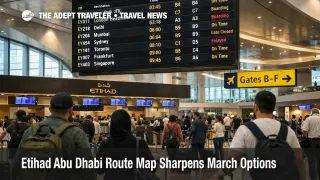
Etihad Abu Dhabi flights are no longer just a generic restart story. Etihad's March 6 update now gives travelers a published destination list scheduled to operate to and from Abu Dhabi through March 19, 2026, including New York, London Heathrow, Delhi, Mumbai, Chicago, Toronto, Sydney, and dozens more, while the airline still says passengers should not go to the airport unless they were contacted directly by Etihad or already hold a confirmed booking. That changes the traveler decision this week because Abu Dhabi can now be judged as a dated, limited recovery platform rather than a vague reopening headline. For stranded passengers, the practical message is simple, move only on a confirmed Etihad chain, and treat onward connections outside that restored bank as fragile.
The key shift since prior coverage is specificity. Adept already covered the March 6 restart in Etihad Abu Dhabi Flights Resume on Limited Routes, but the traveler value now comes from the dated operating window and the route map itself. That matters because a named city list through March 19 is enough to separate realistic departure options from wishful airport runs.
Etihad Abu Dhabi Flights: What Changed
Etihad says the following destinations are scheduled to operate between Abu Dhabi and March 19, 2026, with a broad but still limited map spanning North America, Europe, South Asia, Southeast Asia, and Australia. The list includes New York John F. Kennedy International Airport (JFK), Washington, London Heathrow Airport (LHR), Manchester, Paris, Frankfurt, Munich, Zurich, Delhi, Mumbai, Bengaluru, Hyderabad, Karachi, Muscat, Cairo, Bangkok, Singapore, Manila, Tokyo, Sydney, and Toronto, among many others. Tickets are on sale, but Etihad has kept the operational gate tight by warning the public not to travel to the airport without direct contact from the airline or a confirmed booking on one of those flights.
That is a stronger operating position than Doha right now, but it is not a normal hub recovery. Qatar Airways says its March 9 operation is limited to six inbound city pairs, Amsterdam, Berlin, Frankfurt, London, Zurich, and Muscat, and those flights are only for passengers whose final destination is Doha, not for people trying to reconnect onward through the hub. Dubai also remains in a narrower operating posture at the airport system level, with Dubai Airports saying passengers should not go to Dubai International Airport (DXB) or Dubai World Central, Al Maktoum International Airport (DWC) unless an airline has directly confirmed a departure time.
Which Travelers Have the Clearest Abu Dhabi Path
The travelers in the best position are passengers whose entire itinerary sits on Etihad metal, on one reservation, with Abu Dhabi as the only major hub dependency. They now have a real, published recovery bank to work from, especially on trunk routes such as London, New York, Delhi, Mumbai, and Muscat. Travelers trying to rebuild around those city pairs have a cleaner decision path than they did when the airline was speaking only in general restart language.
The risk rises fast once the trip depends on a second carrier, a separately ticketed onward flight, or a tight ground or hotel chain at the far end. A published limited schedule is not the same thing as restored hub integrity. Abu Dhabi is more usable than Doha for general commercial movement this week, because Doha is still operating only in narrow slices, and it is more transparent than Dubai because Etihad has published a defined destination set instead of leaving the whole airport system in confirmed only ambiguity. But none of the Gulf hubs are back to stable banked connectivity. That means misconnect risk, overnight hotel demand, and call center pressure remain high even where departures have resumed.
Travelers weighing the broader regional picture should also read Dubai Airport Flights Halted After March 7 Blast and Qatar Relief Corridor Opens Doha in Slices, because the comparison is no longer academic. It directly affects whether Abu Dhabi is the cleaner exit platform this week for passengers who can still choose where to reconnect.
What Travelers Should Do Now
Start with booking reality, not schedule hope. If you already hold an Etihad booking on one of the published routes, confirm that the flight is still active through Etihad's manage booking or flight status tools before you move toward Zayed International Airport. If you do not have that confirmation, Etihad's own guidance is to stay away from the airport.
Rebook around Abu Dhabi when your itinerary can stay inside the restored Etihad map, or when the onward segment has generous buffer and protection on the same ticket. Wait, or reroute elsewhere, when your trip depends on a separate onward ticket, a same day long haul connection beyond Abu Dhabi, or a destination not inside Etihad's published March 19 operating bank. That is the real threshold this week. A broad limited schedule can save the first leg, but it does not guarantee the rest of the journey.
Over the next 24 to 72 hours, watch three things. First, whether Etihad keeps the published city list stable or trims it. Second, whether Dubai broadens beyond airport wide confirmed only gating. Third, whether Doha moves from final destination relief flying back toward true transfer functionality. Until those three signals improve together, Abu Dhabi is the strongest of the three Gulf recovery platforms for many stranded commercial passengers, but only in a controlled, partial sense.
Why Abu Dhabi Is More Usable Than Doha, but Not Yet Normal
The mechanism is straightforward. A restart becomes operationally meaningful only when travelers can see a dated route bank, buy into it, and measure whether their trip fits inside it. Etihad has now crossed that line by publishing a destination list through March 19. Dubai has partially resumed, but the airport system is still effectively policing access through airline confirmation, which makes it harder to treat the hub as broadly reliable. Doha remains the weakest of the three for ordinary connecting passengers because its March 9 flying is still framed as limited point to point relief into the city, not a restoration of scheduled hub connectivity.
That difference creates the first order and second order split travelers care about. First order, Abu Dhabi offers more actual commercial paths out for passengers who fit the map. Second order, selective restoration still leaves pressure on rebooking queues, hotel extensions, ground transfers, and onward reservations whenever a trip spills outside the restored bank. The main mistake now is reading any Gulf restart headline as a sign that the regional hub system is functioning normally again. It is not. It is functioning in uneven slices, and Abu Dhabi currently has the clearest slice.