

Muscat Private Jet Access Stays Open, Friction Remains
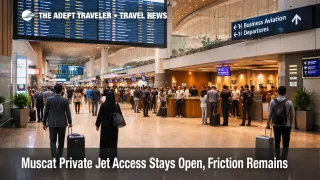
Muscat private jet access is still officially open, but the premium exit lane is no longer something travelers should treat as effortless. Reuters reported on March 9 that Muscat International Airport denied sending a message telling operators to avoid extra private jet flights, and an airport spokesperson said there is no ban or limit on private jet operations. That matters because Muscat has become one of the region's key evacuation and rerouting nodes while nearby airspace closures and schedule cuts keep pushing traffic into Oman. For travelers, the practical takeaway is simple, charter remains possible, but speed, slot timing, ground handling, and onward coordination now matter more than the rumor cycle.
The change from prior coverage is not that Muscat suddenly opened to private jets. It is that the airport has now publicly pushed back on claims that it is quietly shutting the lane down while giving government and commercial traffic priority. That denial narrows the story from "private jets blocked" to "private jets still operating inside a stressed system."
Muscat Private Jet Access: What Changed
What changed on March 9 is the official line. Reuters said a message seen by some operators had asked private jet traffic to avoid "additional flights" so the airport could prioritize government and commercial movements, but the airport later said it had not sent that message and that there was no ban or limit on private jet operations. Locally, Oman linked reporting also said Muscat International Airport continues to welcome and facilitate private jet and business aviation movements, and that Oman Airports and Transom are still providing dedicated support for that traffic.
That does not mean the premium channel is normal. Muscat is still carrying crisis demand well above ordinary planning assumptions, and Oman Air said on March 9 that it had added nearly 80 extra flights in response to sharply higher travel demand. In parallel, Muscat has been functioning as an evacuation hinge for special flights, repatriation movements, and overland repositioning from the United Arab Emirates. The airport can be open to private aviation and still be operating under real pressure.
Which Travelers Can Still Use Muscat Best
The travelers most likely to benefit from Muscat now are not casual luxury buyers looking for a frictionless same day escape. They are corporate security teams, high net worth travelers with flexible budgets, embassy linked movements, and families or firms that can tolerate changed departure times, extra paperwork, and short notice repositioning. When the whole trip chain is organized, airport handling, crew legality, permits, ground transfer, and an actual destination slot, Muscat can still work.
The weakest fit is the traveler who assumes money alone solves the problem. Reuters previously reported that private jets had become an alternative way out as commercial options shrank, but also noted scarce aircraft and high prices amid regional closures. In practice, that means charter buyers may still face limited lift, slower confirmations, or awkward routings even without an official airport restriction. Premium commercial seats out of Oman may remain the cleaner option when they are available, especially for travelers who do not need bespoke security or group flexibility.
This also matters for non private flyers. If charter traffic can keep moving through Muscat, even imperfectly, it can absorb some premium demand that would otherwise spill into the same business class inventory, hotel rooms, drivers, and airport services being chased by stranded commercial passengers. If charter handling slows, that pressure moves back into the public side of the system. Muscat is not just an airport story right now, it is a pressure management story across the wider Gulf exit network.
What Travelers Should Do Now
Treat Muscat as usable, not guaranteed. Charter brokers and travelers should work from the airport's current public position, private jet operations remain open, but they should also build their plans around operational friction. That means confirming handling, crew timing, overflight and landing permissions, and ground transport before anyone starts a long repositioning move into Oman.
Use a hard threshold for when charter is worth paying for. It makes the most sense when the trip involves multiple passengers, urgent timing, security concerns, pets, or a failure of workable commercial options. It makes less sense when a traveler is simply trying to beat crowds but still lacks confirmed airport handling and a realistic onward slot. In that case, a premium commercial booking from Muscat, or a wait for added scheduled capacity, may be the better value and the more stable plan.
Over the next 24 to 72 hours, watch for three things. First, whether Oman Airports or Oman's carriers publish more explicit handling guidance for business aviation. Second, whether added commercial capacity from Muscat eases pressure on the whole exit system. Third, whether nearby Gulf airspace becomes reliably more usable, because that would reduce the need to funnel so much demand through Oman in the first place. Until then, Muscat private jet access is open on paper, but the operational question is how much friction your plan can absorb.
Why the Muscat Bottleneck Debate Matters
The mechanism is straightforward. When several nearby hubs lose normal connectivity, demand does not disappear, it concentrates in the nearest functioning node. Muscat has been filling that role because Oman's airspace and airport system remained usable while much of the surrounding region faced closures, suspensions, or unstable restart windows. That is why even a rumor about private jet restrictions matters. It changes assumptions about where scarce travelers, aircraft, and support services can still flow.
First order, the dispute over Muscat policy affects charter booking confidence. Second order, it affects commercial fare pressure, airport processing loads, hotel inventory, and overland transfers from the UAE into Oman. Adept's earlier reporting already showed Muscat becoming both an air exit hub and an overland fallback point. The new March 9 clarification does not remove that pressure, but it does keep one more lane open inside the system. For travelers and brokers, that is meaningful, even if it is not the same thing as easy capacity.
Sources
- Oman's Muscat airport receives private jets amid reports on limits, Reuters
- Private jets are welcome to operate at Muscat Airport, Oman Observer
- Muscat International Airport enhances passenger services and private aviation support, Muscat Daily
- Oman Air boosts capacity with 80 extra flights to meet rising demand, Muscat Daily
- Muscat Evacuation Flights Become Gulf Exit Hub
- UAE Oman Border Crossings Offer Overland Exit