

Gulf Tourism Slump Redirects Demand to Europe
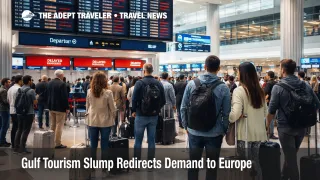
The Gulf tourism demand shift is now large enough to matter beyond airports and airline schedules. Reuters reported on March 3 that Oxford Economics company Tourism Economics sees a 2026 downside case of $34 billion to $56 billion in lost regional visitor spending, while UAE vacation rental cancellations more than doubled after the initial attacks and Ryanair said Middle East bookings had collapsed as travelers redirected toward Europe. For travelers, the practical change is that this is no longer only a disruption story about canceled flights through Dubai, Doha, or Abu Dhabi. It is now a demand and pricing story, which means people choosing not to book the Gulf can start pushing pressure into substitute markets, especially Portugal and Greece.
The new fact versus earlier coverage is that the travel hit is no longer limited to passengers already stranded in the system. It now includes future leisure demand that is being deferred, canceled, or redirected, even as some destinations in the region stay partially open and local tourism authorities try to support affected guests. That distinction matters because an airport recovery can happen faster than a confidence recovery, and traveler sentiment usually lags behind operational reopenings.
Gulf Tourism Demand Shift: What Changed
The measurable change is not subtle. Tourism Economics said the region could lose 23 million to 38 million international visitors in 2026 versus its prior baseline, equal to an 11 percent to 27 percent drop from earlier expectations. Reuters also reported that UAE vacation rental cancellations more than doubled in one day after the conflict escalated, with many of those cancellations tied to March stays. That is a clearer signal than anecdotal traveler anxiety, because it shows bookings are already being unwound in the near term.
The same Reuters reporting said Ryanair was seeing stronger Easter demand to European destinations as Middle East demand weakened. Reuters separately reported that travel brands including TUI and Ryanair were identifying Portugal and Greece as beneficiaries of that shift. That does not mean every Gulf traveler is simply swapping Dubai for Lisbon or Athens, but it does show the substitution pattern has started, especially for discretionary leisure travelers who can still change destination without blowing up a fixed business trip or family obligation.
Which Travelers Are Pulling Back First
The first travelers most likely to pull back are short haul and medium haul leisure bookers, especially couples, families, and spring travelers who had flexibility and were using the Gulf as a warm weather city break or resort destination rather than as a nonnegotiable business stop. Vacation rental data from the UAE points in that direction, because rentals are closely tied to discretionary leisure demand and tend to react faster than large managed hotel accounts.
A second vulnerable segment is the stopover traveler. The Gulf had become a major break point for Europe to Asia, Africa, and Indian Ocean itineraries, but conflict makes a stopover market fragile because travelers do not have to reject the whole long haul trip, they only have to reject the stopover logic. That is part of why this story now fits with earlier Adept coverage such as Middle East Airspace Closures Ground Gulf Hubs and Middle East War Shifts Travel Demand Away From GCC. When hub confidence breaks, both transit traffic and destination traffic can weaken at the same time.
Business travel is more complicated. Some essential travel will keep moving, especially around energy, government, logistics, and relocation work, but that does not offset the loss of soft demand that normally fills hotels, tours, rentals, and premium leisure seats. Reuters noted Dubai officials were emphasizing visitor support and operational continuity, which suggests authorities understand that keeping infrastructure open is not enough if sentiment stays weak.
What Travelers and Advisors Should Do Now
For travelers still considering the Gulf, the main decision is whether the trip depends on confidence, convenience, and flexible leisure timing, or on a fixed purpose that justifies higher uncertainty. Leisure travelers with open dates should price and compare substitute markets now, because the likely second order effect is tighter inventory and firmer fares in places absorbing displaced demand, especially southern Europe. That kind of spillover is also consistent with broader airline capacity pressure dynamics explained in FAA Delays on Boeing 737 MAX 10 Hit Airline Capacity, where limited supply meets shifting demand and pushes prices higher.
Advisors and planners should also separate "operating" from "recovered." A destination can have hotels open, flights published, and government support measures in place, while still suffering a weak booking environment because clients no longer see the trip as worth the perceived risk. Rebook sooner if the Gulf trip is optional and price sensitive. Wait only if the booking is highly purpose driven and you can tolerate more schedule and sentiment volatility over the next several weeks.
The next thing to monitor is not just airspace. Watch forward booking commentary from airlines and tour operators, short term rental cancellation data, and whether substitute destinations start reporting stronger than expected shoulder season demand. A real recovery signal would look like cancellations stabilizing, carriers talking about booking normalization instead of collapse, and travel sellers seeing confidence return without heavy discounting. Until that happens, the demand shock should be treated as active, not historical.
Why This Is Happening, and What Recovery Would Look Like
The mechanism is straightforward. Airport shutdowns and airspace restrictions created the first shock, but destination demand is now being hit by a second wave, the loss of perceived safety and trip comfort. Tourism Economics said the conflict's demand effect would linger beyond the immediate fighting period, which is why its 2026 forecast assumes a larger tourism hit than the operational outage window alone would suggest. In plain language, planes can resume faster than travelers rebuild trust.
That also explains why the second order effects matter so much. If Gulf demand weakens, hotels and rentals lose occupancy, airlines lose higher yielding discretionary traffic, and tour operators have to rebalance inventory. At the same time, travelers still determined to go somewhere warm and accessible shift their money into substitute destinations, which can raise room rates and reduce booking flexibility outside the Gulf. Reuters directly tied that redirection to Portugal and Greece, making this not just a regional crisis story, but a wider Mediterranean demand story as well.
A recovery signal would need to be broader than a few resumed flights. It would require lower cancellation velocity, steadier booking data, and public carrier commentary showing that future demand has normalized, not merely that emergency transport has resumed. Until those signals appear, travelers should treat the Gulf as a destination confidence story with spillover effects, not just an airport operations story.
Sources
- Iran conflict threatens Gulf tourism, undermining years of investment, Reuters, March 3, 2026
- UAE holiday rental cancellations climb steeply on Middle East tensions, data shows, Reuters, March 3, 2026
- Ryanair's O'Leary sees surge in Easter bookings to Europe due to Middle East war, Reuters, March 3, 2026
- Tourism impacts in Middle East from Iran War, Oxford Economics, March 3, 2026