

Finnair Extends Dubai, Doha Suspensions Into April
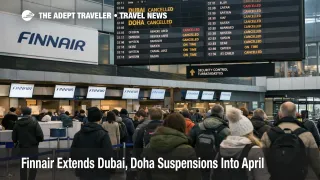
Finnair has turned what looked like a short Gulf disruption into a longer planning problem for travelers using Helsinki as a northern one stop bridge. The airline now says all Dubai flights are canceled through March 29, 2026, and all Doha flights through April 2, 2026, because of the heightened safety situation in the Middle East. Finnair says it will contact all affected customers personally, but it also warns that alternative flights are very limited and filling quickly, which means late March and early April travelers should not assume a quick restart will save the original itinerary.
The practical change versus earlier Finnair coverage is that Doha now stays offline beyond the Dubai cutoff. That matters because Helsinki Airport (HEL) is not only a Finland origin point, it is also a connection point for travelers from Sweden, Norway, Denmark, Estonia, Latvia, Lithuania, and parts of Northern Europe who were using Finnair's network for Gulf access or onward trips to Asia and the Indian Ocean. Once those Gulf links disappear for another two weeks or more, the problem is no longer just a canceled city pair. It becomes a network problem built around scarcer seats, longer elapsed travel times, and a higher chance that a clean one stop trip turns into a two stop repair job.
Finnair Dubai Doha Suspensions: What Changed
Finnair's current public update is unusually clear. It says all Dubai flights between February 28 and March 29, 2026 are canceled, and all Doha flights between February 28 and April 2, 2026 are canceled. The airline also says it is temporarily not flying through the airspace of Iraq, Iran, Syria, or Israel, which helps explain why this is lasting beyond a simple airport reopening cycle. In plain language, the carrier is not treating this as a narrow airport issue. It is treating it as a broader regional safety and routing problem.
Finnair also says it will contact affected customers personally about cancellations. That is useful, but it does not remove the need to act. The same notice says rerouting to Doha or Dubai may not be possible because commercial flight availability is limited, recommends refunds for customers who cannot be rerouted, and tells travelers already mid journey to contact customer service for an alternative flight. That shifts this from a wait and see disruption into a real trip triage problem.
Which Nordic and Baltic Travelers Face the Most Pressure
The most exposed travelers are those trying to preserve short, efficient one stop routings from the Nordics and Baltics into the Gulf, South Asia, Southeast Asia, or the Indian Ocean. Helsinki normally works well in that role because it is geographically efficient for northern departures. When Finnair removes both Dubai and Doha from sale for this long, those passengers do not just lose a seat. They lose a routing logic.
The next group at risk is travelers on mixed tickets or fixed itineraries. A protected one ticket itinerary can still be painful, but it is easier to repair than separate tickets tied to a cruise embarkation, resort transfer, wedding, or business event. Adept's earlier reporting on Gulf hub disruption and Asia Europe fare pressure has already shown that when hub capacity disappears, remaining seats on alternative routings tighten quickly and replacement fares can spike.
Corporate travelers and travel managers also have a duty of care problem here. Once the disruption window is published into early April for Doha, waiting for the original routing to come back makes less sense for trips with hard arrival times. The main tradeoff is cost versus certainty. Waiting may preserve fare rules, but rebooking earlier may preserve the trip itself.
What Travelers Should Do Now
Travelers booked on Finnair to Dubai or Doha in the affected window should first watch for direct outreach from the airline, then verify whether the proposed replacement still protects the full trip. If Finnair cannot reroute you to the Gulf point you actually need, a refund may be cleaner than accepting a partial fix that only solves one segment. That matters most for travelers with separate onward bookings, same day hotel transfers, or time sensitive events.
For realistic rerouting, the safest assumption is that demand will keep shifting away from Helsinki based Gulf one stops and toward larger alternative hubs with more recovery capacity. In practice, that can mean longer westbound or southbound detours through bigger European gateways, Turkish routings, or limited Doha options where Qatar's restored schedule happens to match the city pair. That is partly inference, but it is grounded in the wider pattern already visible across British Airways' longer Gulf cuts, Qatar's still limited Doha schedule, and broader Europe Asia fare pressure after Gulf disruption.
The threshold is simple. Rebook now if your trip has a fixed date, a separate ticket, or a low tolerance for an overnight disruption. Wait a bit longer only if you are on one protected ticket, your replacement options remain flexible, and you can absorb another change. Over the next 24 to 72 hours, monitor whether Finnair changes the cutoff dates again, whether Qatar adds more stable Doha capacity, and whether other European carriers publish more hard stop dates that tighten spring seat supply even further.
Why the Disruption Spreads Beyond Helsinki
The mechanism here is straightforward. Gulf hubs are not just endpoints, they are transfer machines. When a carrier like Finnair drops two Gulf points for weeks, the impact spreads outward through the network. First order, Helsinki loses direct links to Dubai and Doha. Second order, travelers who would have used those links crowd into a smaller pool of alternative seats via other hubs, which raises misconnect risk, stretches journey times, and increases the odds of extra hotel nights or missed onward transport.
This is also why the story matters beyond Finland. Wider Gulf disruption has already pushed other airlines into long suspensions and forced Europe Asia travelers to compete for a reduced set of routings. British Airways has extended some Gulf cuts deep into spring, and Qatar's Doha operation is still functioning on a limited published schedule rather than normal hub strength. Finnair's extension fits that same pattern, but from a northern Europe angle that hits Nordic and Baltic travelers especially hard.