

Air India Gulf Flights Add Lift, Long Hauls Keep Moving
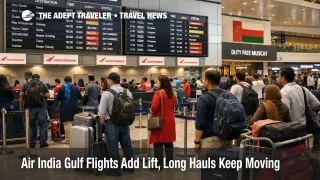
Air India Gulf flights became more usable on March 7, 2026, because the carrier said scheduled service to and from Jeddah, Saudi Arabia, and Muscat, Oman, continues, while extra non scheduled flights are being added for Abu Dhabi, United Arab Emirates, Dubai, United Arab Emirates, Muscat, Oman, Ras Al Khaimah, United Arab Emirates, and Sharjah, United Arab Emirates. The important change from Adept's earlier Gulf exit coverage is that Air India has now turned a broad "watch for resumptions" story into a more defined pickup map for India bound travelers, while also confirming that Europe and North America flights are still operating through longer alternative routings.
That matters most for stranded passengers trying to get back to India from the Gulf, especially those who were deciding between waiting in place, running overland to Oman, or paying for extra hotel nights while carrier schedules stayed unstable. It also matters for long haul passengers connecting beyond India, because an operating flight is not the same as a normal one when reroutes add flying time, technical stops, and more opportunities for the day to unravel.
Air India Gulf flights now give travelers a clearer split. Some Gulf points are regaining targeted lift to India, but that is not the same thing as full regional normalization. Travelers with active bookings should check whether they can be moved onto these extra flights, while long haul passengers should expect a slower, more fragile recovery even when their ticket still shows as operating.
Air India Gulf Flights: What Changed
What changed since prior coverage is specificity. Air India's March 6 and March 7 updates moved from general language about resumed service and special flights to a named list of scheduled and extra operations. The carrier said scheduled flights to and from Jeddah and Muscat continue, and that additional March 7 flights are planned to and from Abu Dhabi, Dubai, Muscat, Ras Al Khaimah, and Sharjah to bring stranded passengers back to India. It also said priority on those extra flights goes to travelers who already hold bookings with Air India or Air India Express.
That makes Muscat operationally different from the UAE points. Muscat is both a scheduled node and an extra capacity node in Air India's current plan, which means it functions as a steadier release valve than airports where the added lift is more tactical and tied to one day recovery needs. Abu Dhabi, Dubai, Ras Al Khaimah, and Sharjah matter because they expand the pickup map inside the UAE, but they still sit inside a more disrupted operating picture where many regular routes remain suspended until further notice.
The long haul side also shifted in a useful way. Air India said its Europe, United Kingdom, and North America services have been operating on safe alternative routings since March 2, 2026, and that flights from India to North America are making technical stops at Rome Fiumicino or Vienna in the current operating pattern. That is not business as usual, but it does mean the airline is preserving intercontinental flow instead of relying only on outright cancellations.
Which Travelers Benefit Most From the Added Lift
The clearest beneficiaries are India bound passengers already stranded in Gulf cities that made Air India's extra flight list. For that group, this is a better outcome than waiting for a full system restart, because the airline is now naming actual pickup points rather than asking travelers to infer where recovery might appear. Passengers in Dubai or Abu Dhabi gain a more direct path than a pure wait and see strategy, while passengers in Ras Al Khaimah or Sharjah benefit because the recovery map is no longer centered only on the largest hubs.
Muscat remains a stronger fit for travelers who can tolerate one more handoff in exchange for a more reliable departure platform. Air India already treats Muscat as safe for scheduled flying, and Adept's own recent reporting shows Oman has been functioning as a broader regional pressure release point for multiple carriers, even as seats tighten and exit demand piles up. That does not make Muscat easy, but it does make it more structurally useful than a city that only gets a one off extra flight without the same scheduled backbone. For related context, see UAE Oman Border Crossings Offer Overland Exit, BA Muscat Exit Flights Tighten as March 8 Sells Out, and India Entry Requirements And New E Visa.
Long haul travelers also benefit, but in a narrower way. If your trip depends on getting from India to Europe or North America, an operating Air India flight is better than a cancellation, but the tradeoff is now time and resilience. Longer routings and technical stops raise the chance of missed onward connections, crew and aircraft rotation strain, and weaker schedule recovery later in the day if one sector slips. Travelers on separate tickets beyond India, Rome, Vienna, or a final long haul gateway should treat the current setup as workable but delicate.
What Travelers Should Do Now
Passengers with active Air India or Air India Express bookings from the affected Gulf region should move fast, but not blindly. Because the carrier says priority on the additional March 7 flights goes to guests with existing bookings, the most rational first step is to work through Air India or Air India Express rebooking channels rather than self dispatching to an airport in hopes of being accommodated on the spot. This is especially important in the UAE points, where airport surges can build quickly once stranded travelers see named lift return.
Muscat is the cleaner fallback when the full chain still works. Choose it over a same day airport gamble in the UAE only if you already have a workable road or air transfer into Oman, lawful entry, and enough time buffer for the onward departure. If those pieces are not already lined up, staying put for a confirmed rebooking may be safer than turning one disrupted itinerary into two. Adept's recent Oman and Jordan coverage points to the same rule across the region, the usable gateway is the one you can reach legally, early, and with a confirmed next step, not the one that merely looks open on a map.
Long haul passengers should also reset expectations even when their flight is technically operating. Avoid tight onward connections, protect hotel and ground transport plans at both ends, and assume the next 24 to 72 hours may still produce late equipment swaps or timing changes as aircraft and crews absorb the longer routings. The decision threshold is simple. Keep the itinerary if the ticket is confirmed and the rest of the trip can absorb delay. Rework it if you are carrying a cruise embarkation, a fixed event, a same day domestic connection on a separate ticket, or a hard arrival deadline in Europe or North America.
Why the Network Is Stabilizing Unevenly
The reason this looks better for India bound travelers than for the wider region is that Air India is solving two different problems at once. First, it is rebuilding a limited extraction network for stranded passengers from a set of Gulf pickup points. Second, it is keeping its longer haul network alive by rerouting around unsafe or unavailable airspace. Those are connected, but they are not the same form of recovery. One restores targeted lift out of the Gulf, the other preserves intercontinental continuity at the cost of longer and more complex flying.
That distinction matters because it explains why the system can look partly open and still feel unstable. First order, extra flights reduce hotel nights, border runs, and pure uncertainty for some stranded passengers. Second order, they can also create sharp airport surges in the cities that regain lift, while longer westbound routings put more pressure on aircraft utilization, crew timing, and downstream connection banks. In practical terms, the network is functioning again in pieces, not as a fully restored Gulf hub system.
The broader regional picture supports that reading. Air India's own suspension list still shows many West Asia routes paused, while other recent Adept reporting has shown travelers leaning harder on Oman, Jordan, and selective relief corridors rather than assuming the major Gulf hubs are back to normal. That is why Air India Gulf flights are useful news now, but not a signal that the region has returned to ordinary operations.