

British Airways Pauses Muscat Relief Flights
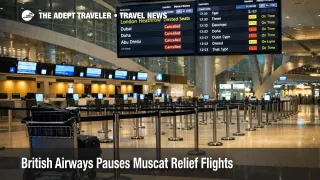
British Airways has narrowed one of the cleaner escape valves out of the Gulf, saying its Muscat, Oman, to London Heathrow Airport (LHR) repatriation flights on Tuesday, March 11, 2026, and Wednesday, March 12, 2026, will pause after those dates because demand has fallen. That matters because BA also still says it cannot operate Abu Dhabi Zayed International Airport (AUH), Queen Alia International Airport (AMM), Bahrain International Airport (BAH), Hamad International Airport (DOH), Dubai International Airport (DXB), and Tel Aviv Ben Gurion Airport (TLV), with Abu Dhabi suspended until later this year and the others until later this month. For travelers, the message is blunt, Oman is still a possible way out, but it is no longer a fallback you should build around without a confirmed seat and a complete onward plan.
The practical update is not that Muscat stopped working. It is that British Airways Muscat flights are moving from an active relief lane into a shorter, managed window, which raises the odds that stranded passengers will have to pivot to non BA routings, more hotel nights, or a Europe rebuild outside the Gulf system.
British Airways Muscat Flights, What Changed
British Airways says it has limited seats remaining on Muscat to Heathrow repatriation flights for March 11 and March 12, and that those flights are only for customers with an existing booking. After March 12, the airline says the flights will pause, though it also says the situation remains under continuous review. That is the meaningful change from earlier coverage, because Muscat had been acting as a named BA recovery lane for some stranded customers in Oman or the United Arab Emirates, not just a vague regional fallback.
The other critical split is time horizon. BA's Muscat relief flying is ending now, while its wider network problem remains divided between shorter and longer suspensions. British Airways says Amman, Bahrain, Doha, Dubai, and Tel Aviv are canceled until later this month, but Abu Dhabi is canceled until later this year. That makes Abu Dhabi a very different planning problem. Travelers can still reasonably watch a short suspension for signs of restoration, but the Abu Dhabi pause is long enough that many BA customers should stop treating it as a near term recovery lane and rebuild the trip around another carrier, another hub, or a different destination logic entirely.
Which Travelers Face the Hardest Rebuild
The travelers most exposed are BA customers who were using Oman as a backdoor after plans through the UAE or wider Gulf broke down. The Muscat flights were never a general walk up option. British Airways said they were for customers with an existing booking, which means a traveler who can physically reach Oman but does not fit BA's eligibility or does not have confirmed onward space is in a much weaker position than the route map suggests.
That matters even more because Muscat itself has become a tighter node. Oman Air Cuts Nine Muscat Routes Through March 15 showed how one of the region's more workable fallback hubs lost nine city pairs through Saturday, March 15, 2026, including several Gulf links and one Europe connection. So the risk is no longer just "Can I get to Oman?" It is also "Once I get there, does the onward network still fit my real trip?" For travelers on separate tickets, cruise joins, tours, or long haul connections that fail if London slips by a day or two, that second question is now the more dangerous one.
There is also a broader competitive effect. BA Muscat Exit Flights Tighten as March 8 Sells Out already showed that BA's added Muscat capacity was being absorbed quickly. Once a relief lane pauses while other Gulf suspensions remain in place, displaced demand does not disappear, it compresses into fewer working seats, more expensive hotels, and more brittle ground transfers. That is why a route that still exists on paper can stop being decision useful in practice.
What Travelers Should Do Now
The first move is procedural, not physical. Do not go to the airport unless BA has confirmed your reservation and told you to travel. British Airways is explicit that the Muscat sectors were for existing customers, and earlier UK government evacuation messaging around Oman carried the same basic warning, only notified passengers should proceed for these managed departures. For anyone still trying to use BA recovery flow, keep your booking reference, passport details, visa status, and any onward Heathrow plans ready so you can accept or reject a reroute fast.
The second move is to use a hard rebooking threshold. Wait only if you are already inside BA's eligible group, can safely stay in Oman or the UAE for extra nights, and your onward plans from Heathrow can absorb delay. Rebuild now if your trip includes a same day onward ticket, a cruise embarkation, a nonrefundable tour, school holiday timing, or any ground plan that breaks once London moves. In this phase, the main market risk is not just cancellation, it is replacement scarcity.
The third move is to stop thinking only in Gulf hub terms. If your goal is simply to restore long haul integrity, Europe based recovery hubs may now be more rational than waiting for a perfect Gulf restart. Lufthansa Europe Hub Lift Grows as Gulf Routes Stay Tight documented added replacement flying through Frankfurt Airport (FRA), Munich Airport (MUC), and Vienna International Airport (VIE), which helps some disrupted travelers rebuild around functioning banks instead of around a still fragile Gulf system. That is not ideal, but it can be the lower risk choice once Oman stops serving as a dependable BA bridge.
Why Oman Is Still Usable, but Much Less Forgiving
The mechanism here is simple. A fallback hub only works when three things line up at the same time, you can get there legally and safely, the airport is operating, and the onward network has enough useful seats to reconnect you to the rest of your trip. Muscat still clears some of those tests, but British Airways is now shrinking its own contribution to that system just as other regional suspensions remain in place. As a result, Oman becomes less of a broad workaround and more of a selective exit point for travelers who already have confirmed fit.
That is why BA's long Abu Dhabi tail matters so much. Shorter Gulf suspensions create uncertainty, but a much longer Abu Dhabi pause changes traveler behavior. It pushes BA customers away from waiting for a familiar nonstop to come back and toward harder choices now, overland transfer to another airport, a different carrier, a Europe connection, or abandoning the original itinerary logic altogether. The second order effects are where costs climb, border timing gets tighter, hotel nights stack up, and one delay starts breaking other paid parts of the trip.
That is also why this update is bigger than one airline pausing two flights. Muscat became useful because it offered a cleaner, named route out when other parts of the Gulf system were unstable, as Adept noted in Muscat Evacuation Flights Become Gulf Exit Hub. Once one of those cleaner lanes pauses, travelers are forced back into a rougher operating reality, more competition for fewer viable routings, more pressure on transfers and lodging, and less room for same day improvisation.
Sources
- British Airways, Latest travel news
- British Airways Media Centre, Our Middle East operation: 06 March 2026
- Reuters, First UK repatriation flight to leave Oman on Wednesday
- BA Muscat Exit Flights Tighten as March 8 Sells Out
- Oman Air Cuts Nine Muscat Routes Through March 15
- Lufthansa Europe Hub Lift Grows as Gulf Routes Stay Tight
- Muscat Evacuation Flights Become Gulf Exit Hub